

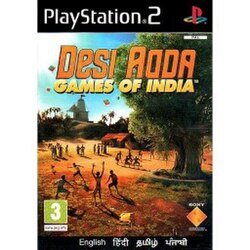

When a console catalog is peppered with shoot-em-ups, role-playing epics and the occasional sports sim, a title that trades tank controls for kite string and boss battles for matchmaking duty arrives like something from another world. Desi Adda: Games of India is that oddity: a PS2 cartridge-shaped attempt to bottle village pastimes and sell them to a generation raised on polygons, power-ups and patch updates. Developed in India by Gameshastra and published by Sony Computer Entertainment Europe, the game markets itself as a cultural compendium and an entry point for first-time gamers. It also makes the bold claim of being grown, compiled and presented for the PlayStation audience in multiple regional tongues. The intention is admirable; the execution lands somewhere between community center hobby night and earnest school project.
Desi Adda is, at its core, a collection of traditional Indian games assembled into a hub-based experience. The player assumes the role of Avinash, an NRI returnee who drops into his ancestral village and quickly becomes entangled in local affairs. The central narrative is unusually quaint for a minigame compilation: Avinash must help a young couple, Gowri and Gopal, win the village's approval despite the objections of the stern headman, Garjan Singh. The plot functions mostly as connective tissue; you talk to villagers, pick up tasks, and unlock games as you go. For a game aimed at eight-to-fifteen-year-old first-time players, a light narrative is a reasonable choice, and the developers use it to justify movement between the various pastimes on offer. The activities themselves are a mix of board and field games. Included are kite fighting, kabaddi, pachisi, bagh-chal and gilli-danda. Each is presented as a discrete mode with its own rules and a simplified control scheme that favors accessibility over realism. Gilli-danda works best of the bunch: its rhythm and unpredictability create short bursts of satisfying gameplay, and the mechanics are straightforward enough that even a newcomer can find a groove. Pachisi and bagh-chal, being essentially board games, feel faithful but thin; they play out like a digital set of pieces on a table with minimal tactical depth. Kabaddi is a commendable attempt at translating a very physical, tactical sport into controller mechanics, but suffers from limited animations and an over-reliance on button prompts rather than emergent play. Kite fighting will likely split opinions. Its premise is delightful, and the idea of trimming lines and outmaneuvering an opponent makes for a potentially tense match. In practice the controls are serviceable but not elegant; wind is abstracted into predictable patterns and the tug-of-war for string feels more like a tug-of-input. The game rewards familiarity, but because the input feedback is light, mastering it never feels like a true achievement. There is a bonus beat-matching dance game unlocked after completing the story. It tries to graft rhythm-action onto the Desi Adda package, but critics noted - and this reviewer confirms - that the timing and responsiveness leave much to be desired. When a rhythm mode's core input feels laggy or imprecise, the dance element becomes frustration rather than celebration. Desi Adda is clearly aimed at casual and young audiences, and in short play sessions the minigame loop can amuse. For seasoned gamers, however, the repetitive simplicity and loose controls blunt long-term appeal. Multilingual support is a notable feather in the cap: English, Hindi, Tamil and Punjabi options make the title unusually accessible to different linguistic groups. The village hub encourages exploration and conversation, but the NPC interactions are scripted and shallow, serving primarily to unlock the next activity rather than to flesh out a living world. For what it is - a cultural sampler meant to introduce players to a slate of traditional games - the gameplay package does the job, albeit without polish or lasting depth.
Graphically Desi Adda is plainspoken. The PS2 era taught players to tolerate low-poly villagers and stiff facial rigs as long as the game beneath them had heart; by that standard, this game trudges along with good intentions and modest assets. The village is presented with colorful textures and caricatured character models that communicate setting and tone, but up-close the seams show. Animations are serviceable but limited, and many of the smaller gameplay modes rely on static boards or repetitive loops rather than fluid presentation. Reviewers at the time observed that the visuals were very simple and would not charm players older than ten, and that assessment still rings true. There is value in the visual honesty of Desi Adda: it does not pretend to be a blockbuster, and the art direction leans into a stylized simplicity rather than trying to render photo-realism. Where it falters is in feedback. Successful minigame compilations often cue the player with crisp animations and satisfying particle effects; here the cues are muted and the spectacle is minimal. The bonus rhythm mode, in particular, should have benefited from a brighter, more immediate visual language to compensate for its control shortcomings. Instead it feels sparse and undercharged, which magnifies its responsiveness problems. Overall, the graphics serve the pedagogical purpose of the title but rarely elevate it.
Desi Adda: Games of India is a curious footnote in the PS2 library. It is a product of its ambitions: to preserve, present and promote a repertoire of Indian traditional games for a console audience that may have never encountered them. For that alone it deserves credit. The inclusion of four languages and the attempt to build a narrative around a village hub are thoughtful touches that separate it from a mere menu of minigames. That goodwill cannot fully cover the game's technical and design limitations. Controls are occasionally unresponsive, the rhythm bonus feels like an afterthought, and the overall simplicity means older or more demanding players will be left cold. Critical reception at the time was lukewarm; outlets praised the novelty of some modes like gilli-danda but criticized the rhythm mode and the modest production values. As a learning tool or a family diversion for younger players it can be enjoyable in short bursts. As a PS2 title attempting to compete for attention in a crowded market, it struggles. If you are a collector, an enthusiast of cultural games, or someone looking for an accessible introduction to traditional Indian pastimes, Desi Adda will offer a few pleasant sessions and the occasional bright moment. If you are a seasoned player seeking tight controls, depth and visual flair, you will find it wanting. On balance this reviewer scores it a middling five out of ten: an earnest, well-intentioned project that needed more polish to match its promise.
 The Wacky History of Platform Games
 Nintendo Switch
 Deca Sports DS on DS
 Accolade Sports Collection on Xbox Series X/S
 Alan Hansen's Sports Challenge on PS2
 EA Sports MMA on PS3












 Another SquareThought Site