

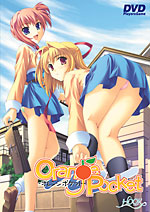

Orange Pocket: Root arrives on the PS2 with the kind of calm insistence usually reserved for cats and slow-moving rivers. It is a domestic, pastoral visual novel that trades explosions and lasers for tea, school corridors and the milling social gravity of a handful of attractive classmates. The premise is simple: Hideaki Eda, a boy who used to live in the city, now lives somewhere rurally blessed with a mountain, a river, and just enough quiet to make everything feel important. Nazuna Ayase, his childhood friend, returns from the city and promptly upends the town's ambient tranquility by being sociable, bright and excellent at reflex tests. If your emotional tolerance for melodrama is somewhere between 'comforting soup' and 'mildly combustible memoir', Orange Pocket: Root will likely be your kind of slow burn. The PS2 port removes the adult content from the original PC eroge release, pads the cast with a console-exclusive heroine (and an extra scenario), and bundles in new scenes that make the game's small town feel slightly less static. If you prefer a story where the most violent thing is someone dropping a textbook, Root offers commitment: many choice points, repeated replays, and the opportunity to discover nine different character routes depending on how much social navigation you can stomach. It does not, and I feel this is important to note, contain any oranges that are pockets. The title remains a mood, not a fruit-management system.
Root behaves like most visual novels: you read, you click, you occasionally make a life-altering decision that leads to another chapter of polite emotional posturing. The interactivity is minimal by design. Text appears, it describes dialogue or Hideaki's inner monologue, and every so often the game pauses for a decision point, usually two or three options. Choose wisely, or at least differently, because the story branches and you will be required to replay sections to see every ending. The original PC release reportedly had ten main plot lines-one for each heroine-but the PS2 and Dreamcast ports reworked that slightly. Because console versions received exclusive content and their own additional heroines, you get nine heroines to pursue in Root; one of the console-only heroines (Arika) received a fleshed-out scenario on PS2, while another console-only character appeared in the Dreamcast version instead. This means the PS2 edition is a slightly different animal compared to the PC original: cleaner for younger audiences, but no less committed to the slow social grind. Gameplay loops are built around conversations and small-town rituals: school days, library naps, bicycle rides, part-time jobs in a watch store and a bakery, music practice for aspiring musicians and the ever-present small-town festivals that exist purely to manufacture shared feelings. There is no combat, no inventory-unless you count 'pillow' as an inventory item, which one heroine carries specifically for her unique ability to fall asleep anywhere. Decision points matter because they guide which heroine becomes the focal point of Hideaki's attention. Some routes are straightforward: spend time with a character, answer their questions in a sympathetic way, trigger unique scenes. Others require minute attention to earlier choices so you can meet the prerequisites for late-game set pieces. The result is predictable but satisfying: each heroine's arc reveals different personality facets, family contexts, and, occasionally, insecurities that the game handles with a surprising amount of gentle honesty. Character writing is the meat of Root. Hideaki is a deliberately bland baseline, allowing the heroines to orbit him and display their individual chemistries. Nazuna is the bubbly childhood friend with city pedigree, Minori is the sleepy pillow-hoarder with some bravura statistics about her chest size that the script never lets you forget, Madoka is the outwardly confident but inwardly insecure energiser, Eru behaves like a younger sister who cooks and cleans (endearing), Sakino is shy and contemplative, Kiriko stalks the campus with a camera and a cool exterior that might crack under the right light, Haya is a tsundere with a short stature and complex loneliness, Yūki is the neighbor who calls Hideaki 'Onii-chan', and Arika-the PS2 addition-goes from minor to proper route by bringing the older-sister act and a secret guitar habit. There is an economy to the relationships: the game rewards consistency and repeated time investment with scenes that feel earned rather than manufactured. Replayability is both a promise and a mild punishment. To see all the character routes you will replay many sections, which means absorbing the same banalities and jokes multiple times until the new plot beats land. Thankfully, the game offers a decent audiovisual atmosphere-the music and voice acting (where present) make repetition less punishing. Root also adds the kind of exclusive scenarios and bits of art that will make collectors of character moments very content. If you play for plot, expect the slow drip of revelations; if you play for comfort, expect a long soak in warm, vaguely wistful domesticity.
Visually, Orange Pocket: Root is an artifact of early 2000s visual novel aesthetics: clean 2D character sprites, pastel backgrounds of rural Japan, and close-ups that linger just long enough for the music to help you feel the feeling the writers intended. The console port trims any extra 'mature' illustrations from the PC release, which means the PS2 visuals are more coy and, in some ways, more tasteful-if you prefer your romances implied rather than diagrammed. Character designs are competent and distinct: Nazuna's city shine, Kiriko's camera-toting coolness, and Haya's tsundere eyebrow all read instantly in sprite form. Background art does the job without trying to command attention; the mountain and river that supposedly define the setting are there, they look pleasant, and they behave like a passive character would-supportive and slightly mysterious. The PS2's hardware did the port some favors. Transitions are smoother than the original CD-ROM, and load times are appropriately restrained, so you rarely have to wait between dialogue beats. The visual novel format means you don't need polygonal fidelity, and Root knows this. What the PS2 version lacks in flashy animation it compensates for with voice work and a handful of slightly extended CG illustrations tied to key scenes. Those CGs are the game's postcards-more detailed, colored set pieces that reward route completion. The OST helps sell the visuals: the opening 'OrangePocket' and the ending 'Haruoto' are pleasant, cozy numbers by Maki Yuzuki, and the Sound Pocket soundtrack provides gentle background textures that turn a static conversation into a mood piece. If you are the sort of person who notices how a piano motif can make a bench feel like an altar, the graphics and audio together will do their quiet duty.
Orange Pocket: Root is not trying to reinvent the visual novel. It has no ambition to cure insomnia, launch a revolution, or teach you how to bake ten different breads based on feelings. Its strengths are in small things done correctly: a well-curated cast, gentle writing that is rarely mean-spirited, and a PS2 port that trims the adult content without neutering the emotional beats. The addition of Arika's full scenario on the PlayStation 2, and the console-exclusive bits of content more generally, make Root worth seeking out if you appreciate character-driven stories and don't mind repetition as a means to completeness. The PS2 version is best for players who want the soft edges of a harem visual novel without the adult content-someone who enjoys hanging out and listening to people discover themselves in a town of rice paddies and clocks. The game also makes a reasonable case for buying a limited edition-if you're the type who likes drama CDs and artbooks-because Hooksoft and Pionesoft were thoughtful about offering collectors a few tokens of extra affection. Score: 7/10. Orange Pocket: Root is a cozy, pastoral route-jumper that rewards patience. It is not dramatically necessary, but it is quietly effective. If you need your romances gentle, your conflicts not maximal, and your endings earned rather than assaulted into existence, Root is a comfortable place to spend a dozen or so hours. If you wanted fireworks, explosions, or oranges that fit inside pockets, you will have to look elsewhere. Either way, the town will be there when you come back-probably holding a tea towel and an unasked-for memory.
 Pocket MuuMuu on PlayStation
 Power Pro Kun Pocket 13 on DS
 Tomoyo After: It's a Wonderful Life on PS3
 Pachislot To Heart 2 on PS3
 Trivial Pursuit Live! on PS3












 Another SquareThought Site