

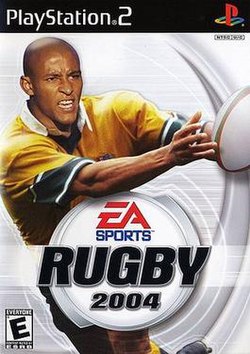

Rugby 2004 is HB Studios' 2003 follow-up in EA Sports' Rugby series, released on PlayStation 2 and Windows. On paper it looks like a box of candy for the rugby nerd: over 60 teams, more than 1,500 players and upwards of 65 stadiums, complete with BBC and Channel 7 commentary by John Inverdale and Gordon Bray and a soundtrack supplied by INXS. The package promises depth and authenticity; in practice the game delivers a curious mash of ambitious scope and awkward technical implementation. The critical reception was mixed-Metacritic clocks the PS2 version at 61/100-so if you want a rugby sim that feels like a polished pro match, prepare to be occasionally benched by rough edges. If you want a technical post-mortem flavored review with a wink, read on.
Rugby 2004's core proposition is straightforward: simulate 15-a-side rugby with licensed squads and stadiums. The roster breadth is impressive for the era-60 teams and ~1,500 players give the game real-world scale and variety, which is useful for career modes, quick matches or multiplayer couch chaos via multitap. EA's decision to include both local four-player support and the PS2's online capability shows they intended this to be played socially, and the team/stadium licensing helps maintain visual and roster fidelity. Where the ambitions meet reality is in the input-to-action chain. Controls are mapped in a fairly conventional sports manner-buttons for pass, kick, tackle and a modifier for special maneuvers-yet multiple outlets reported that responsiveness and predictability were inconsistent. That inconsistency shows up in two technical subsystems: animation blending and collision resolution. Animation transitions try to cover a wide variety of tackle/ruck/maul outcomes, but because the engine blends many discrete motion clips, the result sometimes looks like limbs negotiating a small civil dispute rather than two athletes colliding. When animation blending doesn't mask root motion cleanly, you get perceived latency: press a button, see an on-screen animation that doesn't quite match the expected physical result, and the player feels like they're pushing a puppet through syrup. Collision resolution is another place where the game's logic visibly impacts play. Rugby is a game of frequent pile-ups and contested ball moments; the simulation must reconcile multiple bodies, positional advantage, stamina, and grip mechanics. Rugby 2004 implements a deterministic resolution that favors discrete state transitions-e.g., 'tackle succeeded' or 'ruck formed'-over continual force-based simulation. That approach keeps CPU overhead low on PS2 hardware, but it reduces emergent interactions. Expect predictable outcomes in standard situations, but also expect oddities when three or four players converge at once: the ball may teleport to a player who was not visibly dominant, or a ruck might resolve in a way that contradicts the on-screen momentum. Those are the moments where referees in real games would shrug and the Internet would roar, but in a simulation it breaks the illusion. AI is a mixed bag. Teams exhibit correct high-level behavior-spreading the ball wide when space opens, collapsing defensively on breaks, and forming rucks-but the micro-level decision-making suffers from occasional tunnel vision. Attack patterns can become formulaic, and defenders sometimes commit too late or fail to slide properly. That gives the single-player experience a stop-start rhythm: you can string together brilliant sequences when the AI behaves, but you can also be left holding the ball while teammates hesitate. The AI's situational awareness suffers particularly in support positioning: giving timely options for the ball carrier is not consistent. Ball physics are serviceable but conservative. Bounces and grubber kicks have predictable arcs; the engine opts for stability over chaos, meaning you rarely get wildly luck-driven cutbacks, but you also miss satisfying randomness that can create cinematic moments. Kicking mechanics are functional, with accuracy tied to player stats and timing, though the input timing windows feel slightly narrow. Tackles and offloads are governed by a mix of player attributes and animation outcomes-if an offload window opens, it's a matter of timing rather than a purely physics-derived result. Modes and progression focus on realism through content rather than complex meta-systems. The game offers standard match modes and multiplayer; there's no sprawling franchise meta-game, which keeps the scope manageable but may disappoint players looking for deep team management. The presence of authentic commentators and licensed stadiums enhances immersion, but repetitiveness in commentary lines becomes noticeable over extended sessions. From a systems design perspective, the game prioritizes roster and venue authenticity over novel gameplay loops. Multiplayer on the PS2-local or online-was a highlight for fans who wanted to play with friends. Local four-player matches via multitap are great for parties where rules enforcement is forgiving. Online functionality was a forward-looking inclusion for the console, though network stability and matchmaking were bound to the era's limitations and are not a major selling point today. Overall, gameplay is competent and occasionally rewarding, but hamstrung by middling animation blending, collision determinism and inconsistent AI decisions.
Graphically Rugby 2004 sits in the 'competent but not showy' bracket for the PS2 generation. Stadiums are plentiful-over 65 venues-and that variety translates into differing textures, crowd palettes and field markings which help keep visual variety high across long play sessions. Individual player models are serviceable: face geometry and kit detail capture the broad strokes of star players, and team colors are accurate. Texture resolution and LOD are constrained in places, so up-close geometry can look soft; that was a common trade-off for the platform when balancing high team/stadium counts with real-time performance. Rendering-wise the game tends to aim for stable frame rates over cinematic presentation. PS2 hardware limitations seem to have driven conservative choices in shadowing, lighting complexity and particle effects for turf and dust. The result is a flat but readable visual presentation: you can quickly parse the field state, which is crucial in a sports title where clarity trumps spectacle, but it lacks the dynamic lighting or high-fidelity skin shading that would elevate moments from believable to breathtaking. Character animation deserves a second mention because it intersects both graphics and gameplay. Motion capture underpins many animations, but the blending between clips occasionally produces foot sliding or unnatural hand placements during contested plays. Those visual glitches reinforce the gameplay discontinuities described earlier. Audio design-commentary by John Inverdale and Gordon Bray, plus an INXS soundtrack-adds personality and helps sell the spectacle despite the visual conservatism. Commentary quality is high initially but becomes repetitive; soundtrack placement is tasteful and fits the stadium ambience.
Rugby 2004 is a product of earnest design choices constrained by platform realities. Its strengths are clear: deep licensed content, lots of teams and stadiums, and multiplayer support that makes it a decent party sports title. Technically, the game errs toward conservative stability-stable frame timing, predictable ball physics, and a deterministic collision/ruck system. Those choices make the game approachable, but they also subdue the emergent, chaotic beauty of real rugby. Where the game loses points is in the execution of animation blending, collision outcomes and AI nuance. Those systems are the technical glue that turns a roster-and-stadium simulator into a living match; when they hiccup, the illusion fractures. The mixed critical reception reflects that split: some reviewers (IGN, PSM) found enough merit to recommend it, while others (Eurogamer, GameSpot and GameSpy) called out the flaws more harshly. If you're a rugby completist who wants licensed teams and multiplayer mayhem, you'll find value here. If you demand tight, modern-feeling simulation fidelity from controls to collision, this one will feel like a respectable try that needed one more development cycle. Final verdict: an ambitious roster-rich rugby title with technically sound foundations that occasionally trips over animation and AI roughness. Worth a try for fans and multiplayer sessions; not quite the definitive rugby sim the scope promised.
 NFL GameDay 2004 on PlayStation
 Madden NFL 2004 on PS2
 FIFA Football 2004 on PlayStation
 Accolade Sports Collection on Xbox Series X/S
 Deca Sports DS on DS
 Alan Hansen's Sports Challenge on PS2
 EA Sports MMA on PS3
 PGA Tour 2K25 on PS5
 NHL 09 on PS2
 PGA Tour 2K23 on PS5
 The Golf Club 2 on PS4
 Cricket 2005 on PS2












 Another SquareThought Site