

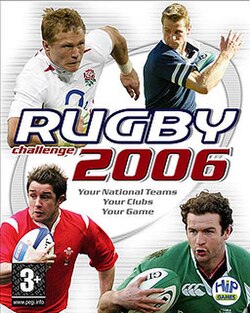

If you've ever wanted to fling a perfectly proportioned, oval piece of leather at a bewildered fullback and call it strategy, Rugby Challenge 2006 on the PS2 is the pixelated pitch you've been waiting for. Developed by Swordfish Studios and published by Hip Interactive with a little Ubisoft marketing elbow grease behind it, this title tries to cram the chaos of rugby union into a demo-friendly box. It doesn't reinvent the sport, but it understands what fans want most: hard tackles, managerial smugness, and an excuse to shout at commentators. The game's ambition is almost adorable. There are club and international tournaments, a career mode that lets you play manager-coach-transfer-whisperer, and a battery of challenge modes for people who enjoy punishing pixelated athletes in creative ways. Multiplayer supports up to four players, meaning your living room can rapidly become a rugby scrum, minus the real-world injuries and with slightly less mud. For a PS2-era sports sim, it serves up enough features to make a rugby tragic nod with approval, even if the execution occasionally trips over its own bootlaces.
At its core, Rugby Challenge 2006 is a rules-respecting rugby sim with an emphasis on accessibility. Passing, tackling and kicking are mapped in a way that feels familiar to anyone who's endured a sports game tutorial; you make the basics look charmingly competent and the advanced stuff requires timing and a willingness to be mildly humiliated on the scoreboard. The inclusion of club and international tournaments lets you swing between representing your nation and nurturing a club's rise from modest mediocrity to slightly less modest mediocrity, depending on how good your transfer market gambling is. Career mode is where the game stretches its legs. You're not just playing matches - you're hiring, trading, training and occasionally pretending you understand a transfer market. There's a recruitment system and basic management options, which means you can build a squad of glorified pixel gladiators and then slowly regret it when your star flanker injures himself in a training drill against a cone. Training mode is impressively thorough for a mid-2000s title; if you've ever wanted to micro-manage the lineout lifters or obsess over scrum engagement routines, this game will let you do it until you forget to eat. For quick thrills, the Challenge Modes deserve a shout-out. Survival mode serves up a gauntlet of ever-tougher matches for those who like their virtual rugby with a side of mounting existential dread. Classic mode unlocks retro teams and games; it's a neat nostalgia button if you enjoy seeing older kits and wondering why no one used shoulder pads like that anymore. Superstar mode is the career-lite: you create a single player, pump them full of training bonuses and watch them slowly morph from rookie to legend, or at least to someone whose name you forget but whose stats look impressive. Controls are generally intuitive but not flawless. Passing can feel a bit stiff at times, and the AI occasionally decides that the best strategy is a spontaneous nap in midfield. Tackles are satisfying when they land; the game conveys impact with a satisfying thud and a brief animation flourish. However, breakdowns and ruck contests sometimes descend into button-mashing fests that reward persistence more than strategy. That said, passing, kicking and set pieces are all present and functional - and the ability to edit players, teams and tournaments gives you the power to fix any roster sins or create league atrocities purely for giggles. Multiplayer up to four players is where Rugby Challenge 2006 stops pretending to be serious and becomes instantly more fun. Sitting on a couch, snacks within reach, as someone attempts an ambitious cut-out pass and another player predicts it with a perfectly timed intercept - that's the good stuff. The game is best enjoyed in this chaotic local setting: AI quirks are forgiven when friends are loudly celebrating a last-minute drop goal and someone blames the controller.
Graphically the game is quintessential PS2: blocky in places, earnest in others, and full of heart. Player models have the appropriate bulk and bruised dignity of rugby athletes, though faces can veer into the 'generalized polygon' territory. Stadiums convey the atmosphere you want: muddy pitches, poorly defined crowd blobs, and floodlights that make every late-night match feel suitably dramatic. Don't expect photorealism; do expect enough detail to recognise whether your team is wearing red or not. Animations are serviceable. There's a satisfying weight to collisions, and some of the tries are accompanied by small victory gestures that are delightfully overcooked for added drama. The crowds don't do much beyond applauding and occasionally looking vaguely excited, but the soundtrack and ambient noise do their best to sell the stadium feel. Commentary, provided by John Inverdale and Dewi Morris, adds that authentic radio-sport flavor - until the lines start repeating like a retired coach telling the same inspirational story. It's charming when it works and hilariously repetitive when it doesn't, which is to say it occasionally sounds like two commentators trapped in a loop of eternal cliches.
Rugby Challenge 2006 is not a revolution in sports gaming, but it's a warm, competent celebration of rugby union for the PS2 era. Between the career mode's managerial distractions, the challenge modes' gauntlets, and a multiplayer setup that turns any living room into an honorary stadium, there's plenty here for fans of the sport. The game trips up on AI consistency and the occasional clunky animation, and the commentary will have you laughing more at its repetition than marveling at its insight. Still, with editors to tinker with, training to obsess over, and enough basic gameplay fun to make a Saturday afternoon disappear, it's a solid pick for anyone craving a rugby fix without the expense of cleats and mud. Score: 7/10 - a solid scrum of a game. If you love rugby, this will keep you entertained; if you don't, it's still worth a go for the multiplayer shenanigans and the oddly satisfying satisfaction of orchestrating a textbook try while your mate screams about line speed.
 Crash Bandicoot: The Wrath of Cortex on PS2
 UEFA Challenge on PlayStation
 Thief Simulator on Switch
 Accolade Sports Collection on Xbox Series X/S
 Deca Sports DS on DS
 Alan Hansen's Sports Challenge on PS2
 Olympic Games Tokyo 2020 - The Official Video Game on Switch
 Cold Winter on PS2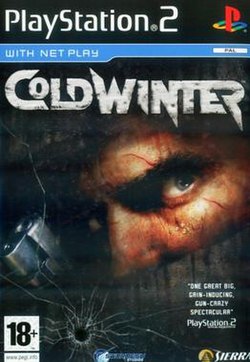












 Another SquareThought Site