

 Oct 2025
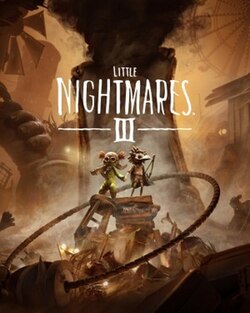

Little Nightmares III brings the franchise's lovable dread and tiny-child-in-a-huge-world vibes to the PS5 with two new protagonists: Low, a boy in a raven mask who likes a bow and arrow, and Alone, a girl who prefers a wrench and probably hates squeaky toys. Supermassive Games took the reins from the original studio and kept the series' core: claustrophobic levels, grotesque enemies, and puzzle-platforming drenched in atmosphere. This entry adds AI companions and online co-op, which changes the challenge calculus. If you came in expecting pure jump-scare brutality, you still get moments of scary surprise, but the meat of the experience is a steady diet of timing, coordination, and puzzle logic. The reviewers were split on whether that diet is delicious or slightly undercooked, but if you enjoy games that make your palms sweat while asking you to be clever with two buttons and a flashlight, this one is worth your time.
Little Nightmares III keeps the familiar 3D exploration and environmental puzzles of the series, but it doubles down on the kinds of challenges that make this feel less like a spooky walk and more like a tightrope act over a vat of cold porridge. Levels are structured around traversal obstacles, enemy patrols, and set-piece encounters with grotesque bosses such as Monster Baby, the Supervisor, and the Hypnotist. Each encounter is less a straight fight and more a carefully choreographed rehearsal: observe, bait, time, and then execute. The two protagonists bring different toolsets that shape the skill demands. Low's bow and arrow turns some encounters into ranged timing puzzles; you might have to shoot a target just as a conveyor belt slides a platform into place, or distract a patrol from a distance. Alone's wrench is more of an up-close utility tool, used for turning valves, levering open hatches, or improvising cover. That asymmetry is where the game gets interesting: puzzles will often require you to think about roles. Who pulls the lever while who climbs the pipe? Which character's animation will finish faster so you can slip past a camera? On PS5, the control feels responsive, and the odds are stacked in favor of precision and planning rather than button-mashing. If you play solo you have an AI companion tagging along. The AI is designed to help with paired actions and simple pathfinding puzzles, which means the game doesn't turn into a two-handed Rubik's Cube when you go alone. It does sometimes misread an elegant solution as 'climb casually into danger' and will require you to babysit it for split seconds, but overall it keeps the core cooperative puzzles intact. In online co-op the experience shifts from patient frustration to full-on buddy-comedy coordination. The game rewards communication; you will need to call out timings, mark targets, or deliberately bait a hazards sequence while your partner moves a platform. Good co-op players will find a satisfying rhythm that blends stealth, platforming, and tool use into elegant solutions. The challenge design favors trial-and-error but not in a lazy way. Expect sequences where you study a patrol route, plan a distraction using environment objects, then execute with surgical timing. Failure is frequent and often quick - you're dropped back just before the set-piece - so the punishment is tolerable and encourages experimentation. That said, some sections lean heavily on pixel-perfect platforming where a single mistimed jump means starting the whole sequence over. Those moments will highlight your dexterity (thumbs and timing) more than your deductive reasoning. Players who prefer puzzles that punish wrong thinking more than wrong reflexes will find this occasionally frustrating. Boss and miniboss encounters are less about health bars and more about pattern recognition and stage manipulation. The Supervisor turning insectoid and shedding limbs is a great example: you are not meant to fight it with raw aggression, you must manipulate cameras, pipes, and hydraulics to turn the environment into a weapon. That design keeps fights feeling fresh, since you're solving an environmental equation rather than learning a generic attack pattern. However, the balance can wobble; some boss rooms demand near-perfect platforming while juggling multiple mechanics, which can turn an otherwise clever solution into a memorization chore if you aren't patient. Puzzle variety is decent. You have lock-and-key logic, timing windows, physics-based object movement, and coordinated tasks that require two hands on the controller, even if only one human is holding them. Spatial reasoning is often rewarded: seeing the level as stacked layers and planning routes through vertical sections will get you through with minimal retries. The game also peppers in memory-driven narrative beats, where flashback glimpses change the immediate environment; these are good for pacing, but they also inject puzzles that rely on observation and inference, testing your attention to small environmental details. One of the most interesting skill demands is silent problem-solving under pressure. Many areas force you to conceal movement with cover, silence, or timing; detection sequences quickly escalate and force you to improvise. Learning to read an enemy's telegraph and respond with a subtle tool use or diversion is a recurring skill that the game refines through its run. For co-op, that becomes a duet: one player baits, the other sneaks, and success feels like a tiny victory over chaos. Difficulty is not customizable in depth, so the main way you modulate challenge is by choosing solo with AI or playing with another human. Solo play is friendlier, but if you want the game to demand maximum coordination and interpersonal patience, online co-op is your answer. That mode amplifies both the fun and the potential for blame when things go wrong. Expect to learn a lot about your friend's ability to time a jump under pressure. Overall, Little Nightmares III is less of a reflex-based beat-em-up and more of a dexterous, timing-focused puzzle-platformer with a heavy emphasis on role-based cooperation. The skills it exercises are patience, spatial reasoning, timing precision, environmental creativity, and if playing with someone else, clear communication.
The visual package is faithful to the franchise: murky palettes, oversized antagonists, and sinisterly cute character models rendered in Unreal Engine 4. On PS5 the game looks worn-in and detailed where it counts: grime on factory belts, the flaking paint of the Carnevale's wooden decks, and the uncanny expressions on puppet faces. Lighting and shadow play a practical role in gameplay, not just aesthetics; hiding spots and camera cones are visually readable, which helps when your survival depends on reading tiny visual cues. Motion and animation lean toward the exaggerated and creepy, and most boss designs are memorable for their grotesque silhouettes. The art direction does the heavy lifting emotionally, even if the textures sometimes show their age. Performance is generally stable on PS5, and the crisp responsiveness helps when the game asks for pixel precision.
If you want a horror puzzle-platformer that tests both your brain and your thumbs, Little Nightmares III serves up a decent plate. The game rewards careful observation, coordinated thinking, and surgical timing, and it adds meaningful cooperative dynamics that amplify the challenge in a satisfying way. It stumbles a bit when it mixes high-precision platforming with complex multi-step puzzles, which can feel unfair to players who prefer thinking over twitching. Critical response landed in mixed territory, and the PS5 score reflects that measured consensus. For those who delight in tiny-sweaty-palmed victories, clever environmental solutions, and buddy-based problem solving, this is a spooky little gem worth playing. For players who hate retry loops and prefer puzzles that punish logic mistakes rather than a missed jump, proceed with caution. Either way, bring patience, practice your timing, and maybe make a snack before you tackle Monster Baby.
 Little League World Series Baseball 2009 on DS
 The Dark Pictures Anthology: Little Hope on Xbox Series X/S
 Little Anchor on PS2
 Crow Country on PS4
 Tormented Souls on PS5
 Crow Country on Xbox Series X/S
 The Forest on PS4
 Little Nightmares III on Xbox Series X/S
 Until Dawn on PS5
 Directive 8020 on PS5
 Directive 8020 on Xbox Series X/S
 The Dark Pictures Anthology: House of Ashes on Xbox Series X/S










 Another SquareThought Site