

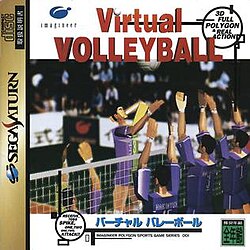

Victory Spike (originally released in Japan as Virtual Volleyball) arrives in the mid-90s like a fashionably awkward cousin of the fledgling 3D era: ambitious, polygonal, and oddly sincere. It claims a tiny piece of historical bragging rights as one of the first volleyball games to go full polygons, attempting to move the sport out of 2D sprites and into a blocky, three-dimensional court. If you pick it up expecting a modern-feeling simulation, you will be disappointed. If you pick it up expecting a curious relic that demands patience, timing, and a surprising amount of mental gymnastics to control an entire team, you might find something worth grinding through. This review leans hard on the challenge aspects: what the game makes you learn, what skills it asks of you, and whether those demands end in satisfying triumph or flustered button-mashing.
Victory Spike is less pick-up-and-play arcade volleyball and more an endurance test in spatial reasoning and team management, disguised in an early-3D sports wrapper. The core challenge stems from one brutally honest design truth: you're not controlling a single star player - you are supposed to run, set, and spike as an entire six-person team using a controller with far fewer buttons than the real sport has players. The game tries to map rotations, player switching, and team positioning into a handful of inputs. That means the first real skill you learn is patience. The second is anticipation. Anticipation matters because the camera and control system rarely gift you tidy sightlines. The polygonal court translates into limited depth perception; a ball that looks like it's three meters away in one frame can be two feet off the net in the next. You'll find yourself predicting arcs, not reacting to them. Good players (read: human brains that adapt) build a mental model of ball trajectory, opponent tendencies, and the timing window for bump-set-spike combos. Precision timing is rewarded - if you hit the sweet spot for a set, your spiker will blast through the few defensive animations the AI has. Miss by a fraction and your team will perform a sad, floppy volley that reads like a middle-school gym class. Another pillar of the game's difficulty is managing rotations and positioning with limited control fidelity. You are often forced to trust the AI teammates to run to their spots. The game's designers apparently assumed you enjoy being an orchestra conductor with gloves, because you will be signaling plays you can only half-manage. This makes reading your opponent's formation hugely valuable. If you can predict where their setter will place the ball, you can pre-position your best blocker. If you can fake a move and bait a predictable set, you can time a chase and a counterspike. All of this sounds tactical - because it is - but the execution feels like trying to sip coffee through a straw with a missing slurper. Serve mechanics lean toward being deceptively simple but tactically rich. A floaty, well-placed serve that disrupts the opponent's first pass creates chaos, and Victory Spike gives chaotic outcomes in spades. Serving is one place where you can express skill without wrestling too much with the controls: placement and timing will win you free point opportunities, especially against the AI. Defensive play, however, requires muscle memory of block timing and jump windows. The block animation has a short, brittle sweet spot; press it too early and you look like you're politely attempting to intercept a breeze, press too late and you watch your blocker perform an interpretative dance as the ball rockets past. Multiplayer turns the system's awkwardness into a party trick. With another human, the game becomes a coordination puzzle where communication and pre-agreed roles matter more than raw inputs. Two humans can exploit nuance, baiting and bluffing with serves and movement in ways the AI cannot predict. The learning curve here is: learn to read your partner and accept that some losses will be the fault of your teammate's hands and not your tactical genius. AI opponents, conversely, oscillate between competent mistakes and borderline psychic plays - which adds to the game's uneven difficulty spikes. Overall, Victory Spike rewards cerebral play: spatial awareness, prediction, timing, and a willingness to embrace imperfect controls. It punishes button spamming and expects you to think a few moves ahead, which is admirable. The trade-off is that the game's interface sometimes fights the player for control authority, turning triumphs into relief rather than elation.
Graphically, Victory Spike wears its age like a pair of neon windbreakers - loud and unmistakably 90s. The polygon models are blocky, animations are limited, and characters move with the stiff elegance of wooden marionettes. The camera work tries to sell the 3D court but often gets in the way of the gameplay; awkward angles and sudden camera shifts can obstruct your view at critical moments, which compounds the timing and positioning challenges. Crowd and court details are minimal, but the clean, uncluttered presentation does make it easy to focus on the ball and players, when the camera cooperates. There is charm in the simplicity: when you land a perfect spike and the polygonal player flings their limbs in triumph, it feels rewarding because these are rare, earned moments in the game. Sound design and presentation are modest. Crowd noises and music are functional but forgettable, and the lack of nuanced feedback for player actions means you often rely on visual cues alone. For a title from 1996, the visuals deserve a pass for trying something new with polygons, but modern expectations (or even later 90s standards) will find them thin. If you approach the graphics like a historical artifact - the first shaky steps into 3D volleyball - the blockiness becomes part of the experience rather than a flaw that ruins it.
Victory Spike is a mixed bag wrapped in a polygonal net. Its biggest strength is the challenge it offers to players willing to learn a quirky, tactical volleyball system: prediction, timing, rotation awareness, and teamwork are all skills that will carry you through. Its biggest weakness is that the control and camera systems sometimes sabotage those very skills, turning clever plays into frustrating near-misses. Critics at the time were harsh - and with good reason - because the game doesn't always do enough to smooth over the inherent difficulties of controlling a team in early 3D. If you're after a polished, modern sports sim, this is not your court. If you're a retro enthusiast curious about early 3D experiments who enjoys the mental gymnastics of out-thinking both camera and opponent, you'll find enough here to keep you attacking the net. Score-wise, Victory Spike lands in the middle of the road: historically interesting, occasionally clever in its demand for genuine volleyball smarts, but ultimately hamstrung by technical and design choices that make mastering it more of a trial than a triumph. Recommended to the patient, the curious, and anyone who likes their gaming history with a side of challenge.
 Inazuma Eleven: Victory Road on Switch
 J-Stars Victory Vs on PS3
 Accolade Sports Collection on Xbox Series X/S
 Deca Sports DS on DS
 Alan Hansen's Sports Challenge on PS2
 Olympic Games Tokyo 2020 - The Official Video Game on Switch













 Another SquareThought Site