

 May 2026
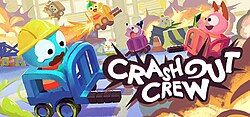

Crashout Crew is Aggro Crab's foray into cooperative logistics chaos: a four-player forklift simulator that asks you to hustle boxes into trucks before they drive off, while the game gleefully throws obstacles, lava, and meteors at you. Announced in October 2025 and demoed during Steam Next Fest, it shipped on May 28, 2026 for Windows and Xbox Series X/S. On paper it's a simple arcade puzzle-coop: deliver X items, beat the clock, repeat. In practice it becomes a test of spatial awareness, controller finesse, and networked physics hygiene. This review approaches Crashout Crew from the angle that matters for players on a modern console: how the core mechanics are implemented, how the engine treats player input and physics under stress, and whether the online/multiplayer experience supports the intended chaos without collapsing into frustration.
Crashout Crew's gameplay loop is ruthlessly concise. Up to four players share responsibility for loading a specified number of items into departing trucks. The twist is the 'stress' mechanic: collisions with walls, other players, standing on lava, or getting smacked by meteors increment a stress meter that eventually causes your forklift to lose precise control and veer erratically. From a systems perspective this is the central gameplay governor - it both amplifies emergent chaos and intentionally injects nonlinearity into what would otherwise be a deterministic cargo-delivery minigame. Technically, that stress meter is the most interesting design decision. It functions as a state machine layered on top of standard vehicle physics: nominal state (direct player input mapped to wheel/steering/acceleration), stressed state (input mixing with procedurally generated erratic torque/steering noise), and recovery (gradual damping back to nominal). Good implementation requires careful attention to interpolation and input smoothing. If the transition is too abrupt it feels unfair; if it's too slow it neuters the panic that makes the game memorable. Crashout Crew mostly lands the sweet spot - collisions meaningfully degrade control, but the player still retains sufficient agency to attempt recovery maneuvers. The sensation is close to playing a remote-control vehicle with an increasingly janky receiver. The cooperative element is where technical choices shine or crack. Cooperative physics-based games demand robust prediction and reconciliation to avoid players seeing different realities. Given the title's emphasis on contact (player-to-player bumping is a stress trigger), the networking model needs to either authoritative-server-simulate collisions or run deterministic lockstep. For a modern indie like Aggro Crab, the practical approach is client-side prediction with server reconciliation. When it works, the result is snappy controls and believable collisions; when it doesn't you get teleporting boxes and forklifts that ghost through each other in the local client's view. Crashout Crew's netcode in the demo and launch build manages the usual trade-offs well - local multiplayer is rock solid because there's no network layer, and online matches are generally coherent. That said, in high-latency sessions the stress mechanic amplifies desyncs: a lagged collision that should have increased stress can arrive late and trigger a sudden, disorienting loss of control. It's not fatal to the experience, but players in competitive time runs will notice. Level design, from a mechanical standpoint, favors tight spaces and predictable chokepoints that make collisions both frequent and meaningful. That design choice is intentional: the warehouse is almost a character, an obstacle course designed to maximize player interaction. The addition of environmental hazards like lava and meteors is clever because they are deterministic hazards that are easy to detect visually but hard to survive in the heat of a run. Lobbies support single-player (with AI or solo challenges) and multiplayer, and the pacing adjusts well between solo and co-op; however, the game's entire conceit scales heavily with player count. Solo runs feel like practice; four-player matches are where the physics and network code must both be at their best, and when they are, the result is sublime chaos.
Visually Crashout Crew opts for readability over photorealism, which is the correct call for a game where dozens of physical interactions and fast decision-making are the gameplay core. The art direction favors high-contrast props and clear color-coding for interactive objects (boxes, trucks, hazards), ensuring that frame-to-frame decisions don't require squinting. On Xbox Series X/S the UI is minimalist and unobtrusive, placing timers and truck goals in the periphery so the playfield remains uncluttered. From a technical rendering perspective, the game doesn't attempt to push shader or lighting boundaries; instead it allocates budget where it matters: physics fidelity and object count. That means you can expect well-behaved rigid body simulations, stable shadowing for moving objects, and asset LODs that preserve readability when dozens of crates are in motion. Particle effects for meteors and hazard visuals are punchy but not GPU-taxing, which helps maintain a consistent frame pacing during chaotic moments. The modest visual ambition is a strength: it avoids overloading the Xbox's GPU during multi-actor schlams and keeps the CPU/physics thread from stuttering due to expensive post-processing. If you are into nitpicking, a few texture pop-ins and occasional animation snapping crop up when many players cluster tightly - an artifact of culling/streaming priorities and the decision to favor physics throughput over texture streaming. Those are minor annoyances in the context of a title that sells itself on frenetic cooperative mayhem.
Crashout Crew is a compact, technically competent cooperative game with a focused design and a mischievous heart. Aggro Crab distilled the freight-handling fantasy into a few elegant systems: a stress-driven control modulation, physics-first interactions, and level layouts that maximize player contact. On Xbox Series X/S the experience feels polished where it counts - responsive controls, readable visuals, and generally robust online behavior - though high-latency multiplayer sessions can occasionally punch holes in the otherwise tidy networking. The game's strengths are its emergent moments and the way technical decisions (clear visuals, prioritized physics, lightweight rendering) support those moments. If you want perfection, this isn't a simulation-grade forklift sandbox; it's a deliberately chaotic party game where the engine is tuned to encourage mayhem instead of eliminating unpredictability. For groups who love cooperative screw-ups and tight, physics-driven challenge, Crashout Crew is a blast and earns a solid 7/10. For solo completionists or latency-sensitive competitive players, the occasional reconciliation hiccup and the scaled-down visual ambitions might leave you wanting more. Either way, if you enjoy multiplayer warehouse mayhem - and the game's reception is right to call it chaotic - Crashout Crew delivers fun at the intersection of technical craft and delightful disorder.
 Bomber Crew on PS4
 Star Trek: Bridge Crew on PS4
 Coloball 2002 on PS2
 Game Dev Story on PS4
 Press Your Luck on PS3
 Trivial Pursuit on PS3
 Another Crab's Treasure on PS5










 Another SquareThought Site