

 Apr 2026
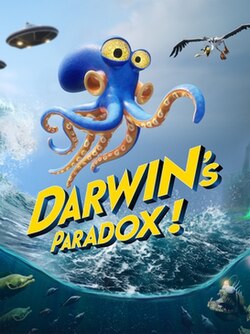

Darwin's Paradox! is a 2.5D platformer that asks an important question: what happens when a blue octopus called Darwin gets abducted by a UFO and then must break into a sinister food corporation to save his friend? The answer, as it turns out, is mostly 'platforming puzzles with a side of ink'. Built in Unreal Engine 5 by Paris-based ZDT Studio - a new outfit formed by a few ex-Argane-ish types - the game trims its ambition into something neat and slightly melancholy. You are small, soft, and tentacled; the world is clinical, industrial and suspiciously fond of conspiracy-themed branding. The plot flirts with sci-fi tropes (mind control, alien invasion, corporate malfeasance) without stomping on them, which is to say it keeps enough distance to remain charming rather than exhausting. The music, courtesy of Francis Chavihot, does a lot of the heavy lifting for mood, while the gameplay does what it needs to do: remind you that octopuses can be stealthy, squishy engineers of escape.
On Xbox Series X/S Darwin's Paradox! plays like a pared-back cousin of Limbo and Little Nightmares - an influence the studio has openly acknowledged - except this cousin literally has eight arms and prefers suction cups to cryptic symbolism. The game is 2.5D: movement runs on a plane, art flirts with depth, and puzzles reward you for thinking like a cephalopod. Darwin's toolkit is built from things an octopus would reasonably have: arms you can latch with suction cups, ink you can spray to blind or distract, and a surprising amount of environmental curiosity. You shimmy through vents, sneak past security, and jury-rig contraptions with a slapdash genius that feels appropriately squidlike. The puzzles are generally tidy. They rarely require trial-by-frustration and often hinge on combining your amphibious toolkit with observation. Stealth segments punctuate the action, asking you to avoid detection rather than compete in twitch reflexes. Critics were divided on how well those stealth mechanics were used; some felt they were charmingly underplayed, others saw them as opportunities wasted. Personally, the restraint works: there are moments where you feel genuinely clever for outthinking a guard or using your ink to create noise, and those moments land because the game trusts you to be resourceful. Difficulty and pacing err toward modest. The platforming is not built to make your controller cry; it's built to make you think. That said, a few environmental interactions can feel slippery on Xbox Series X/S - a point Destructoid raised about performance - where hit detection and input responsiveness occasionally introduce an unwanted 'did I do that or did the game do that' mystery. Bugs are not rampant, but the odd physics quirk or collision issue can interrupt the mood. Overall, Darwin's Paradox! is a carefully edited puzzle-platformer with enough variety to avoid monotony but not so many moves that you need a manual. If you like small, smart challenges and a protagonist who is more clever than combat-ready, this will charm you.
The visual presentation is one of the game's quieter wins. ZDT Studio leans into contrast: the oceanic blues and softer textures that represent Darwin are set against the antiseptic, industrial palettes of UFOOD's warehouses. The result is a pleasing visual shorthand for 'home' versus 'invasion'. Using Unreal Engine 5 gives the game room to render detailed lighting and subtle particle effects - ink clouds, dripping pipes, and the occasional creeping shadow - that elevate atmosphere without showboating. Character animation is economical but expressive; Darwin's tentacles have a believable, limber quality that sells both vulnerability and capability. There are moments where the 2.5D framing is used cleverly - foreground elements that you can interact with, and background details that tell story without words. On Xbox Series X/S the game mostly runs well, and the higher-end hardware smooths over some of the more fiddly physics. Some reviewers noted rougher performance on other platforms, which aligns with the occasional 'slippery' feeling in controls mentioned earlier, but graphical fidelity and art direction remain consistent. The aesthetic sits comfortably between eerie and whimsical: not grotesque enough to unsettle permanently, not saccharine enough to forget you are escaping an alien food corporation that specializes in unethical experiments.
Darwin's Paradox! is not trying to reinvent platformers; it is trying to be a concise, characterful example of what the form can do when you pare it down and give the player an unusual protagonist. The game lands most of its beats: the stealth is thoughtful rather than frantic, the puzzles favor cleverness over repetition, and the atmosphere is nurtured by solid art and a dependable score from Francis Chavihot. It stumbles occasionally, mostly with minor performance niggles and the feeling that some mechanics could have stretched further, but those missteps are rarely catastrophic. Critical response has been mixed-to-positive: the Xbox Series X/S version averages around 74/100 on Metacritic and OpenCritic sits at roughly 60% recommended, a fair reflection of a game that is dependable rather than daring. For players on Series X/S who enjoy moody puzzle-platformers and would like to spend a few hours thinking like an octopus, this is a worthwhile swim. For those hunting for blockbuster surprises or exhaustive mechanical depth, Darwin's Paradox! is an amiable tidal pool rather than an ocean. It still smells faintly of fish, which given the premise, feels appropriate.
 Ancestors: The Humankind Odyssey on PS4
 Stellaris on PS4
 Twisted Metal on PS3
 Pure Chess on PS4
 Gnosia on Xbox Series X/S
 Watch Dogs on PS3










 Another SquareThought Site