

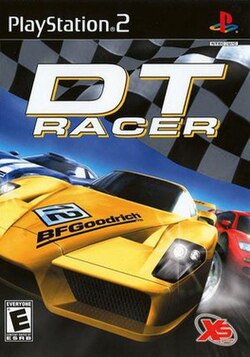

DT Racer arrives like a polite car crash. Developed by South Korea's Axis Entertainment and released on the PlayStation 2, it is a ported and lightly re-dressed version of Axis's 2003 game Axel Impact. The changes between the two are tasteful: menu redesign, a few sound effects, and a new soundtrack. The underlying bones remain reliably unchanged, like a familiar sitcom rerun where the jokes forgot to get off the couch. Critics were not impressed-IGN called it "pure crap, plain and simple"-yet the game still managed to sell 900,000 copies, which is either a triumph of marketing, a snapshot of mid-2000s retail chaos, or proof that somewhere, someone thought this was exactly what they wanted. This review will offer a calm, measured tour through DT Racer's virtues and failures, told in the tone of someone who has seen worse and is still slightly surprised.
DT Racer's gameplay is straightforward to the point of stubbornness. It places you behind the wheel, lets you choose a car, and then asks you to do the same things racers in every other game do: accelerate, brake, steer, and hope the rubber on your tires remembers what physics is. There are single-player and multiplayer modes-because the modern world insists that a racing game must at least admit other humans into the equation. The career and event structure is functional but unambitious. Races are predictable: finish, earn money or points, unlock another track or vehicle, repeat. If you're nostalgic for the uncomplicated joy of 'pick a race, race it, repeat' without the pressure of deep mechanics, there's comfort to be found. If you were hoping for nuanced handling models, inventive power-ups, or AI that learns your weaknesses and develops an unnerving vendetta, you will be disappointed. Handling in DT Racer sits between 'arcade fluff' and 'feigned realism.' Cars corner with enough slipperiness to keep most players from mastering a single consistent technique, but not so much that every turn turns into a catastrophe. The physics are functional rather than memorable-like a rental car that reliably gets you to the airport. AI opponents are equally pragmatic: they will follow their lines, occasionally challenge you, and rarely do anything surprising. The difficulty curve is uneven. Early races provide gentle nudges, then the game remembers it has levels and suddenly expects quasi-professional precision. There are also balance quirks; sometimes you will win by a hair, other times by the grace of a rubber-banding system that seems to interpret 'competition' as a gentle suggestion. Mechanics such as drafting, nitro boosts, or car customization exist in the margins, but none are deeply integrated. The upgrade tree is present but forgettable; cosmetic and performance tweaks exist primarily to give you the comforting illusion of progression. If you're playing DT Racer for the tactical depth, you will not find it. If, on the other hand, you want easy-to-pick-up racing with short, unobjectionable races and a friend to share a split-screen with, it accomplishes that with minimalist determination.
On the visual side, DT Racer looks like a PlayStation 2 title that understands its limitations and does its best with them. Cars are modeled well enough to be recognizable and colorful, though detail levels are modest and textures occasionally resemble mood boards for 'plastic.' Tracks are serviceable. They have distinct layouts and a few set-piece moments, but the environments lack personality; billboards, generic cityscapes, and indistinct crowds fill the background like placeholder actors in a low-budget film. Frame rate is mostly stable but not immune to stutter, especially when the race gets busy. Draw distance and pop-in are present and conspicuous, which is the console equivalent of someone whispering spoilers about the scenery. Lighting is competent; reflections and wet-road gloss are used sparingly. Sound design does what it must: engine noises, skids, and collision sounds are all there, though the audio mix occasionally elevates canned effects while nudging music into awkward prominence. The soundtrack, one of the elements changed from the original Axel Impact, aims for adrenaline but often lands in the 'background playlist at a used car dealership' category. In short, DT Racer's graphics are neither ugly nor beautiful. They are the visual equivalent of beige: unobjectionable, practical, and likely to blend in with your memory after a few weeks. For players who prioritize fidelity or artistic track design, this will feel thin. For those who care only that cars look like cars and the road looks like a road, DT Racer delivers.
DT Racer is a competent, forgettable racing game with a stubborn commitment to bland reliability. It doesn't attempt to innovate or annoy with bold ideas; instead, it provides a steady stream of ordinary races, ordinary tracks, and ordinary cars. Critics were blunt-the game received brutally low scores from outlets like IGN and Jeuxvideo-and calling it 'pure crap' is blunt but not imaginative. Yet it found commercial success, selling 900,000 copies, which is an intriguing contradiction: a game that provoked disdain from reviewers and yet convinced nearly a million people to buy it. Perhaps it hit the market at the right time, or perhaps someone mistook familiarity for quality. If you are collecting PS2 racers for completeness, have a nostalgic itch for simple arcade racing, or plan to use the game as a social vehicle for split-screen gaming with friends who don't care about nuanced handling, DT Racer will do the job without drama. If you want memorable tracks, intelligent AI, or a racing experience that pushes the genre forward, look elsewhere. Consider the score given here-3.2 out of 10-a diplomatic summary: functional in execution, barren in imagination, and oddly successful for reasons that inspire only mild bewilderment. DT Racer is a tidy reminder that not every game needs to make a statement; some simply exist, quietly, and manage to sell almost a million copies while doing so.
 Ridge Racer DS on DS
 Minit Fun Racer on Switch
 Roary the Racing Car on DS
 Team Sonic Racing on Switch
 Garfield Kart: Furious Racing on Switch
 Ben 10: Galactic Racing on PS3












 Another SquareThought Site