

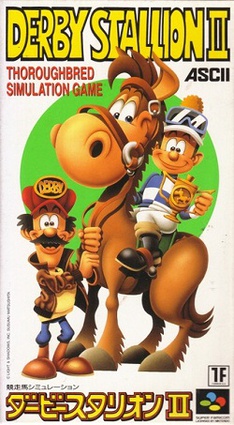

Derby Stallion 04 arrives as a mature entry in a franchise built less on horsehair and more on spreadsheets. The series' DNA - a hybrid of horse-racing and business/farm simulation - is well established by 2004, and this PlayStation 2 installment inherits a long tradition of granular, systems-first design. If you bought into the idea that managing bloodlines and training schedules could be as thrilling as last-second overtakes, DS04 is pitched directly at you. Its strengths are technical: sprawling databases, interlocking mechanics (breeding, training, trading, racing), and a simulation loop that rewards patient optimization. Its weaknesses are also technical, albeit of the human interface variety: a steep learning curve, menu density, and a presentation that occasionally treats you like a terminal operator rather than a jockey.
Derby Stallion games have always been about managing a racing stable like a small, temperamental corporation, and DS04 doubles down on that model. The primary objective remains the same: develop horses to achieve Group I ranking in the fictitious SRA calendar and keep climbing. The core systems are modular and tightly coupled - breeding influences genetic potential, training regimes modify performance curves over time, and race selection must be coordinated against an annual schedule of weekday and holiday events. From a technical design standpoint, DS04 is a simulation stack with distinct layers. At the bottom is the data model: each horse carries persistent stats, pedigree links (sire/dam), temperament markers, age, and race history. Above that sits the progression model: training programs, rest cycles, and race exposure change statistics via deterministic and probabilistic rules. The game rewards players who understand the cadence of these systems - when to push for a race, when to let stats converge through breeding, and how to manipulate the market via sales and trades. That sense of emergent complexity comes from deterministic mechanics augmented by randomness: breeding and race outcomes present probabilistic variance, but the underlying formulas appear stable enough that smart decisions compound across seasons. Interface-wise, DS04 is unapologetically menu-driven, which is important to the technical experience. You're not steering the horse in real time so much as selecting training blocks, mating pairs, and market strategies. That separation lets the simulation prioritize data fidelity over flashy inputs. Save architecture for the series historically supported several methods of data exchange (password codes, memory pack exchange, Satellaview and Randnet services, even phone-based transfers), which speaks to a design that treats horse data as portable, modular assets. For DS04 on PS2, that heritage translates into practical features like trade/sale mechanics and the ability to continue play after meeting the top goal - both helpful for long-form experimentation and competitive multiplayer by exchange. Multiplayer in Derby Stallion is an interesting technical challenge and one the series has historically approached creatively. Rather than simply offering synchronous races, the franchise provides mechanisms for trading horses, breeder agreements, and asynchronous competition through data exchange. That design is efficient for the era: it sidesteps the need for low-latency networking by treating horses and pedigrees as the primary shared objects. For players interested in metagame analysis, this means DS04 is less about reflexes and more about data portability and meta-economics - you can test breeding strategies, benchmark stallions across farms, and iterate on rosters received from friends. The systems fidelity also affects pacing. A single in-game year is dense with races and management decisions, and the SRA schedule forces you to think temporally. There's an implicit optimization problem every season: which horses to enter, how to allocate training load, and when to liquidate assets. That problem is the game's engine - and it's satisfying because it's solvable through disciplined analysis rather than luck alone. Technical friction points exist. The series' evolution toward more control has made the interface more feature-rich but also more intimidating to newcomers. If the game's internal models are deep, they are not always transparent, and you'll spend a nontrivial amount of time reverse-engineering the outcomes of inheritable traits and training curves. For players who enjoy systems analysis, that's a feature; for players who want immediate feedback loops, it can be a barrier.
Derby Stallion's priorities are clear: data over spectacle. Historically the series has favored functional visuals - charts, menus, and concise race reports - and while the PS2 has 3D horsepower to spare, the design sensibility remains conservative. The technical trade-off here is deliberate: processing and memory budgets are allocated to tracking long-lived simulation state, pedigree databases, and AI opponents rather than fancy real-time rendering. Expect economical race visuals or summary cutscenes that conserve CPU/GPU cycles for the simulation stack. This approach has a practical upside. By keeping the rendering pipeline lightweight, DS04 reduces the risk of frame-rate or state-sync issues during complex calculations like breeding outcome resolution or multi-horse training simulations. For local performance instrumentation, the game's UI likely prioritizes update determinism and quick list rendering over shader effects - which is exactly what a player managing dozens of horses wants: clarity and speed when paging through stats. Aesthetically, the presentation can feel dated compared to action-heavy PS2 titles of the era, but when judged as a technical product the choices make sense. Readability and ergonomics of informational screens are the real graphics challenge for this type of game, and Derby Stallion trains its pixels where it counts: conveying pedigree trees, stat tables, and race calendars without ambiguity. If you're expecting photorealistic gallops, you'll be disappointed; if you want a UI that surfaces the actionable data fast, DS04 has your back.
Derby Stallion 04 is a technical simulation that wears its priorities on its sleeve. It is an engineer's take on horse racing: complex underlying models, portable asset design for trading and multiplayer, and a user interface that leans toward dense but precise information delivery. This makes DS04 a rewarding sandbox for players who enjoy optimization problems, iterative testing, and long-form strategy. It also means the game can be punishing for players who prefer immediate, visceral thrills or hand-holding tutorials. In terms of score, I give DS04 a 7.5/10. It earns high marks for systems depth, faithful continuation of the series' data-first philosophy, and clever multiplayer-by-data-exchange design. It drops points for accessibility and visual ambition - not because it lacks technical care, but because its polish is applied to simulation fidelity more than onboarding or spectacle. If you like tinkering with statistics, balancing breeding equations, and running a digital stable like a micro-conglomerate, Derby Stallion 04 on PS2 is a highly competent toolset. If you want instant gratification and chrome, you'll be left tending the stables while other games burn rubber on the graphical front. Either way, it's a brilliant piece of simulation engineering - in other words, a nerdery-approved barnstormer.
 Derby Stallion DS on DS
 Derby Stallion '99 on PlayStation
 Roary the Racing Car on DS
 Team Sonic Racing on Switch
 Garfield Kart: Furious Racing on Switch












 Another SquareThought Site