

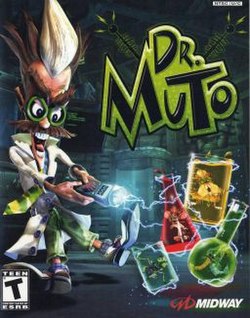

In an era when mascots were either mugging for cereal commercials or trying to outdo each other with acrobatic jumps, Dr. Muto arrives as a slightly off-kilter specimen: part mad scientist, part collectathon protagonist, and entirely determined to rebuild a planet he accidentally vaporized. Launched on the PlayStation 2 in November 2002 by Midway Games West, Dr. Muto is equal parts ambition and rough edges. It promises a cartoonish science-fantasy romp in which you wield a device called the Splizz Gun to mutate into other forms, loot the local wildlife for DNA, and recover the scattered components of the Genitor 9000. The premise is gleefully absurd and, for stretches, genuinely entertaining. The execution, however, is the kind of thing that would have made a 1990s print reviewer put down his coffee, sigh, and underline the word "potential" in bold.
Dr. Muto is built around a core mechanical conceit: morphology as progression. From the start you possess the Splizz Gun, a do-everything contraption that extracts DNA from enemies, electrocutes fools who get too close, fires lasers when a blunt instrument is required, and - crucially - allows Muto to assume five different creature forms. These morphs are not cosmetic; they're the key to advancing. You unlock them by collecting isotopes and animal DNA scavenged across the game's planets. Said planets are serviceable playgrounds for platforming, with the standard mixture of jump puzzles, environmental hazards, and an insistence on backtracking to use newly acquired forms. If you come to Dr. Muto expecting a lean linear gauntlet, you will be mildly surprised. The game leans hard into classic collectathon territory: there are 4,250 isotopes and 86 bits of terra to locate. This is not a game for players allergic to repetitive scavenging. The designers even included a rather Dickensian quirk - due to design oversights some isotopes are almost impossible to retrieve without the most extreme patience or pixel-perfect actions - but mercifully only 80% of isotopes are required to complete the game. That threshold feels like a confession: the developers know the collection likely outstays its welcome, so they let you limp past the most egregious chores and still finish the story. The Splizz Gun's DNA-extraction funhouse provides the best moments. Morphs come with specialized abilities and small mechanical wrinkles that are satisfying to discover. Coupled with seven different gadgets to unlock, the game encourages experimentation. There is genuine pleasure in learning the peculiar physics of a new form and then applying it to a previously impassable nook. Combat is serviceable: the gun's electric lash and lasers are fine for basic pests, while enemy design tends to be more goofy than threatening. Platforming controls, however, are not uniformly tight. There are instances where camera and collision bells ring in ways that remind the player of console platformers from a prior generation. These rough edges undermine some of the more intricate traversal puzzles. Narratively, the plot is deliciously retro. Dr. Muto builds a free-energy machine for his world of Midway, the villainous Professor Burnital sabotages it, Midway goes boom, and our titular scientist - drained but upright - decides to piece the planet back together with the Genitor 9000. It's the kind of madcap motive that keeps the tone buoyant and provides an in-game excuse for the relentless resource collection. The balance between humor and mechanical design is uneven but often tilts in the game's favor thanks to sly writing and a protagonist who never quite takes himself too seriously. In short, play it for the morphing and the extraction-based puzzles; be ready to tolerate a glut of collectibles and the occasional calibration issue in platforming.
Visually, Dr. Muto presents a cartoon-flavored palate that leans toward the whimsical rather than the photoreal. Textures and model detail are serviceable for a 2002 release; the engine delivers colorful worlds and character models with a comedic, exaggerated style which suits the mad science theme. Critics at the time noted the game's personality and humor as assets, and the presentation aids those strengths. On the downside, the camera can be stubborn, and animation blends sometimes underwhelm when morphs snap between states. The levels show a competent but not cutting-edge tech suite - think attractive Saturday-morning-toon aesthetics applied to a mid-generation console platformer. If you own a PS2 and remember how forgivingly you accepted stylized graphics back in the day, Dr. Muto will feel familiar and often charming. If you sit with modern expectations of polish, certain animation and camera issues will stand out.
Dr. Muto is a game that sits comfortably in the category of "ambitious, flawed, but worthwhile." It carries the DNA of a 1990s platformer in its love of collectibles, its reliance on transformation-based puzzles, and its sometimes sanguine approach to difficulty spikes. The Splizz Gun and the five morphs are genuinely fun to tinker with, and the conceit of rebuilding a destroyed planet with a macguffin called the Genitor 9000 is delightfully offbeat. Critically, the reception was mixed - aggregators placed the PS2 release in the high 60s to low 70s percentage range and a high-profile outlet like IGN gave it an 8.5, praising its sly humor and gameplay elements - and that split-slate response is fair. If you prize originality of conceit and enjoy methodical exploration sprinkled with mischievous humor, you will find much to like. If you require tight platforming controls and a streamlined progression with minimal collecting, frustration may outpace fun. Also of note to aficionados of game history: Dr. Muto was the last title designed by Ed Logg, which lends it a small piece of arcade-era lineage. Give it a whirl for the mutations and the mad scientist charm, but be prepared to forgive the occasional rough jump and the compulsion to chase thousands of tiny gleaming isotopes.
 Roblox on PS4
 Toki Tori on Switch
 PlayStation Home on PS3












 Another SquareThought Site