

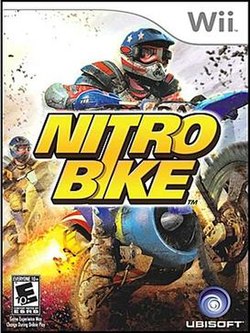

Nitrobike arrives with a pedigree stamp you can smell from across the garage: Left Field Productions, the studio behind Excitebike 64 and MTX Mototrax, pitched a motocross racer to Ubisoft promising arcade pace, trick-driven boosts, and Wii-specific motion steering. The result is one of those oddball Wii-era titles that wears enthusiasm like a leather jacket but forgets sunscreen - it looks like it should be fun from across the room, and then you ride it into a cactus. This review is technical-first and mercilessly nosy; if you want feelings, there are other reviewers who will happily woo you with metaphors about wind in your hair. If you care how the controls map to the physics model, how online is architected for a Nintendo console designed around friend codes, and whether the game's presentation actually supports its performance claims, read on.
Controls and input mapping are the spine of any racing game, and Nitrobike frames its ambitions around Nintendo's motion interface. The primary control scheme uses the Wii Remote held on its side with yaw input - you literally twist the remote to steer left or right. That design choice is a clean one on paper: one axis of rotation for steering, face buttons for throttle/brake and tricks, and motion gestures to add a layer of physicality. In practice, that input model exposes the trade-offs of the Wii Remote's sensor suite circa 2007. The remote's accelerometer and yaw tracking are serviceable for gross steering changes and for translating big player movement into game input, but they lack the fine-grained analog fidelity of a thumbstick. The result is steering that emphasizes snap-turn inputs over subtle line correction. When the game pairs that steering behavior with its arcade-leaning physics, you end up with a control feel that rewards confident, aggressive corrections but punishes precision play. Nitrobike's physics are explicitly positioned as arcade-like rather than simulative. Left Field's CEO promised a speed roughly five times that of Excitebike 64 and larger air time; the game keeps that promise in spirit. Tracks are designed around momentum, big jumps, and trick opportunities. The interplay between aerial rotation/tricks and boost is the game's central systems interaction: performing tricks mid-air lengthens your boost window, which in turn increases average lap speed. That's a neat design loop because it ties player skill (execution of tricks) to the core performance metric (lap time). It's also where the implementation choices matter. Arcade physics are typically simpler to simulate and cheaper to run, but they demand consistent, deterministic collision handling and predictable mid-air dampening so players can reliably land tricks and chain boosts. Reviews suggest Nitrobike falls short of that reliability: critics described the experience as "clumsy" and "slow" in places, which implies problems with animation transitions, recovery windows after crashes, or perhaps input buffering for trick execution. From a systems standpoint, that often maps to too-coarse state machines for rider animation, insufficient interpolation of physics states between network ticks (for multiplayer), or aggressive camera corrections that fight player control. Multiplayer and network architecture are particularly interesting on the Wii. Nitrobike supports up to six-player online races and uses the Wii's friend code system for matchmaking and friend play. Architecturally, a six-player session at the time would have to be lean: the Wii's networking stack and the typical consumer broadband circa 2008 were not built for high-bandwidth, low-latency data streams. A motocross racer can get away with lower update rates if you have good client-side prediction and rubber-banding that doesn't break immersion. Nitrobike's approach - offering random worldwide matches divided by NTSC/PAL regions and friend-code-based matches - is pragmatic. The Wiki notes that it tracks stats like races played and first-place finishes across friends, which implies a server-side persistence layer for player metadata. The implementation trade-off here is typical of the era: keep game-state messages small (position, velocity vector, player inputs) and reconstruct physics locally, but this requires very consistent physics determinism. If the local physics diverge, you'll see teleporting riders or corrective snaps. The critical reception hints that presentation and pacing undermined the online experience, and that the single-player feel didn't carry over to multiplayer. Game modes and ancillary content are modest but notable. There's an unlockable "Crash Bowling" minigame that reviewers singled out: it isn't revolutionary, but it's the kind of small diversion that can mask the tedium of a poorly paced main loop. From a design perspective, including a contained physics sandbox (bowling pins, ragdoll behavior) is smart because it leverages the game's existing physics engine to deliver variety without significant additional asset or systems cost. However, the presence of such a minigame also tacitly admits that the core race loop may lack depth. Difficulty tuning and AI are areas where Nitrobike apparently struggled. When reviewers describe a title as "slow" or "without soul," they are usually pointing to pacing problems: poorly tuned AI that either follows obvious rubber-banding scripts or is too passive to encourage close racing; sparse trackside feedback; and reward systems that don't reinforce mastery. The trick-to-boost loop is a strong mechanical foundation, but if the game fails to consistently reward it due to unreliable physics or input recognition, the loop collapses into a shallow arcade ride. In summary, Nitrobike's gameplay architecture is conceptually sound: motion steering, trick-linked boosts, fast arcade speed, and online six-player support. The execution - based on contemporary reviews - suggests systemic implementation shortcomings: middling control fidelity due to motion input limitations, inconsistent physics and animation transitions, and a presentation layer that fails to make the technical systems feel satisfying.
Nitrobike shipped first on the Wii and later hit PlayStation 2, two platforms with comparable peak performance ceilings but different control and display expectations. Left Field's background with Excitebike 64 and MTX Mototrax suggests an engine tuned for textured geometry, relatively flat shading, and an emphasis on frame-rate and readable track geometry over shader trickery. The Wii's GPU and PS2's GS are both capable of producing colorful, stylized motocross environments, but they require careful LOD (level of detail) and draw-call management to sustain frame rates during multi-rider races and large jump scenes. The visual presentation, as reported by critics, lacked "soul," which in graphically analytical terms points to a thin audiovisual feedback loop: bland lighting, low-detail trackside assets, and uninformative particle systems. High-impact moments in racing games (a big air time, a perfect landing, a nitro-fueled pass) rely heavily on immediate visual and audio reinforcement. If dust clouds are cheap sprite-based puffs, rider model animations are rigid, and camera shakes are either absent or overzealous, the player's sense of speed and achievement suffers. The Wii version's screenshot thumbnails show readable track geometry and distinct rider silhouettes, which is important for multiplayer readability, but that is the minimum bar. Where Nitrobike might have sacrificed depth is in texturing resolution, draw distance tuning, and the fidelity of rider-bike interaction animations - all of which make or break perception of quality on lower-powered hardware. From a performance standpoint, maintaining stable frame-rates during six-player races and big jumps is non-trivial on the Wii. The engine must balance physics update frequency, animation blending, and network packet rates. Judging by contemporary reviews calling the game "slow" or "clumsy," it's plausible that either frame pacing suffered in hectic scenes or the game's timing (animation frames vs. physics steps) produced a disconnected feeling between input and on-screen outcome. On consoles like PS2 and Wii, that kind of desynchronization is often perceived more harshly than a lower polygon count, because it directly impacts playability. Finally, the UI and HUD design play a role in how graphics convey information. A minimalist HUD that fails to clearly telegraph boost availability, trick timing windows, or incoming player approach can render technically sound mechanics useless in practice. Critics uncomfortable with NitroBike's presentation likely saw missed opportunities in the informational layering that a well-executed HUD provides.
Nitrobike is an instructive case study in how good ideas bump their heads on execution. The mechanical skeleton is strong: a trick-enabled boost loop, motion-steered controls, and online six-player racing all make theoretical sense for a late-Wii motocross title from a studio with relevant experience. Where the game loses traction is in the implementation details that actually make those systems satisfying day-to-day: input fidelity, consistent physics and animation integration, audiovisual feedback, and pacing. Critics were blunt, and the Metacritic aggregation reflects that bluntness with a 49/100. If you're a completist interested in the curious cross-section of Wii motion controls and motocross arcade racing, Nitrobike is worth a look for its systems-level ambitions and its small, functional online suite. If you care whether those systems are polished, responsive, and expressive - the qualities that turn a racer into an addictive one - then the game's flaws will be immediately noticeable. From a technical reviewer's perspective, Nitrobike underscores a lesson that still matters: performance and feel trump flashy design promises. You can design boosts and tricks all you want, but unless the control input maps cleanly to a deterministic physics model and the presentation gives hard feedback when you succeed, a fast bike just feels like an angry paperweight. Score-wise, the Metacritic conversion gives it approximately 4.9/10, and that feels about right for a title where the ambitions are visible but the execution leaves too many loose bolts on the track.
 Team Sonic Racing on Switch
 Garfield Kart: Furious Racing on Switch
 Ben 10: Galactic Racing on PS3












 Another SquareThought Site