



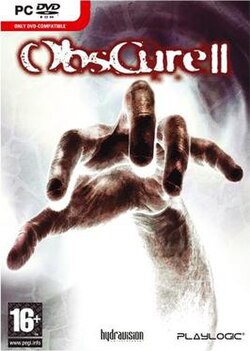
ObsCure is Hydravision Entertainment's teenage-goth riff on survival horror that shipped to PlayStation 2 (and PC/Xbox) in late 2004 and early 2005. Built on RenderWare and scored by Olivier Deriviere, the game pairs high-school melodrama with photosensitive monsters and a surprisingly system-driven lighting gimmick: enemies are weakened by a flashlight and outright killed by sunlight. On paper, that's a clever bit of systems design - light becomes both a mechanic and a storytelling device - but under the hood sits a mid-2000s console-era architecture that both enables and constrains the idea. This review focuses on the technical and mechanical elements that define the PS2 version, from engine choices and co-op implementation to how well the lighting-based design actually plays on Sony's little-white-box hardware.
ObsCure's spine is squad-based design dressed in high-school clichés. You never roam alone for narrative reasons: the game gives you a roster of five students and the ability to control one while the others are either AI-driven companions or a second human player in the two-player cooperative mode. That co-op is local, campaign-based cooperation rather than an online lobby system, and it's arguably the game's most robust design decision: two humans can split duties, coordinate flashlight-and-weapon combos, and exploit character specialties. The character specialization system itself is interesting from a systems-design angle. Each student has a unique mechanical advantage - Josh can detect unfinished tasks in an area (a kind of proximity quest hint system), Stan gets a lockpick/hacker edge that shortens time-to-access, Shannon is effectively a support class with better healing returns, and Ashley has weapon proficiency. The key design note is that these special abilities are optional; the game designers intentionally made them shortcuts rather than gating mechanics. That decision has pros and cons. It reduces the risk of soft-locks from losing a specific teammate, and it lets players experiment without being railroaded, but it also deflates the tactical importance of party composition. If the game had leaned harder into class-dependent puzzles or combat roles the cooperative mode would have had more emergent depth. From an interaction standpoint, ObsCure supports item combination - the oft-cited example being taping a flashlight to a firearm. That mechanic is not merely cosmetic: it fuses two item systems (light and damage) and demonstrates an internal object model that treats items as modular components. For a mid-2000s title on RenderWare this is fairly sophisticated: it requires stateful item interactions, inventory logic that supports combined properties, and animation/UX to reflect the changed item. The enemy design ties directly to this: monsters are photosensitive, which means the AI includes a light-based behavior tree or at least a checkbox in their stimulus-response system for 'is_in_light'. When the flashlight is shone, monsters perform a weakened behavior; when exposed to sunlight (an environmental trigger) they die. Implementing that in levels implies the engine supports environmental state checks per enemy entity and that level scripting can toggle 'lethal to monster' flags under certain world conditions. This is neat in principle but shows the engine's limits in execution, which I'll get to in the graphics section. The companion AI is serviceable but unspectacular. The teammates will follow, attempt to engage, and sometimes solve required tasks; because the special abilities aren't mandatory, the AI rarely needs to behave like a full partner. When players die, the game lets you continue with remaining characters - a quality-of-life decision that reduces frustration but also lowers stakes. Combat is tuned for atmosphere more than twitch precision: you engage hordes that react to light and basic line-of-sight, and you have to manage limited resources. The PS2 control scheme is straightforward: movement, aim, interact and context-sensitive buttons, and the two-player mode maps a second controller into the same interaction model. The result is a campaign that hands you a handful of tightly-focused systems (light mechanics, item combination, and character traits) but doesn't fully exploit them into deeper, emergent gameplay loops.
RenderWare was a pragmatic engine choice for a studio like Hydravision targeting PS2, Xbox and PC. It offered cross-platform portability and an established toolchain, but the PS2 build shows both the engine's strengths and its era's constraints. Character models are serviceable for their time - faces passable, body rigs adequate for the animation requirements - but texture resolution and shader complexity are clearly budget-conscious. The flashlight mechanic is the game's graphical MVP: it's more than a visual gimmick because it feeds directly into enemy AI. The game implements localized illumination that affects enemy states, which on PS2 implies either a dynamic light probe system or a series of trigger volumes tied to light cones. Full per-pixel dynamic lighting with soft shadows is not something the PS2 could sustain across the game's levels, so Hydravision selectively applied dynamic lights where gameplay required them and relied on baked lighting for architectural ambience. That's a sensible trade-off: dynamic light for gameplay-critical moments, baked light for mood. The interaction between light and monsters suggests a collision of rendering and gameplay systems. For the flashlight to 'weaken' a monster the engine must register when the player's light cone intersects the monster's collision or sensory volume. Doing this efficiently on PS2 requires limiting checks to nearby enemies or using a lightweight flagging system to avoid frame hits. Occasional pop-in and lower LOD complexity in geometry betray those optimizations, but they're obvious only if you're looking for them. Animations during enemy hits and death sequences are chunked and often reused, a common memory-saving technique. Audio design is more generous; the voice cast (Sam Riegel, Liam O'Brien, Tara Platt, Stephanie Sheh and Scott Haze) provides fully-voiced lines that help sell the characters without taxing the engine in the way additional animation would. Performance-wise the PS2 experience sits in the 'mostly stable' zone. RenderWare's cross-compilation pipeline means assets were tailored for platform limits, and the PS2 build shows conservative polygon budgets and texture streaming. Frames hold up in most indoor scenes, but dense set-pieces with multiple dynamic lights and particle effects pull the framerate down occasionally. These aren't game-breaking, but they reflect the juggling act required to make the light-mechanic work without exceeding the PS2's memory/processing envelope. When you compare reception across platforms, the aggregated Metacritic scores - PS2 around mid-60s, Xbox and PC similar - mirror that technical parity: the idea was portable, execution varied by platform just enough to influence reviewers' impressions.
ObsCure is a useful case study in mid-2000s design constraints: a conceptually tight mechanic (photosensitivity + flashlight) married to the realities of a limited console architecture and a studio with finite resources. The game is not a technical triumph in the sense of pushing hardware to its limits, but it is clever in how it maps gameplay onto technical constraints. Item combination, light-triggered AI states, and a local two-player cooperative campaign are all systems that require careful engineering, and Hydravision implemented them with measurable competence on RenderWare. If the critique is harsh, it's because the studio half-committed in places where a deeper commitment would have paid dividends. Character abilities that are mostly optional reduce tactical richness; visual compromises dilute the emotional punch of horror set-pieces; and AI companions are reliable but not creative partners. Still, ObsCure gets points for systems-minded design and for delivering a playable, often enjoyable horror romp on PS2 hardware without breaking under the weight of its ideas. For players who enjoy survival horror as a blend of atmosphere and mechanical puzzles - and who have fondness for era-appropriate technical trade-offs - ObsCure is worth playing, especially in local co-op. For those chasing bleeding-edge graphics or complex AI companions, this one will feel like a promising blueprint rather than a fully-realized mansion of nightmares. Final verdict: a technically competent, occasionally inventive survival horror with a clear mechanical hook that is hamstrung by conservative execution. Recommended for curious horror fans and systems-minded players who want to see how light can be coded into fear. Score: 6.5/10.
 Jeopardy! on Switch
 Knowledge is Power on PS4
 Crow Country on PS4
 Tormented Souls on PS5
 The Forest on PS4













 Another SquareThought Site