

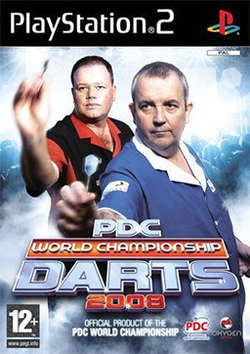

PDC World Championship Darts 2008 arrives on PS2 like a low-key stage play where every protagonist wears slightly different shirts and has an emotional relationship with a tungsten dart. On paper it's a straightforward sports sim: eighties pub-to-stadium authenticity, a roster of 16 real-life professionals, a career mode and motion-captured animations. In practice it is an earnest attempt to anthropomorphize the PDC circuit - translating reputations, temperaments and nicknames into gameplay quirks. This review takes the odd approach of treating those pros as characters in a soap opera, because if you are going to spend hours watching someone called 'The Power' stare down a dartboard, you deserve a little narrative context. Expect talk of controls, career arcs and why a crowd's roar can make 'The Rocket' feel human.
PDC 2008 plays darts like a three-act play. Act one is the aim: you pick your target with the analog stick (PS2), the classic pointing mechanic transcribed into tiny joystick gestures. Act two is power: you decide how much shove to give the dart - either by holding a key/analog pull or timing a meter. Act three is the release: a quick flick of the right stick on PS2, where left/right deviations punish sloppy timing with a rogue treble. The game mirrors real darts rules faithfully: 501, legs, sets, and the sacred double-out finish. World Grand Prix insists you begin on a double, like a stubborn director ordering a dramatic opening line. The control scheme is satisfyingly tactile on PS2. It asks you to become intimate with the right stick's twitch, and the learning curve rewards precision. Amateur mode is a training montage, with visible power meters and forgiving visuals; Professional strips the training wheels away and forces you to read the player's arm motion; Master mode is pure torment for perfectionists. The physics are more than cosmetic - under- and over-stacking, flights falling out and bounce-outs are simulated, turning a single match into a sequence of micro-dramas. Those tiny events are where player arcs evolve: sometimes a veteran like Phil Taylor, dubbed 'The Power', produces a crushing checkout; other times a crowd favorite fluffs a double and his in-game AI shows the subtle wobble of 'belief' meters. Career mode is the emotional backbone. You create a character and guide them through the PDC calendar: seven major tournaments make up the season, and the game tries to make your rise - or fall - feel consequential. The AI uses real-life averages and personalized stats (stamina, belief, pressure, complacency and accuracy) to shape matches into little tragedies or triumphs. That means a young custom pro who starts with shaky legs can, through training and luck, develop into a consistent finisher. The in-game pros behave like archetypal characters. Phil Taylor is the immutable mentor - high stamina, deadly accuracy, rarely rattled. Raymond van Barneveld enters as last season's champion, a man carrying a trophy-sized emotional baggage that makes him both inspiring and a target. John Part is the stubborn veteran who occasionally flickers between clutch hero and end-of-night melancholy. Dennis Priestley comes across as the grizzled elder, quietly competent, while Adrian Lewis feels like an apprentice with flashes of danger. Modes beyond career add layers to the narrative. Exhibition lets you stage any duel you fancy, and custom tournaments mean you can script your own Cinderella run or revenge arc. Party Games like Around The Clock and Killer exist like offbeat side-stories - silly, low-stakes episodes you play when you don't want to emotionally invest in a season. The character editor is surprisingly robust for a darts game: male and female models, a decent palette of hairstyles, dart barrel weights and flight designs. Customization lets you craft a protagonist with a look and preferred checkout that matches the story you want: the underdog, the showman, or the methodical grinder. AI and motion-captured animations credibly reflect personalities. Players have stylized walk-ons and unique throwing styles recorded via motion capture, so when 'Hawaii 501' (Wayne Mardle) struts up, the gait and muscle memory are recognizably his. The net result is that matches feel like rounds in a serialized drama - each opponent has a tempo and a temperament, and between-throw chatter and crowd reactions punctuate the tension. On PS2 the balance between simulation and arcade is reasonable: it never becomes a physics nutter's wet dream, but neither is it purely casual flinging. It's a middle-class narrative where everybody wears sensible shoes and occasionally hits a 180.
Graphically the game does the job without pretension. Player models are decent for the era, with motion capture elevating throw animations and walk-ons from clunky to human. Facial fidelity isn't top-shelf - nobody will mistake the likenesses for photographic doubles - but body language and stance are convincingly individualized. The arenas are modeled on real tournament sets and succeed in providing context: the lights, sponsor boards and the mock-TV stage make you feel like you're in a major event rather than someone's damp living room. Crowd audio and ambience are the game's secret sauce. Commentary is functional, crowd noise dynamic and the atmosphere of a big leg builds slowly and then explodes on a checkout. The sound design makes the player arcs more affecting: when a home favorite misses, the collective gasp lands like a plot twist; when a veteran nails a double under pressure, the applause reads like a cathartic finale. Visual enhancements such as improved player textures and realistic sets help, but it's the audio and animation pairing that truly sells the illusion that these stone-faced men and women are characters with arcs, not just stat blocks.
PDC World Championship Darts 2008 on PS2 is an oddly compelling little drama disguised as a sports sim. It excels where it leans into personalities: motion-captured throws, varied AI driven by real-life averages, and a career mode that tracks a player's rise and fall with more flair than you'd expect. The controls reward practice and the inclusion of real darts physics turns small mechanical events into narrative turning points. Weaknesses are mostly cosmetic and breadth-related: player likenesses aren't perfect, and the roster of 16 pros, while respectable, limits the depth of the PDC universe you can explore. If you want a party-friendly darts game, this does the job; if you want a deep, endlessly replayable simulation with hundreds of pros, you'll find this a more modest offering. For fans of the sport, and for anyone who enjoys the idea of turning a sport match into serialized character development, PDC 2008 is worth a rental or a cheap buy. Its best trick is making you care about a double-out like it's a season finale. Score: 6/10 - solid, occasionally stirring, and charmingly underdog-ish.
 Project Awakening on PS4
 Harvest Moon: One World on Switch
 Accolade Sports Collection on Xbox Series X/S
 Deca Sports DS on DS
 Alan Hansen's Sports Challenge on PS2
 EA Sports MMA on PS3













 Another SquareThought Site