

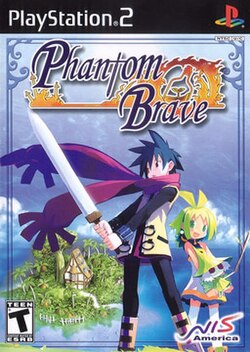

Phantom Brave on PS2 is the kind of strategy game that sneaks up on you like a phantom shoe horned into your life: deceptively cute sprites and a soft, melancholic story mask a surprisingly deep, sometimes brutal, tactical engine. If Disgaea taught you to love numbers, Phantom Brave will teach you to love moving numbers off cliffs. The core conceit - Marona, a plucky 13-year-old who can 'confine' phantoms to objects to summon them into battle - is gimmicky in the best possible way. It produces a combat system that rewards spatial imagination, long-term planning, and a willingness to think like a very petty ghost-obsessed logistics manager.
If you want the short version: the battlefield is a sandbox, and the rules are 'physics, consequences, repeat.' Phantom Brave ditches a standard grid for a gridless 'dm' movement system, which means positioning is analog rather than tile-based. That alone tightens the skill ceiling: you need spatial awareness (where can I move, how far will I slide, who will I accidentally shove?), and a feel for momentum because terrain has traction and pliability. On slippery floors you can 'ice skate' by taking tiny steps and letting sliding carry you-beautiful when it works, infuriating when you slide past the enemy you wanted to dump O.B. (out-of-bounds). The confine mechanic is the game's strategic spine and the main source of its challenge. You don't recruit units in the usual sense; Marona binds (confines) phantoms to objects on the battlefield-trees, rocks, flowers, random scenery-and those objects give stat modifiers. Different classes like different bindings: a soldier likes a rock, a witch loves flowers. Your choices matter on three levels: which phantom to confine, which object to confine them to, and when to let them stay or force them back. Each class has a different confine duration (witches might last three turns, soldiers eight), and varying confine lengths demand tactical timing. Want to O.B. a group of cannon fodder so your remaining enemies level up? Confine a bomber to a short-duration item and watch the chaos unfold. Want sustained frontline pressure? Confine a soldier to something sturdy and plan around his long stay. Throwing and holding mechanics are another layer that turns maps into Rube Goldberg devices. Units can pick up objects and people and toss them. You can throw a phantom into the middle of a mob to create devastating combos, or fling enemies off the stage to remove them entirely (but be warned: throwing the last enemy off the map is impossible, and throwing an enemy O.B. raises the level of those left standing). This creates a distinct risk-versus-reward calculus: remove many weak enemies by O.B.-ing them and face fewer, stronger foes, or grind them down slowly and keep experience predictable. Mastering the angle, distance, and weight of throws is part physics lab, part slapstick. Resource management here is mostly about mana and fusion. Mana accumulates when you kill enemies and becomes the currency for improving characters, fusing items, raising weapon stats, and transferring skills. Fusion lets you consume characters or items to raise another character's level cap; it's brutally satisfying but requires long-term vision. Early on the choices seem small; later, when you want to hit absurd level caps (yes, characters can go to 9999), the game rewards methodical planning and a willingness to invest time into building a handful of absurdly powerful units. If patience and spreadsheet-adjacent thinking make you twitch, you'll either love or hate this. Random dungeons and titles add meta-strategy. You can create dungeons with the Dungeon Monk - some floors have special layouts or titles that buff every enemy in the dungeon. Titles can be applied to weapons and characters, shifting stats and roles. Popular tricks include giving a dungeon the 'failure' title to flood you with high-level enemies you can farm for mana and loot. This is where Phantom Brave transitions from tactical battles to optimization: reading the dungeon's visible characteristics, choosing when to retreat (returning costs money and is depth-dependent), and planning multiple runs to grind necessary fusion materials separate the casual from the obsessive. Phantom Isle - the game's hub - is a mini-management game. You summon phantoms for a fee (they always join at level 1), talk to them, and use specialists: Healers, Blacksmiths, Witches (who reorder spells/skills), Merchants, and Fusionists. Learning what each class does on-island and using those utilities effectively is a skill in itself; a well-tuned island workflow speeds up the grind and cuts down on needless repetition. The difficulty curve leans into 'hardcore' territory. Post-game maps are intentionally punishing and often require heavy fusion and weapon upgrades. Critics called the game 'for dedicated strategists' for a reason: success requires spatial intuition, a comfort with long-term resource allocation, mastery of throw/hold physics, and patience for repetitive but rewarding grinding. If you bring those skills - plus a gleeful willingness to throw friends into pits - Phantom Brave becomes an absurdly deep playground; if you don't, it will feel fiddly and occasionally punitive.
Visually Phantom Brave wears its pedigree on its sleeve. Takehito Harada's character art gives the cast personality without trying to impress anyone with photorealism, and the PS2-era visuals are charmingly sprite-forward: cutscenes and character portraits have personality, while battlefield sprites move with a satisfying, slightly toy-like quality. The isometric battle boards are plain but functional, intentionally designed to prioritize clarity for the game's physics-heavy encounters. On PS2 the game looks dated compared to modern releases, but the style ages well because it communicates information cleanly. You'll never be distracted by an unreadable interface - and you need that, because the tactical layer expects you to pay attention to every slippery inch of terrain.
Phantom Brave on PS2 is a strategy game for players who derive joy from making clever use of odd rulesets. It asks you to become a planner, a thrower, and a patient grinder. Skills that pay off are spatial reasoning, timing, resource optimization, and a tolerance for procedural tedium when it's rewarding. The confine mechanic and the gridless movement give you a tactical toolkit that's refreshing and occasionally savage. If you like systems that let you turn a battlefield into a series of chain reactions, and you don't mind spending hours fusing weapons and rearranging skill trees, Phantom Brave will feel like finding the perfect weird hobby. If you want a bite-sized, hand-holdy tactics romp, this isn't that - but for anyone who wants to master a quirky, well-crafted strategic beast, it's worth the summon.
 Brave Prove on PlayStation
 Saint Seiya: Brave Soldiers on PS3
 Coloball 2002 on PS2
 Press Your Luck on PS3
 Game Dev Story on PS4
 Mom Hid My Game! on Switch
 Disgaea 5 Complete on PS4
 Disgaea 1 Complete on PS4
 Disgaea 6: Defiance of Destiny on PS5
 Little Princess: Marl Ōkoku no Ningyō Hime 2 on PlayStation
 Disgaea 4 Complete+ on PS4












 Another SquareThought Site