

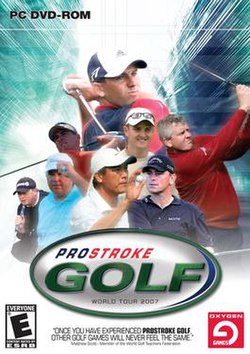

ProStroke Golf: World Tour 2007 arrived on PS2 at a time when golf sims were trying to be either zen-like sporting meditations or adrenaline-fueled swings of hyper-precision. Gusto Games chose the sober path: a fairly methodical simulator that offered a variety of modes, 16 fantasy courses and eight licensed pros to swing at glory. The game comes with commentary by Ian Baker Finch, Sam Torrance and Alan Green, which attempts to give the proceedings a sense of gravitas. Critics responded with a collective shrug - the PlayStation 2 version averages around the low 60s on aggregate review sites. This review courageously pretends the game has a narrative spine and then proceeds to perform a deep-dive into the characters, their arcs and why the so-called plot left some reviewers wondering if they accidentally loaded a sports menu instead of a screenplay.
At heart ProStroke Golf is a cozy toolbox of modes: training, quick round, tournament play and career mode. The mechanical heart is familiar: aim, select club, set your power and timing, then try not to shank the ball into an unkind pixelated bunker. Multiplayer supports up to four players on one console, which is where the game becomes less of a simulator and more of a social event - the sort of thing that turns you from a solitary simulator devotee into a buddy who will high-five your roommate for making par. Because the source material gives us merely eight licensed professionals and a set of fantasy courses, I decided to treat the competitors as full-blooded characters. Think of the eight pros as a cast of archetypes who inhabit the career mode like NPCs in search of emotional beats. There's The Veteran - the player you expect to beat you with patience and a mildly patronizing wink. The Rising Star is inexplicably young, annoyingly talented, and will be the reason your ego files for unemployment. The Grinder shows up every tournament, sand in their shoes and humility in their swing. These archetypes are not written into lengthy cutscenes; instead they exist in the subtler, older-school way video games sometimes do: through the ebb and tilt of leaderboard positions and the commentary that narrates them. The commentators function as a kind of Greek chorus. Ian Baker Finch offers comforting, instructional observations; Sam Torrance chimes in with a twinkle of inside-the-ropes history; Alan Green supplies the brusque, 'you-just-saw-that' energy. Their arc is predictable - they begin as neutral observers and, as the tournament progresses, they attempt to manufacture drama. When the career mode tries to nudge you into a personal journey, the chorus leans in. Unfortunately the script they were handed is light, so their emotional beats often land like polite applause at a silent disco. Career mode tries to stitch the matches together in a way that suggests progression: you rise through tournaments, unlock challenges and, ideally, feel like a story is unfolding. Critics called the plot a problem, and with some justice: the game flirts with narrative without committing. Instead of character-defining choices or meaningful off-course interludes, the arc is largely the grind: perform well, move up, occasionally hear someone say your name between strokes. The lack of a robust character-driven storyline made some reviews sour, because when a sports sim hints at story, players expect at least a decent dramatic payoff. The designers gave us an ensemble of pros and a chorus of commentators, but not a script that makes us care deeply about any single human soul beyond 'did they make a birdie?' The mechanical arc, however, is solid by simulation standards. Training mode is forgiving enough that you can learn the ProStroke timing and the feel of different clubs without raging at your controller. The quick round option is the kind of mercy a player with real-life responsibilities will appreciate: you can practice a course without committing to an entire career. Tournament play and multiplayer are the modes where the characters we invented truly matter - presence in a shared match turns the otherwise sparse narrative into a lived story: someone chokes on a par-five, someone else storms back with a clutch putt, and friendships are confirmed or casually ruptured depending on whether you lose a playoff. The game excels when it remembers it's a game first and a drama second. When it sticks to the swing, the pacing is deliberate and satisfying; when it thumbs through the idea of plot to satisfy PR, things get awkward.
Visually the PS2 version is competent but modest. Course design favors readable greens and sensible landmarking over eye-watering photorealism, which is fine for a title that prioritizes gameplay over look-at-that-distant-sunflare. Character models are not the sort that will make you pause the action to admire facial animation; instead they look like golf avatars who have read one emotive novel and decided to be understated about it. Reviewers generally treated the visuals as serviceable backdrops rather than selling points, and that sentiment is fair. Environments are clear enough to judge slopes and hazards, shadows do their job, and the occasional texture pop is more nostalgic than jarring on a decade-old console. If you want visual drama, this isn't the game that will make you gasp; if you want clarity and straight-to-the-point presentation, ProStroke gives you exactly what you need to pick a club and not immediately curse the designers.
ProStroke Golf: World Tour 2007 on PS2 is a curious blend of solid golfing simulation and an embarrassed attempt at narrative fussing. The gameplay foundations are steady: timing, club selection and course knowledge matter, and multiplayer turns routine rounds into memorable social matches. The attempt to give the game a storyline - populating it with eight licensed pros and a trio of commentators - is interesting in theory, but in practice those elements never reach a meaningful arc. Critics dinged it for that mismatch, which explains the middling scores around the low 60s on aggregate sites. If you approach ProStroke like a toolkit for good virtual golf sessions and an excuse to hang out with friends, you'll get your money's worth: the swing mechanics are decent, the courses are varied, and the career mode offers enough carrot-and-stick progression to keep a weekend golfer entertained. If you were hoping for an engrossing single-player narrative where characters evolve, suffer, and redeem themselves between holes, this game will probably leave you wanting. In short: a respectable PS2 golf sim that tries to be more theatrical than it manages to be. Play it with friends, ignore the attempted plotlines, and savor the satisfying sound of a well-executed putt - the closest thing ProStroke offers to a character moment that actually lands.
 Harvest Moon: One World on Switch
 Tennis World Tour on Switch
 Nobody Saves the World on Xbox Series X/S
 Accolade Sports Collection on Xbox Series X/S
 Deca Sports DS on DS
 Alan Hansen's Sports Challenge on PS2
 Olympic Games Tokyo 2020 - The Official Video Game on Switch












 Another SquareThought Site