

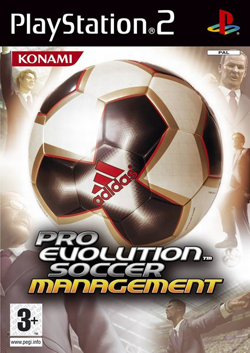

There is a certain gravity to the phrase "football management game" that in the 1990s meant spreadsheets, interminable menus and an almost monastic dedication to tactics. Pro Evolution Soccer Management arrives in 2006 trying to marry that old managerial reverence with the brawny presentation of Konami's Pro Evolution Soccer franchise. What we get is a curious chimera: a management title dressed in the engine and commentary of Pro Evolution Soccer 5, but stripped down and, for all its bright uniforms and polished cut-scenes, hamstrung by design choices that make it feel less like a worthy successor to classic managers and more like a half-made promise. Fans of the pitch will recognize the trappings-the 2005-06 season, 114 selectable clubs across six major leagues, and the reassuring voices of Trevor Brooking and Clive Tyldesley-but recognition does not always equal satisfaction.
Konami's intention is plain and defensible: give the Pro Evolution faithful a managerial playground that looks and sounds like the series they love. You begin by choosing from 114 clubs drawn from six of Europe's top leagues: England's Premier League, Spain's La Liga, Italy's Serie A, Germany's Bundesliga, France's Ligue 1 and the Netherlands' Eredivisie. The campaign is pegged to the 2005-06 season, and the game's architecture revolves around a currency called Glory Points. Every completed match grants Glory Points that can be spent unlocking players and features and, once you have amassed enough, allow you to apply for management jobs at more prestigious clubs. It is an attractive conceit-progression tied to merit and time in the dugout-but the execution blunts much of its potential. Matches render using the Pro Evolution Soccer 5 engine, which is simultaneously the game's greatest asset and one of its subtle liabilities. On the one hand, watching a team you have shaped play out a match in a familiar engine, complete with professional commentary, lends the proceedings cinematic weight. On the other hand, the game's focus on presentation seems at odds with the managerial depth the audience expects. There are editing tools and a welcome option to import save data from Pro Evolution Soccer 5, which grants a degree of continuity for players migrating from the mainline series. Licensing is patchy: some clubs and team managers are incorrect and a few stalwarts are renamed (Liverpool appears as "Merseyside Red"), a detail that bothers purists and underlines the game's reliance on PES5's database rather than a bespoke managerial one. Where conventional management sims excel is in the balancing act: scouting, transfers, training regimes, finances, youth development and the endless spreadsheet ballet behind promotion and relegation. PESM picks a few of those beats-transfers, tactics, and squad selection-then seems to lose faith in the rest. A glaring omission is the absence of relegation. The same set of clubs remains year after year, which neutralizes one of the sport's rare and most delicious tensions: the prospect of failure with real consequence. Remove relegation and you remove meaningful league churn; the game never forces you to rebuild in humiliation or proves your genius in an underdog's rise. It feels like someone ported the aesthetic layer of PES5 onto a managerial skeleton and then decided not to let the bones move much. Interface design contributes to the malaise. Critics at the time were quick to call out an awkward, sometimes clumsy UI that makes routine tasks feel like negotiations with a badly written database. Browsing squads, poring over player stats or hunting for the right tactical tweak should be the joy of the manager's chair; here it is often an exercise in patience. Compared to contemporaries like LMA Manager and Championship Manager-the latter the standard-bearer for depth-PESM is lean to the point of being spare. For a player coming from those franchises, the lack of depth is conspicuous: fewer layers of scouting, limited realism in competition structure and an absence of the long-term managerial arc that makes matches matter beyond the next fixture list. Multiplayer options are present but feel perfunctory. The game supports both single-player and multiplayer modes, but the core single-player experience is where Konami invested their energy. For managers hoping to cultivate dynasties, the inability to sink into seasons of authentic unpredictability is a dealbreaker. There are redeeming features, however. Glory Points introduce a nice meta-game and reward continuity, and the PES5 match engine provides a visceral pleasure when a plan comes off and your side plays the football you intended. Editing tools let diligent players correct licenses and tweak names, which is a small mercy for those with the patience to patch the game themselves. Importing saves from PES5 also allows for some continuity in player pools, but this feels like a concession to the engine's strengths rather than a fully integrated solution.
The game benefits from the graphical muscle of the Pro Evolution Soccer 5 engine. Players and stadiums are rendered with a level of polish uncommon in management titles of the era; on the ball animation, ball physics and presentation values look and sound like a mid-decade Konami sports product should. Matchday sequences feel alive thanks to motion and commentary, giving you the occasional thrill of watching your tactical instructions manifest themselves in believable football. The trade-off is obvious: when you step out of the 22-on-22 sequences into menus and team screens, the visual design is serviceable but uninspired. There is a sense that the juice of PES5 was squeezed primarily into match visuals and broadcast flourishes, while the management faceplates-lists, charts and profile screens-received less care. It's perfectly possible to be entertained by the match visuals while being frustrated by the dry and turgid UI you must navigate to arrange those very matches.
Viewed through the lens of 1990s seriousness-when reviewers measured a game's worth by how well it respected the player's time and intelligence-Pro Evolution Soccer Management is a cautionary tale. It demonstrates that a beloved engine and good presentation are not substitutes for the systems and consequences that make management sims worth returning to. The absence of relegation, the clunky interface, partial licensing and a database lifted wholesale from PES5 turn what might have been an intriguing experiment into a product that feels unfinished and, at times, lazy. There is fun here: pulling off a tactical masterstroke and watching your side celebrate in the PES5 engine is a real hit. For those who want a light, visually familiar managerial romp and don't mind doing their own editing, PESM offers a few hours of entertainment. For anyone seeking the deep, season-spanning agonies and triumphs that experienced managers live for, this is not the title that will sit on your shelf for a decade. Konami's gamble was bold but the house folded; a sequel is unlikely and, if you were hoping for the next big managerial saga from the Pro Evolution team, you will find the field disappointingly empty.
 NHL Hitz Pro on PS2
 Power Pro Kun Pocket 13 on DS
 Pure Pool on PS4
 Accolade Sports Collection on Xbox Series X/S
 Deca Sports DS on DS
 Alan Hansen's Sports Challenge on PS2
 ISS Pro Evolution 2 on PlayStation
 Pro Evolution Soccer 2 on PlayStation
 Metal Gear Solid 3: Snake Eater on PS2
 Metal Gear Solid: Integral on PlayStation
 Pro Evolution Soccer on PS2












 Another SquareThought Site