

 Aug 2025
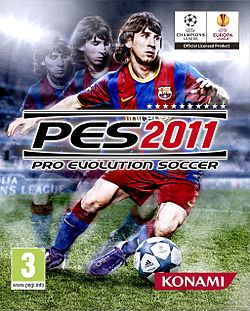

In an era when football videogames were beginning to shed the arcade sheen in favour of something that felt more like real sport, Pro Evolution Soccer 2011 arrived like a curt nod from an old master. Konami, the long-time steward of the PES line, put Lionel Messi back on the cover and pushed a system that wears its pedigree with quiet confidence. This is not a game that wants to dazzle you with bells and whistles; PES 2011 wants to convince you that what happens on the grass - the passes, the pressing, the tiny mechanical decisions of a midfielder - matters above all else. Released in October 2010 for the PlayStation 3 among other platforms, PES 2011 is the sort of seasonal sequel that aims to refine rather than reinvent. It brings with it, for the first time in the series, full licences for the UEFA Super Cup and South America's dusty, fervent jewel, the Copa Libertadores, while retaining the heavyweight UEFA Champions League and Europa League integrations. For the purist of the 1990s sensibility - the reviewer who once judged games by control tightness and the sound of a referee's whistle - PES 2011 is an unapologetic attempt to restore technique and tactical thought to football videogames.
If you remember football games from the early to mid 1990s, you remember two things: controls that made sense and matches that could be won by good positioning rather than button-mashing. PES 2011 revives that old-school creed with a modern sheen. The first thing any experienced player notices is the shift in tempo. Konami tightened the feel of passing and first touch so that possession becomes a craft again. A well-weighted pass arrives to the foot with the promise of options; a heavy touch can ruin a move in a heartbeat. The result is a game that rewards patience and planning rather than constant flair. The defensive AI, after several patches, emphasises pressing and situational awareness. Version 1.02, in particular, altered defender behaviour so that pressing is more consistent and cursor switching is less of a gamble when crosses arrive. This means defenders will attempt to read the game rather than act like puppets on a string, and that makes matches feel like chess at times - a rare and welcome strategy element for a football title. Master League receives practical updates: the integration of licensed tournaments such as the Champions League and the Copa Libertadores gives single-player campaigns a genuine narrative arc. Transfers and the economy were adjusted post-launch - transfer fees and AI behaviour were tweaked so that your fantasy club's progression felt less like exploitation of a broken system and more like gradual sporting ascent. For those who love to tinker, PES still includes two editable fictional leagues, the PES League and D2 League, which the community has historically used as canvases for domestic leagues via patches. On the pitch the controls are both simple and deep. There are no extravagant gimmicks here; the special moves are toned down - the rainbow flick, for instance, is made more difficult - and the emphasis is put firmly on the fundamentals. Crosses and headers feel heavier; timing and player selection for aerial duels matter. The cursor-switching improvements reduce the number of frustrating moments where control is handed to the wrong player at the worst possible time, which used to be a recurring complaint in earlier PES titles. Online services arrived with features such as Legends, Community and Competition, expanding the game's longevity. These systems aimed to cultivate a committed player base who wanted to test tactics against real opposition rather than CPU routines. Sadly, as modern readers will note, Konami shut down online services on November 30, 2013, which now leaves PES 2011 as a primarily offline, archival experience. Commentary is multilayered and regionally attuned. On the English-language side Jon Champion is paired with Jim Beglin, giving a familiar broadcast flavour for those who grew up listening to televised football in the nineties. The roster of commentators for other languages - Spanish for Latin America, Portuguese for Brazil and Portugal, French, German, Italian, Greek, Japanese and Turkish - demonstrates Konami's clear focus on a global audience. The commentary, while sometimes repetitive, contributes to immersion in a way that older games simply could not manage. PES 2011 is not without its foibles. Licence coverage is improved but still patchy: club names and kits are a mixed bag depending on version and region, and community patching remains the practical route for players wanting perfect authenticity. The Copa Libertadores teams are fully licensed but restricted in their availability within certain modes, a curious constraint that keeps some desirable features locked behind design choices rather than technical necessity. Nevertheless, for players who prioritise gameplay and tactical depth, these are quibbles rather than deal-breakers.
Visually, PES 2011 sits somewhere between the glossy ambition of its era and the more austere realism that would follow in later years. Player likenesses are good in close-up, and when a well-known striker bares down on goal you can often recognise them - Messi's presence on the cover is echoed in his in-game poise. Crowd models and stadium atmospheres are serviceable; Konami prioritises the match itself over background spectacle, which is consistent with the game's 1990s-meets-2010s philosophy. One of the subtler strengths is animation blending. Movements flow with convincing transitions from run to control to pass. When two players contest a ball the resulting animation often conveys the tussle convincingly, which amplifies the sense that you're watching a contest of wills rather than a sequence of canned clips. The lighting is competent; evening matches possess a satisfying twilight glow and pitch textures avoid the plasticky look that afflicted weaker sports titles. Menus and presentation are the film grain to the cinematic shot: they are serviceable but not showy. The interface is functional, occasionally ungainly, and bears marks of being designed for efficiency rather than style. This ties into the game's larger character: it is a tool for the match rather than a spectacle to be admired between whistles. For a reviewer raised in the years when gameplay mattered far more than polish, that is not a criticism so much as an observation. Post-release datapacks improved kits, boots and rosters, while patches fixed certain errors - an amusing incident saw the Belgium and Republic of Ireland kits temporarily swap to a Dutch club's kit, which Konami corrected quickly. These updates reflect a developer willing to refine the product after launch; for players alive to the era of cartridge rigidity, ongoing patch support felt like luxury.
PES 2011 is not the loudest or flashiest football game of 2010. It does not trumpet itself as a revolution. Instead, it takes the older virtues of tight control, considered tactics and believable player behaviour and polishes them until the game hums. Critics at the time were divided: some outlets praised its return to nuanced football, others pointed out that licensing gaps and a conservative menu system held it back from mass-market perfection. Those scores - ranging from middling to very positive - reflect a title that is strong where it counts and modest where it does not. For the serious fan who values on-pitch fidelity, PES 2011 offers a rewarding, sometimes stern, education in proper football videogamecraft. It is a title that wants you to learn the language of the pitch: jockey for position, pick the pass, press intelligently. If you approach it expecting fireworks you may be disappointed. If you approach it expecting a living, breathing simulation of ninety minutes and the strategic chess that underpins it, you will find much to admire. That combination of restraint and competence is precisely why, if you like your videogame football to feel like the real thing rather than a highlight reel, PES 2011 still matters in the lineage of the sport-sim genre.
 NHL Hitz Pro on PS2
 Pro Evolution Soccer 2008 on DS
 Pro Evolution Soccer 2018 on PS4
 Accolade Sports Collection on Xbox Series X/S
 Deca Sports DS on DS
 Alan Hansen's Sports Challenge on PS2
 EA Sports MMA on PS3
 Metal Gear Solid: Integral on PlayStation
 ISS Pro Evolution 2 on PlayStation
 Pro Evolution Soccer 2 on PlayStation
 Metal Gear Solid 3: Snake Eater on PS2
 Dance Dance Revolution Best Hits on PlayStation










 Another SquareThought Site