

 Aug 2025
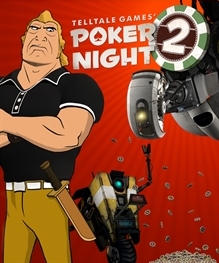

In an era when most game sequels try to out-gun, out-run or out-parkour their predecessors, Telltale Games took a more analog tack for Poker Night 2: sit a gaggle of unlikely fictional personalities around a table, give them chips and a microphone for snark, and see what happens. Released on the PlayStation Network in the spring of 2013, Poker Night 2 is less an exercise in cutting-edge gameplay and more an exercise in character-driven entertainment. If you remember the days when magazines printed box art close-ups and dev interviews used to be typed on dot-matrix printers, you'll appreciate the oddball charm of a title that trades explosions for banter. This is not a full-fledged multiplayer poker megahit or a simulator aiming to replace a real felt table; it is, instead, a single-player tabletop circus in which the player sits, largely silent, opposite four loudmouths from across pop culture: Claptrap from Borderlands, Brock Samson from The Venture Bros., Ash Williams from Evil Dead, and Sam from Telltale's own stable. GLaDOS mans the dealer's shoe like an amused, homicidal hostess and Reginald Van Winslow returns as the host. The result is a handful of hours of poker punctuated by genuinely funny lines, platform-linked unlockables, and an unusual mix of Texas hold 'em and Omaha modes. If you pick it up on PS3 you will find a serviceable port of a concept that works best when you let the personalities do the heavy lifting.
At its mechanical core, Poker Night 2 is simple and familiar: the player - an unseen, silent participant - starts with the same stake as the other characters and plays to bankrupt them in rounds of standard poker. Telltale has not tried to reinvent the wheel; rather, they have polished it and attached a sound system so the spokes can heckle you. The game raises the ante from the first title, offering $20,000 per player (a $100,000 table pot total) which changes the tempo of bets in a small but noticeable way. The package includes Texas hold 'em, the tried-and-true staple that most console poker players will know, and it adds Omaha hold 'em for those who enjoy juggling more hole cards and slightly more complicated decision trees. Where Poker Night 2 lives and breathes is in the interplay between the card mechanics and the surrounding theatre. Each of the four AI players is a fully voiced character - Claptrap's manic quips, Brock's macho one-liners, Ash's gruff sarcasm, and Sam's dry, sometimes surreal observations - and they react to your play. The player does not speak, which is a wise move; it places you in the role of the straight man to a table of comedians. Characters comment on each other's plays, on your betting patterns, and, crucially, on the thematic choices you make for chips, cards, and table skins. There are unlockables tied to those cosmetic choices and to in-game goals. These "Bounty Unlocks" are a clever cross-promotional flourish: perform a certain deed and you can claim bonus items in Borderlands 2, or platform-specific trinkets such as Team Fortress 2 items on Steam, avatar bits on Xbox, or PlayStation themes on PS3. The banter is not simply window dressing. Telltale wrote a surprising volume of dialogue, and the characters' remarks will adapt when you mix and match themed chips, cards and tables - an attentive touch that makes collecting cosmetics feel worthwhile beyond mere vanity. There are also micro-systems that let you influence the table more directly: you can buy drinks for opponents at the bar to encourage or punish them, which nudges their shows of tells and abusive chatter. Drinks are effectively a social lever, and seeing Brock or Ash slur their way through a hand adds both amusement and a slight strategic consideration. The game plays the hand-by-hand rhythm straight: deal, community cards, betting, showdown. Visual cues and a clear interface keep you aware of pot size, stacks and the flow of action, which is essential when the cast is busy yanking your attention. Omaha mode offers a welcome change of pace; it demands a different kind of math and forces you to think about the combinations on the board versus your four-hole estimates. For players seeking deeper poker simulation - advanced odds calculators, customizable tournaments or long-form statistical tracking - Poker Night 2 will feel light. It deliberately trades simulation depth for a stream-of-consciousness comedy hour. Wins and losses are less about climbing leaderboards than about the pleasure of seeing Claptrap explode into a tirade when you river a miracle. A few cameo appearances - a waiter from Gravity Bone, a Save-Lot Bandit, and others - pop up during the evening and signal Telltale's comfortable place as a weaver of cross-franchise moments. The game also includes a handful of unlock conditions that reward repeat play: certain challenges will net unique card backs, chip sets and even Inventory decorations that open up new lines of conversation among the cast. For collectors and completists the progression loop is serviceable; for those hoping to grind for trophies on PS3, the offerings are modest and strongly tied to simply playing and triggering specific table events. If you are the sort of player who enjoys reading the room, extracting tells and baiting opponents into overplaying, Poker Night 2 gives you the theatrical tools to do so. If you prefer a hardcore competition against ranked humans or the cold arithmetic of professional poker sims, this isn't that. Instead, it sits between a talk show and a card game, and if that hybrid appeals, it can be oddly addictive. Expect 6-10 hours of entertainment from the jokes alone, and longer if you chase the cosmetic unlocks and platform bonuses.
Graphically, Poker Night 2 wears the modest badge of Telltale's in-house Telltale Tool. On the PlayStation 3 the table and character models are serviceable rather than spectacular: the environment is stylized and clean, not striving for photorealism. Animation work is competent; facial movements and gestures are tuned to emphasize punchlines rather than showcase technical prowess. This is, after all, a studio known for episodic adventure games where writing carries far more weight than polygon counts. The Inventory setting is attractive in a utilitarian, late-90s-arcadey way - a stage for conversations rather than a living, breathing world. Card animations, chip stacks and UI elements are crisp and readable on a living-room screen. When playing Omaha the extra cards are displayed neatly and the interface makes it easy to follow complex hands even when your head is spinning from Claptrap's commentary. Lighting is moody enough to feel like a private poker den without becoming a cinematic distraction. On PS3 the port manages to avoid performance issues commonly associated with cross-platform releases of the era, though you should not expect frame-rate miracles. Where the visuals truly score is in character design and expression: the caricatures are faithful to their original franchises and the voice acting injects personality into models that otherwise would be static. GLaDOS as the dealer is a visual and aural treat - the cold, sardonic lines are delivered by Ellen McLain's voice with precision, and the dealer animations match the deadpan tone. For a game whose primary joy is dialogue, the modest graphical package is perfectly adequate. It complements the performance rather than competes with it.
Telltale's Poker Night 2 is a curious artifact: a round table of licensed characters, a handful of card rules and an outsized reliance on witty writing. Seen through the lens of a 1990s review ethos - one that prized tone, personality and context - it makes sense to score it not only on mechanics, but on what it sets out to do. Poker Night 2 does not pretend to be a professional poker training tool. It is a social simulator in a digital room, the quality of which depends entirely on whether you like the company you keep. When the jokes land, they land hard. Claptrap's manicism, Brock's gruffness and Ash's chain-saw attitude produce genuine chuckles and the occasional belly laugh. The unlockable tie-ins to Borderlands 2 and platform-specific rewards were smart promotional flourishes that gave the title an extra layer of value for owners of those ecosystems. Conversely, players seeking deep, competitive poker will find the offering shallow; the game lacks robust statistical tracking and the AI is designed to entertain rather than to be ruthlessly optimal. The PlayStation 3 version performs adequately and brings over the charm of the PC and iOS ports, but its Metacritic reception was mixed relative to other platforms, which is reflected in the score given here. If you admire clever voice acting, enjoy cross-franchise cameos, and like your poker with a side of sarcasm, Poker Night 2 is worth a rental or a bargain-bin purchase on PS3. If your blood runs to tournaments, real-money competition, or the sterile perfection of simulation titles, you will quickly tire of the schtick. As a cultural piece - an auteur exercise in licensed banter - it registers as a worthwhile curiosity. It is less a lasting classic than a memorable evening out: entertaining, intermittently brilliant, and best enjoyed with friends who understand that winning the pot is secondary to surviving the one-liners. Final verdict: an amiable, occasionally brilliant party game that falls short of being a must-have for serious poker fans, but earns its place at the table for those who want to listen as much as they want to play.
 Don't Starve Together on Switch
 Mineko's Night Market on Switch
 Coloball 2002 on PS2
 Game Dev Story on PS4
 Press Your Luck on PS3
 Mom Hid My Game! on Switch
 Back to the Future: The Game – 30th Anniversary Edition on PS4
 Batman: The Enemy Within on PS4
 Batman: The Enemy Within on Switch
 Sam & Max: The Devil's Playhouse on PS3
 Sam & Max: The Devil's Playhouse Remastered on Switch










 Another SquareThought Site