

 Dec 2015
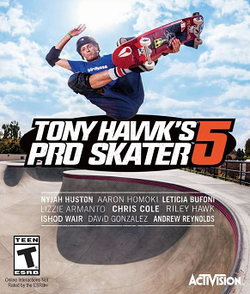

This is a review dressed as an HBO character study, except the cast are professional skateboarders, a washed-up development studio, and DLC turtles. Tony Hawk's Pro Skater 5 on PS3 arrives like a reunion episode where everyone shows up to the same party but forgets to bring the snacks, the music, and coherence. The Wikipedia-style facts are plain: it's a sports/skateboarding title built on Unreal Engine 3, developed by Robomodo with help from Disruptive Games and Fun Labs, published by Activision, and released for last-gen consoles worldwide on December 15, 2015. What the text doesn't immediately tell you is that this game's lack of a traditional narrative frees me - delightfully - to read tragicomic arcs into its characters and the people around them. If you want a standard technical rundown, sure, this isn't it. If you want a deep, slightly absurdist look at what these skaters and their in-game incarnations represent, strap in. We'll chronicle rises, falls, cameos, and the curious case of the character that forgot how to be played.
A 'character-centric' look at gameplay might seem like an odd pairing, because Tony Hawk's Pro Skater 5, by the book, 'does not feature a story.' That said, gameplay becomes the story here: every trick, every ruined combo, every invisible NPC becomes a plot beat in the ongoing saga of the franchise's comeback attempt. The cast list reads like a Who's Who of modern skateboarding: Tony Hawk returns as the elder statesman; Riley Hawk, his son, brings filial legacy; Chris Cole, Andrew Reynolds, David Gonzalez, Nyjah Huston, and newcomers Aaron 'Jaws' Homoki, Lizzie Armanto, Letícia Bufoni, and Ishod Wair supply a broad palette of skating personalities - each with their own public arc in real life. In-game, those arcs are flattened. The game offers ten pro skaters, but it gives them the dramatic range of an emoji. You can swap heads, torsos, and legs like mise-en-scène accessories, but you cannot reinvent their trick set or personal narrative. Their story beats are fixed, and the emotional crescendo is a high score screen. Mechanically the game attempts to nod to earlier Pro Skater entries: score via aerials, flips, grinds, manuals. The special meter returns as a career highlight - perform enough, and watch your pro unleash special tricks that are supposed to feel like character climaxes. But Robomodo reworked controls: no flatland tricks, no getting off the board to wander around and beg for side-quests, no slow-motion, and - in a move that read to many reviewers like a creative reboot gone wrong - a stomp-to-ground mechanic that shares a button with grinding. In narrative terms, this is like giving Hamlet a single soliloquy and asking him to do everything with it. Instead of fluid, branching combos that feel like character development, you get clipped sequences that stutter because control inputs collide. Levels are brand-new but reverentially derivative. The game contains ten levels, though only seven were available on launch disc content until post-release patches filled the gaps; this itself reads like a serialized novella released as a cliffhanger every other week. Some levels, like The Berrics, wear their real-world inspiration like a plot device, but most feel like recycled set pieces from earlier games. When a video game level feels 'slapped together, like someone was in a hurry' - to borrow a contemporaneous critique - the player's sense of immersion falters. The Create-a-Park mode is present, which should be the game's indie subplot - a place for player-created arcs - but on PS3 (and Xbox 360) the feature is essentially the strongest surviving thread, because the last-gen ports shipped without the multiplayer architecture that filled out much of the modern-gen experience. The offline PS3 player ends up like a character watching the live-action drama through a window. Multiplayer is an optional ensemble piece on the newer consoles, but Fun Labs' PS3/Xbox 360 ports lack multiplayer entirely, retaining only the Create-a-Park. That means the cameo appearances and DLC additions (like Tyler, the Creator; TMNT; and other guest characters that arrived via patches on current-gen) read like post-credits scenes not present in the theatrical cut you own. The in-game celebrity guest skater, Lil Wayne, arrived with his own PR arc; Tyler and the Teenage Mutant Ninja Turtles were later added by patch. These additions are like surprise guest stars in the final act - fun, oddly dissonant, and unable to change the central tragedy: the game's main plot is hampered by glitches, poor pacing, and a development rush that reads from the documents as being motivated by a licensing clock. The meta-arc extends to the developer themselves. Robomodo, which inherited the series mantle after Neversoft pivoted to other projects, had a run of peripheral-supported experiments (Ride, Shred) and a remake (Pro Skater HD) before attempting to revive the core series. The hurried development, allegedly driven by the Hawk-Activision licensing expiry, leaves a residue of 'if only' on every map. The game's systems are intact, the tricks exist, but the polish - the scene composition, the NPC energy, the gleam of character identity - is mostly absent. For a PS3 owner, the result is a playable but emotionally flat skating sim that asks you to invest in characters whose story arcs end at 'select skater, perform tricks, repeat.' There's nostalgia to be mined: rare moments where the combo system briefly sings recall the franchise's golden era. Those are the scenes where the film score swells. They are, however, too rare to save the runtime.
Visually, this entry's character portraits are a study in mismatch between ambition and execution. Early footage prompted criticism for outdated visuals; Robomodo pivoted two months before release to a cel-shaded style - officially pitched as a frame-rate-preservation move. Imagine being cast in a gritty, high-res drama and two months before opening night someone repaints the set in cartoon watercolors. The characters - Tony, Riley, Nyjah, Lizzie - are present, but their in-engine representation frequently lacks the nuance of texture and animation that would make them feel like living performers. Reviewers compared the PS4/One visuals unfavorably to PlayStation 2-era games; on PS3 those comparisons are even less forgiving, because the last-gen port was co-developed by Fun Labs and shipped without many of the modern trimmings. The lack of NPCs in levels makes the world feel like a stage with the audience mysteriously absent; your skaters perform, but there's no applause. Character customization does give players a bit of narrative agency - swapping heads, torsos, and legs can create visual mashups (the roster contains fun crossovers like Octodad or King Graham as removable heads), but these are superficial costume changes, not deep rewrites of identity. The trick set stays stubbornly canon: no branching trick trees, no customizable signature move that grows with your career. That design decision turns player progression into a highlighted montage rather than a full character arc. Technical problems further erode graphical storytelling: frequent bugs, framerate drops, and online connectivity issues on the modern-gen versions make the supposed cel-shaded charm feel like a distraction. On PS3 you're spared some of the online hang-ups simply because the port lacks those online modes, but that is its own kind of deprivation. Graphically, the game is a sketch of ideas rather than a fully inked comic; the characters are in the frame, but they are often waiting for direction that never comes.
If you approach Tony Hawk's Pro Skater 5 on PS3 expecting a narrative-laden odyssey of character growth, you'll be disappointed in the literal sense: the game has no story. If, however, you like interpreting the gaps as subtext, then its characters tell a dozen quiet tales - of legacy (Tony and Riley), of newcomers trying to shine (Jaws, Ishod, Lizzie, Letícia), of celebrity cameos showing up late to the set (Lil Wayne, Tyler, the TMNT), and of a developer that tried to run against the clock and tripped over the finish line. The final act of this project's arc, for Robomodo, is sadly real: the studio closed in August 2016, and Hawk's licensing deal with Activision was not renewed. Critics were merciless at release: low Metacritic scores, outraged thinkpieces, and lists of the year's worst games turned this once-beloved franchise into a cautionary tale. On PlayStation 3, the experience is even more specific. You get the last-gen port, the Create-a-Park consolation prize, the absence of multiplayer spectacle, and the full weight of a franchise remake attempt that never gelled. For a collector of skating lore or someone nostalgic for the series' moments of flow, there are flashes of joy and a handful of legitimately good moments when combo chains click. Those moments are like great monologues in an otherwise forgettable play: they remind you why the franchise mattered. For everyone else - especially those who expect a polished product or a novel of skating characters with true emotional beats - this PS3 edition is a disappointment. I give it a 3 out of 10 because some mechanics still work, some skaters still feel cool to look at, and the soundtrack, in a few places, tries to carry an emotional montage. The game's real story, though, lives off-screen: the hurried development, the post-release patches that added levels and guest stars, and the legacy conversation that ended with a remaster of the originals doing what this one set out to do but much better. Treat this PS3 release as an epilogue with deleted scenes - interesting to historians, painful to fans, and ultimately a lesson in how not to revive a beloved cast.
 NHL Hitz Pro on PS2
 Pro Yakyū Spirits 2019 on PS4
 Online Pro Wrestling on PS2
 Accolade Sports Collection on Xbox Series X/S
 Deca Sports DS on DS
 Alan Hansen's Sports Challenge on PS2
 EA Sports MMA on PS3










 Another SquareThought Site