

 Aug 2025
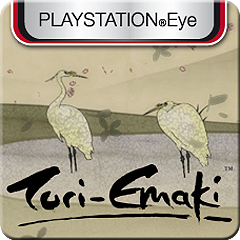

Tori-Emaki arrives not as a game with a plot to conquer and loot to count, but as a living painting you wave at until it moves. Marketed as interactive art on the PlayStation 3 and designed to be coaxed with the PlayStation Eye camera, it asks the player to do something most modern games don't: slow down and narrate with body language. On paper it's a simple conceit - guide a flock of birds along an emakimono-style scroll using gestures - and in practice it becomes a delicate exercise in interpretation. If you expect character sheets, side quests, and dialogue trees, you will be disappointed. If you willingly become the director of a miniature avian theatre and enjoy projecting stories onto minimalist visuals, Tori-Emaki is a short, strangely affecting experience.
The control scheme is the premise and the personality of Tori-Emaki. Using the PlayStation Eye, your hands and whole-body movements become the shepherding force for a flock that responds to left, right, up and down guidance. There are no menu-heavy tutorials, no HUD clinging to your face; the game trusts the player to find rhythm with it. That trust is where the characters - the flock, the environments, the incidental creatures - emerge as personalities. The flock itself is the protagonist. It acts as a collective character rather than a single named hero: sometimes hesitant, sometimes exuberant, it reflects the patience and intent of the player. When you nudge it gently, it meanders like a shy teenager at a house party. When you sweep decisively, it surges forward like a team sprinting for the last subway car. This is a clever trick: by refusing to parcel control into a single on-screen avatar, Tori-Emaki hands you a mirror and asks you to watch how your nudges shape a communal temperament. Around the flock are supporting cast members stitched into the scroll: solitary trees that lean like gossiping elders, fishermen who move with a small, precise choreography, and foxes - or something fox-like - that offer ambiguous menace. These elements are not written to deliver exposition. Instead they are tableau pieces that the flock's movements animate into meaning. A pause under a red maple becomes a moment of rest for the entire group, a sudden swirl around a pagoda reads like curiosity or reverence, and the way birds avoid a farmer's hat can read as politeness or fear. Because there is no explicit story text, the game forces you to invent motives and arcs for every encounter. If we map classical story structure onto Tori-Emaki, the scroll unfurls like a short novella. The opening panels introduce the flock's ordinary world: serene valleys, gentle rivers, and the slow rhythm of village life. This is the 'status quo' - the birds are content but restless. The middle panels introduce subtle complications and tonal shifts: wind gusts rearrange the flock, unfamiliar creatures cross their path, and new landscapes demand new flight patterns. Those are the trials where characters reveal temperament: some birds cling to formation; others test the edges and get swept into small exploratory loops. The climax isn't a battle but an aesthetic crescendo - a place where the scroll's composition tightens, music swells, and your movements must match the urgency the scene demands. The game's endings are not binary achievements but tonal resolutions. Complete a panel with still, contemplative hand motions and the flock will settle into peaceful roosting; coax them onward with brisk, continuous movement and you emerge into a brighter, more kinetic tableau. In that way, each playthrough becomes a different ending based on your physical storytelling. This design choice is bold: it privileges interpretive reading over authorial certainty. For players who enjoy imposing narrative on archaeological scraps of scenery, the result is emotionally satisfying. For players who want clearly defined character development arcs with signposts, the ambiguity will be frustrating. There are mechanical limits here. The reliance on PlayStation Eye means tracking can be finicky; the camera doesn't always translate delicate gestures into reliable bird behavior, and large living-room lighting changes can throw off responsiveness. The game's single-player mode does not invite competitive or social modes, which is both a statement and a limitation - this is meant to be private, a small ritual between you and the screen. That intimacy pays dividends for a certain kind of player but will feel thin to someone expecting layers of gameplay complexity. In short, the gameplay is less about achieving tasks and more about conducting a performance. Characters exist less as penned entities and more as impressionist suggestions. If you enjoy observing the emergent personalities of systems you gently manipulate, Tori-Emaki gives you a brief, charming stage. If you crave explicit arcs and character beats handed to you on a silver platter, the game's subtlety will feel like a plate with no silverware.
Visually, Tori-Emaki looks like a museum exhibit that learned how to fly. The game's aesthetic borrows heavily from the emakimono, the traditional Japanese picture-scroll format, and it embraces two-dimensional, ink-and-wash sensibilities rather than photorealism. Scenes unfold like panels in a scroll - flat, stylized landscapes with layered depth that suggest movement through space without the fuss of heavy geometry. Textures are intentionally restrained: paper-like backdrops, muted palettes, and occasional washes of color that punctuate a scene - a red leaf, a blue roof, a flock of white birds - all stand out like brush strokes. The art direction is where Tori-Emaki earns its 'interactive art' label. Rather than showing off rendering tech, it leans into mood. That choice makes the game age more gracefully than many first-gen PS3 experiments; the visuals have a timelessness that suits the title's meditative pace. There are technical compromises, partly due to the PlayStation Eye interface and partly because the experience prioritizes composition over fidelity. Camera-based controls sometimes cause stuttering animations when tracking errors happen, and the bird flock's movement can feel slightly synthetic at times. These are forgivable if you accept that fidelity isn't the point. The charm of the art lies in suggestion: imperfect tracking, like an ink blot on rice paper, can produce accidental compositions that are surprisingly beautiful. Sound design complements the visuals with restrained, atmospheric music and ambient cues. Instead of bombast, music settles around you like a cushion. When the flock glides into new panels, subtle instrumental motifs shift the emotional temperature. This understated score helps sell the idea that you are reading a living scroll rather than playing a map-based level select.
Tori-Emaki is an exercise in trust: it trusts you to be a storyteller, and it trusts art to be ambiguous. That will make it polarizing. For players who enjoy open-ended emotional prompts and the gentle satisfaction of making patterns with their bodies, this is a small jewel - meditative, original, and quietly handsome. For players who want distinct characters with clear arcs, extensive gameplay systems, or tight camera-based controls, it will feel like an unfinished short story. Treat the flock as the protagonist and the scroll as a stage. Your gestures are its motivations, and its choices are reflections of yours. When the alignment clicks, the game can produce moments of sincere tenderness: a flock pausing under a moonlit maple, an improvised spiral around a fisherman that feels like a conversation. Those scenes are the payoff. They prove that narrative doesn't always need dialogue or explicit beats to carve character; sometimes it only needs a few well-placed brushstrokes and a partner willing to move. If you own a PS3 and a PlayStation Eye and you're curious about what games can be when they stop trying to be everything at once, Tori-Emaki is worth the short, contemplative trip. It won't replace your favorite narrative-driven RPG or your competitive shooters, but it will offer something rarer: the chance to choreograph a tiny, communal life and then step back to watch what story you and the game together allowed to happen.
 Art Sqool on Switch
 Shinobi: Art of Vengeance on Switch
 Art of Rally on Switch
 Teenage Mutant Ninja Turtles: The Cowabunga Collection on Switch











 Another SquareThought Site