

 Aug 2025
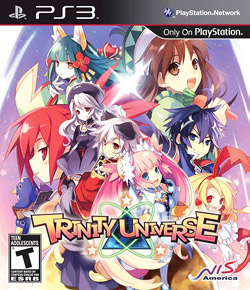

Trinity Universe is the kind of crossover RPG that reads like a fan letter written in capital letters: Disgaea and Atelier characters shoved into one PS3 package and told to behave. On the surface it's cute, loud, and full of anime charm - on the inside it's a battle-focused JRPG that quietly asks you to be good at a few very specific things. If your idea of a good time is juggling action-y combos, watching AP tick down like a cruel clock, and being chased by a timed dungeon objective while a cast of Valkyries, Prinnies, and a Demon Dog King cheer you (or heckle you), this game was made for you. It isn't the deepest RPG pond to wade into, but the challenge lives in the combat choreography, AP economy and timing - not in unbounded character customization. Which is good if you're the kind of player who prefers learning a fighting metronome over tinkering with spreadsheets of stats.
Trinity Universe's combat is where the game wants all your attention. It's not a turn-based museum piece nor a free-form action brawler - think of it as an action-RPG with a strong rhythm element and a strict budget. Each attack costs AP (action points), and skills are mapped to three buttons. That sounds simple until the AP bookkeeping and skill chaining start dictating whether an encounter is a textbook victory or a faceplant. The immediate mechanical lesson here is AP stewardship. Unlike RPGs that hand you a giant AP bar and let you spam your best move until everything dies apologetically, Trinity Universe makes you feel the cost of every decision. When you press a skill button you're not just spending a number, you're deciding whether this move fits into a planned string. The system rewards planning and timing: chaining several skills in the right order deals more damage, so spamming low-cost moves is often inferior to spending AP on a well-timed combo. Mastery means thinking two or three steps ahead under pressure - which skill finishes a staggered enemy, which skill builds into the next, which will leave you AP-starved for the next wave? Those choices define the game's difficulty curve. Timing is the second pillar. Beyond the AP economy, Trinity Universe insists that you learn animation windows, combo links and when to press the next button in a sequence. There's a tactile satisfaction when a string of skills converts into a slick combo, and conversely a real sting when a mistimed press breaks the chain and wastes precious AP. The comparison in the official notes to Hyperdimension Neptunia is apt: both ask players to execute button strings to maximize damage. But where Neptunia leans on customization to soften mistakes, Trinity Universe expects you to get better at the mechanics themselves. If you're the type of player who improves by repetition and muscle memory, the combat will click; if not, the continual AP punishments can feel tedious. Dungeons sprinkle in an extra layer of urgency. Some areas require you to destroy a gravitation field and escape within a set period. These aren't mere timers that ask you to run faster; they force you to reconcile speed with efficiency. Rush and you'll blow through AP and fail fights. Take it slow and you'll run out of time. The sweet spot sits at a rhythmic pace: punch holes in enemies, maintain combo flow, and keep moving toward objectives. It's a stress test of multitasking - spatial awareness plus AP management plus real-time combat decisions. Successfully clearing timed fields is one of the best ways the game differentiates a beginner from someone who's actually been playing. Character selection matters, but not in the dizzying toybox sense. The game's roster blends original leads (like Demon Dog King Kanata and Valkyrie Rizelea) with familiar faces from Disgaea (Flonne, Etna, Prinny) and Gust's Atelier family (Pamela, Viorate). Each character's design and backstory hint at a role: Rizelea's Valkyrie instincts and Kanata's Demon Dog King swagger suggest front-line brawling, while Miyu (the Managraphic artist) and Violet (an alchemist) imply utility and support. Mizuki being an assassin/idol hybrid screams glassy high-damage play. The gameplay doesn't bury you in complex job systems; instead, it gives you a stable of distinct tools and says, "Figure out how these toys combine." That's a different skill set from a min-max spreadsheet: it's observational learning. You watch combos, test who chains well off whom, and then build a party where AP costs and skill windows align. Boss fights are where Trinity Universe's modest complexity becomes meaningful. Enemies telegraph when they'll open up for long combos and when they'll punish reckless chaining. Some bosses change the flow by summoning adds that need to be neutralized fast, which circles back to AP triage: do you spend AP to crowd-control the adds or keep building damage on the boss? Often the correct answer is situational; you'll learn which bosses mandate a precise combo to break a guard, and which require whittling patience. Veteran players will revel in the loop of learning boss patterns and then slicing them down more efficiently each attempt. Casual players may find repeated deaths until they learn those patterns a bit grindy, but also oddly satisfying once the pattern clicks. The structure of two scenarios - the Goddess side (Gust characters) and the Demon Lord side (Nippon Ichi characters) - gives Trinity Universe a minor but valuable replayability boost. The same combat rules apply, but the roster and narrative tilt change how you approach fights. Some characters synergize in ways that only become obvious after a few encounters. For example, a support who extends combo windows makes a glass-damage assassin far more lethal; a sturdy frontline character who can absorb punishment lets you be greedier with higher-cost skills. Part of the challenge is discovering those synergies without the safety net of deep customization. You can't simply respec your way to victory; you have to adapt your playstyle to the party you can recruit. There's also an implicit skill ceiling introduced by the game's limited button mapping. With only three skills mapped to the face buttons, you learn to make the most of what's available. Creative players will find combos that aren't obvious at first: mixing a short-range high-cost skill on the X button with a low-cost Area skill on O and a utility skill on Square to reposition or debuff. The trick is to memorize which buttons give you the best chain transitions for different enemy types and distances. That mental checklist - "AP left: 30, enemy stagger at 40%, use X into O then dash" - becomes second nature the more you play. Trinity Universe is not a punishing hardcore title where a single mistake wipes your progress; save systems and average encounter design keep frustration to a minimum. The real friction comes from repetition while learning to be efficient. If you enjoy the process of refining execution - shaving seconds off clears, trimming unnecessary AP expenditures, learning precise cancel windows - the game rewards you in a steady stream. If you prefer your RPG difficulty to be about character build theory and numbers-crunching rather than reflex and rhythm, this game might feel like a straightjacket. Finally, the crossover charm does more than provide cameo selfies. Recognizing a familiar character's role and then learning to drive them effectively is a meta-skill the game cultivates. Prinny exploding as a projectile may be an expected gag, but learning the timing for that gag in a timed dungeon is pure player skill improvement, not luck. In short: Trinity Universe tests and trains your execution and planning more than your theorycrafting.
Trinity Universe marks a small technical milestone for its contributing franchises by presenting characters from Disgaea and Atelier in fully realized 3D models on the PS3. The visuals lean into anime aesthetics: bright palettes, expressive character models, and clearly readable skill animations - which matters when timing your next input. The art direction (credit to Tsunako) does a decent job of keeping frames clear during combat so that you're not guessing whether a skill connected or not. It's not a trophy for the most cutting-edge graphics of the generation, but the 3D models and readable VFX support the game's challenge loop. PhyreEngine does the job: clean, competent, and functional for the rhythm/strategy hybrid the combat expects.
If you judge Trinity Universe by the number of systems it throws at you, it'll look average - and critics largely agreed, giving it mixed scores. If you judge it by how well it asks you to develop a handful of concrete player skills, it's quietly competent and often fun. The challenges here are clear: manage AP efficiently, memorize combo windows and boss patterns, and juggle the tension of timed dungeon objectives. Those who enjoy learning by doing - becoming a tighter, more economical player through repetition - will find a satisfying core loop. Players who want endless systems to tinker with or a massively deep customization tree might feel shortchanged. For a crossover that could have been a fan service slideshow, Trinity Universe instead built a compact mechanical stage and dared you to dance on it. That's worth a play if you like your JRPGs to ask more of your thumbs and brain than your spreadsheet software.
 DC Universe Online on PS5
 Doki-Doki Universe on PS3
 Coloball 2002 on PS2
 Press Your Luck on PS3
 Game Dev Story on PS4
 Mom Hid My Game! on Switch










 Another SquareThought Site