

 Aug 2025
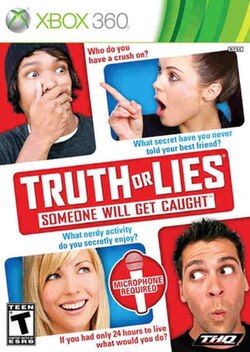

Truth or Lies arrives on PS3 with all the understated drama of a middle-school lie detector demo and about as much credibility. On paper it's the kind of party-game concept that sounds like a guaranteed laugh: a microphone peripheral, thousands of awkward questions sorted by category, and an invisible algorithm that will judge whether you are telling the truth or whether you are fabricating a web of lies so intricate it would make Pinocchio reconsider his life choices. In practice the title behaves less like an interactive social experiment and more like a very expensive parlor trick built on shaky tech and a voice calibration that seems to require a deal with the audio gods. Treating the game as if it had characters (because let's be honest, if you can't anthropomorphize a USB mic you are missing 40% of the fun) reveals the only meaningful personalities in a game with no campaign: The Announcer, The Player (that's you and your increasingly suspicious friends), The Microphone, The Questions, and the Hot Seat mode which plays the role of chaotic neutral. This review is an in-depth look at how those 'characters' move through a story arc that starts with promise and ends in shared bewilderment-and occasionally, a begrudging laugh over how spectacularly the lie detector fails at its job.
The narrative backbone of Truth or Lies is simple: pick a category (kids, teens, adults, couples, families), let each human cast member answer questions across three rounds, and hope the invisible arbiter of veracity behaves itself. The game offers three lengths-short, medium, long-so you can tailor the evening from "speed-run awkward" to "full-blown interrogation." There are more than 3,000 unique questions, which sounds generous until you realize many of them read like they were written by a bored party-game intern who was told to be edgy but only managed mild whimsy. The scoring is straightforward: the microphone listens, a calibration process attempts to learn your vocal baseline, and the software awards you between 0 and 1,000 points based on whether it deems your answer truth or lie. After each round the Announcer tallies the scores and ranks the players; at the end of round three you are crowned truth champion or exposed as the group's resident prevaricator. If we treat the Announcer as a character, his arc is twofold: initially he is an upbeat, helpful narrator who promises structure and drama, but by the end he becomes a bemused accountant reading out tallies that nobody really trusts. He is the face of authority in the game's theater of deceit, and his brittle cheerfulness is an essential part of the experience-when the tech works, he elevates the tension; when it doesn't, he becomes the sarcastic backdrop to the chaos. You, the Player, have an arc driven by hope, skepticism, and eventual resignation. Early rounds are full of bravado: you lean into juicy questions, you expect the microphone to catch your tone and reward your skillful deception. Midway through the game you begin to suspect an invisible bias-perhaps the mic dislikes whisperers, or maybe it only respects people who sound like reality TV contestants. By the final round you either double down (how else can you respond to being judged by a box?) or you pivot to comedy, because if the technology can't be trusted, at least mockery is a valid playstyle. The Microphone is the tragicomic protagonist here. Calibrating it is supposed to create an intimate relationship: you tell it how loud you typically speak, and it promises to be fair. In execution calibration is unreliable-IGN's Kristine Steimer summed it up best: "It would be an interesting game if it actually worked." Multiple reviewers echoed the same beat: the idea is solid, but the implementation doesn't behave consistently enough to sustain tension. The microphone's arc is a descent from promise to impersonality; once it starts mislabeling truth as lies (or vice versa) it ceases to be an arbiter and becomes a punchline. The Questions-those 3,000-plus tiny provocations-attempt to be characters in their own right by offering situational context and trying to coax secrets out of players. Each category alters tone: "kids" questions skew wholesome and small-scale, "adults" tries to push boundaries, "couples" weaponizes intimacy, and "families" skates the awkward intersections of both. Where the script shines is in this categorization and in the variety; the designers deserve credit for offering a library that rarely repeats itself. Where it stumbles is tone and impact-most queries are either too tame to elicit real drama or too clumsy to feel genuinely funny. The best questions provoke a reaction, the worst prompt eye-rolls and a hurried change of subject. Hot Seat, presented as an alternate mode, is effectively a free-form improv stage where the game reduces its role to judge-only: the players in the room ask questions, and the system merely adjudicates truth/lie and hands out points. This should be the mode's saving grace, because human creativity pairs well with human nuance. Instead, Hot Seat underscores the underlying problem: when the mic misfires, the social flow breaks. The rulebook suggests this mode for those who prefer organic conversation; yet even here the technology's inconsistency drags the arc down from playful to frustrated. Mechanically, the scoring system-0 to 1,000 points per answer and cumulative ranks across three rounds-does provide a framework for competition, and it's serviceable when the hardware and software agree. But the real narrative engine of Truth or Lies is not points; it is social risk. The game tries to manufacture the familiar party-game highs and lows: a bold confession, a clever lie rewarded, a friend embarrassingly exposed. When the lie detector is accurate, you have that delicious sting of being outed or the smug triumph of successful deception. When it is inaccurate, the emotional payoff vanishes. Reviewers across the board (Metacritic, Eurogamer Sweden, Official Xbox Magazine, Nintendo Gamer) concurred in their disappointment, citing unreliable microphone behavior and a sense of wasted potential. The arc of the whole experience therefore bends from intrigue to bemusement to, in many cases, polite abandonment.
Graphically this is not a game that wants or needs photorealism; it presents itself like a TV game show set compressed into the ornate-but-lite UI of an early 2010s party title. The menus are functional, the box art is serviceable, and the announcer's presentation is clear-it's just that none of it is memorable in an aesthetically ambitious way. The visual 'characters'-avatars, scoreboards, and the Announcer's animated overlays-do their job: they inform and occasionally add fanfare. But since the core drama relies on voice and social context rather than visual spectacle, graphics occupy a supporting role and are judged by how well they facilitate the party rather than by innovation. If you were expecting slick motion-captured reactions or elaborate cutscenes, you'll be disappointed. The visual design is competent but unimaginative, built to be glanced at between rounds while players stare at each other daringly. The more crucial visual failing is that the UI never quite disguises the game's mechanical thinness: empty spaces, repetitive backgrounds, and a lack of playful visual rewards make successful answers feel muted. The auditory design-announcer voice acting, sound cues for right or wrong-tries to carry the show, and in some sessions it does; in others the soundscape merely punctuates the mismatch between expectation and execution. In short, graphics and presentation are adequate for a party title, but they cannot rescue the game when the microphone refuses to play along.
Treating Truth or Lies as a character-centric drama is useful because it exposes the game's structural truth: the concept is charming, the supporting cast (questions, categories, the Announcer) is promising, but the protagonist-the microphone/software-stumbles through its arc and never reaches a satisfying resolution. Critics were unanimous that the idea was stronger than its execution; IGN's advice to "save your 40 bucks" and opt for analog Truth or Dare paired with some inexpensive libations is advice you should treat as gospel unless you enjoy investigative theatre conducted by unreliable electronics. There are moments of real enjoyment here: when the tech cooperates, confessions hit like emotional grenades and laughs land organically. Hot Seat has potential as a sandbox for human-driven hilarity. The question bank shows thought and variety. But these fleeting highs are eclipsed by frequent technical misreads and a monotonous presentation that turns an ingenious party premise into a frustrating semi-experiment. If you want to buy this game on PS3, consider your expectations: if you are after a novelty, or achievements, or a brief party prop with the potential for amusement depending on your microphone luck, this might pass for a rental or bargain-bin impulse. If you want a reliable, laugh-packed party staple that consistently adjudicates truth and lie, you should skip it. The characters of Truth or Lies-Announcer, Player, Microphone, Questions, Hot Seat-all have arcs and all try to tell a fun story, but the lead's inability to perform turns what could have been a clever social experience into a cautionary tale about relying on early voice-recognition systems for interpersonal drama. Final verdict: a brilliant premise hamstrung by unreliable technology and timid presentation. Buy a bottle of wine, some friends, and a notebook of questions instead-it's cheaper, infinitely less glitchy, and the dramatic arcs are far more satisfying. Score: 2/10.
 Telling Lies on Switch
 Lies of P on Xbox Series X/S
 Super Mario Party Jamboree – Nintendo Switch 2 Edition + Jamboree TV on Switch 2
 Trivial Pursuit on PS3
 The Jackbox Party Starter on Switch
 Rabbids: Party of Legends on Switch










 Another SquareThought Site