

 Sep 2017


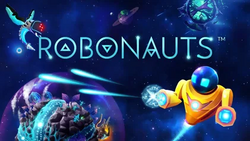
Robonauts is the sort of game that announces its intentions the way a vending machine announces your money is gone: efficiently and without remorse. Developed and published by QubicGames and scored by Simon Viklund with what can politely be called "robotic beats," it launched on PlayStation 4 on 19 September 2017 after sharing its circuitry with the Switch. If you like arcade shooters that boil down to moving, aiming, and pressing buttons in satisfying sequences, Robonauts is a tidy little package. If you like story arcs, moral quandaries, or anything approaching subtlety, this game will suggest replaying the same orbit until something sparkly appears. Both responses are valid.
Gameplay is refreshingly blunt. You play as a Robonaut (yes, that is a portmanteau; no, you do not get to change the name), hurtling from planet to planet, shooting whatever greets you until a gateway deigns to open. Each level is a miniature arena populated by enemies that are content to behave like bad taxi drivers at rush hour: persistent, slightly rude, and difficult to lose. The gateway is the level's exam result - it only opens once you've annihilated all enemies - and the game is perfectly clear that your only path forward is through disciplined, repetitive destruction. The basic loop is classic arcade: primary fire, secondary fire, dodge, repeat. Primary weapons are reliable and familiar, like a dependable coworker who turns up on time. Secondary weapons provide variety and a touch of flamboyance, the kind of thing you buy at a gas station when you'd normally just eat ramen. Together they let you sculpt how each encounter feels: surgical, chaotic, or somewhere in between. The game rewards rhythm and positioning more than blind twitching. There is pleasure in learning enemy patterns and using the small maps efficiently, and Robonauts gives you the tools to do that without making things overly complicated. Two features try to keep the arcade loop from becoming a looped tape: gravity switching and Tactical mode. Gravity switching is as useful as it sounds. Planets are arranged like a planetary salad, and you can hop to ones above, below, or beside you. It turns levels into tiny three-dimensional puzzles inside a two-dimensional plane and injects a little spatial thinking into a genre that often forgets it exists. The novelty is subtle but genuinely smart: one second you are focusing on a swarm in front of you, the next you flick to another world and deal with a boss who seems to be auditioning for the role of "annoying laser-emitter." It keeps momentum up without needing to reinvent the shooter wheel. Tactical mode is the game's polite version of letting you cheat without admitting it. The action pauses and a map appears, highlighting remaining enemies. This is useful if you're hunting a single straggler that's been hiding behind geometry like a teenager avoiding chores. It's an implicit acknowledgment that the core gameplay loop can become repetitive, and rather than pretend otherwise, Robonauts gives players a small, elevator-style button to make the repetitive bits less tedious. Multiplayer exists, in the limited sense that the game allows for local co-op and a Vs. mode. This is the part of Robonauts that smells faintly of living-room nostalgia: bring a friend, share a couch, both of you press buttons in the same space. It's fun, particularly for short bursts, but there is no online play. If your ideal gaming session involves strangers and moral ambiguity, you will be disappointed. If it involves friends, chips, and the slow, quiet judgement of someone who keeps stealing your power-ups, Robonauts performs admirably. The campaign is compact and intentionally arcade-like. If you find repetition problematic, the game will test your tolerance. Reviews at launch noted this too: Nintendo Life gave it a 7/10 for being "well-crafted" but repetitive, and COG called it an arcade-inspired shooter that "should have been better" while still recognizing its precise identity. Those assessments are fair. Robonauts doesn't pretend to be a sprawling epic. It is the kind of game that knows it is an arcade shooter and commits to that identity like a very small, very violent philosophy. For completionists and score-chasers, there is a clear carrot: higher scores, faster clears, and smart use of weapons. For casual players, the bite-sized levels and Tactical mode make it easy to dip in and out without losing progress. The game's longevity depends on how much joy you derive from optimizing runs and replaying levels for cleaner clears. It's short on narrative ambition but long on mechanical polish, which is to say it knows how to make explosions feel good without asking existential questions about them.
Robonauts looks like an arcade machine that got a degree in modern indie aesthetics. The graphics are crisp and colorful in a way that says "we bought good shaders but didn't try to convince you this is photorealism." Characters and enemies are readable, which matters more than cinematic lighting when your primary activity is avoiding a barrage of lasers. The level design prioritizes clarity over spectacle: you can tell at a glance where platforms are, how planets connect, and where trouble tends to spawn. That might disappoint anyone hoping for elaborate, narrative-driven set pieces, but it will please players who want to see the bullets coming and react before they become a feature film. Animations are functional and occasionally charming - explosions have satisfying punctuation, and enemy designs convey personality without needing backstories. The soundtrack by Simon Viklund leans into arcade beats and robotic rhythms, which pairs with the visuals like carbon fiber with a whisper of nostalgia. It propels the action without begging for attention. All in all, Robonauts' presentation is efficient: it gives you what you need to play well and makes the whole affair look slightly cooler than it strictly has to.
Robonauts is not trying to be your life's magnum opus. It wants to be a tidy arcade shooter that you can pick up, play, and put down again without feeling guilty. It succeeds at that. The gravity-switching mechanic and Tactical mode add enough tactical depth to keep repeated runs interesting, and local multiplayer makes it a solid couch option. Its shortcomings are the ones you expect from a game of this type: repetition that can set in if you're not chasing scores, and a lack of online multiplayer for people who prefer their cooperation to come with lag and strangers. If you enjoy precise, well-crafted arcade shooters and have nostalgia for local co-op sessions where everyone argues about who took the last life, Robonauts is worth your time and the modest price it asks. If you were hoping for narrative depth, online chaos, or a reason to write a thesis about robot identity, look elsewhere. For what it sets out to do - be a polished, compact arcade shooter on PS4 - it delivers with the cheerful economy of a machine built to a single, elegant purpose: make you shoot things until the gateway opens. Which, in many people's book, is a perfectly reasonable weekend plan.
 Coloball 2002 on PS2
 Press Your Luck on PS3
 Game Dev Story on PS4
 Mom Hid My Game! on Switch










 Another SquareThought Site