

 Dec 2019
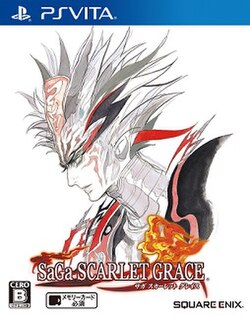

SaGa: Scarlet Grace - Ambitions is the beefed-up console port of a Vita-born SaGa oddity, and on PS4 it feels like a piece of old-school JRPG engineering that's been taken to a modern garage and given new suspension. The original Scarlet Grace (2016) was built in Unity for Vita with a decidedly 'more brain than glitz' philosophy: no random encounters, a pop-up-book overworld, and a combat suite that punishes assumptions about XP, grind and 'do the same attack until you win.' Ambitions (the expanded release) brings voice acting, extra story content, music additions, and practical technical improvements-reduced load times, higher resolution options and movement speed tweaks-making the PS4 version the definitive technical iteration. If you care about systems that behave predictably yet surprise you by design, this is the SaGa entry that reads its manual while sipping tea and then punches you with consequences.
If you want crunchy mechanics over cinematic spectacle, Scarlet Grace serves them in industrial portions. The game gives you four distinct protagonists (Urpina, Leonard, Taria, Balmaint) and treats each as their own mini-campaign within a Free Scenario framework: events on the world map are the main driver, and they can be triggered in virtually any order-or missed entirely. That nonlinearity is not decoration; it changes which events, companions and endings you can reach. The world map itself is a hybrid: 2D province art with a 3D avatar walking across it. Events are node-based (towns, transport points, battle encounters and Production nodes). Production is a lightweight regional-trade mini-system that hands you crafting materials if you like micromanaging resource loops. Combat is the game's raison d'être and where the technical design really shines. Battles are arena-based and turn-based, but you don't get a vanilla ATB or simple turn wheel. Instead you have a Timeline UI showing upcoming actions for both sides, and actions are paid for using Battle Points (BP), visualized as a line of stars. Characters who can't be assigned an action skip their turn-so planning around limited BP is a constant tactical constraint. Formation choice affects stat scaling and available tactics, and there are eight weapon types with distinct attributes and counters, so weapon choice matters beyond raw numbers. Techniques (class-agnostic battle abilities) level up with use and have five ranks; weapons have Weapon Skills that improve similarly. There's no XP-based level cap grind-the game uses usage-based progression to raise stats and unlock or improve skills. This system rewards specific playstyles: if you whack with axes enough, axis skills and relevant stats improve. Conversely, the game will nudge you away from cookie-cutter comfort by withholding predictable power ramps. United Attacks (triggered when the Timeline lines up) are both flashy and mechanically meaningful: they lower BP costs next turn, with the reduction scaling by which participants contributed and how much damage they dealt. There are pushback mechanics, Timeline manipulation techniques, and even passive boons called Benisons that can heal or remove effects at the cost of cancelling the party's current actions for one turn-an elegant risk/reward tool. The game preserves the SaGa tradition of hard choices: Life Points (LP) are a persistent pool that don't replenish in-battle; HP heals normally. When LP hits zero a character is sidelined until they recover (one LP every two battles by default, or via town exchanges). That LP mechanic used to mean permadeath in older SaGa titles; here it's a softer constraint that still forces resource planning across multiple fights. Enemy strength and loot are previewed before you engage, letting you play gambler or optimist with meaningful information rather than blind grinding. Ambitions adds practical QoL and mechanical tweaks: difficulty modifiers (inspired by prior Romancing SaGa systems), multiple battle cry/voice options, and balance adjustments. Importantly for the PS4 port, load times were targeted and reduced, movement speeds increased on the overworld, and screen resolution and graphics customization were exposed-those are not just niceties but fixes that directly affect pacing and player comfort.
Graphically, Scarlet Grace is deliberately strange in a way that will split players. Tomomi Kobayashi's character art and the pop-up-book world map aesthetic are central design choices rather than budget excuses. The map feels like layered 2D plates with 3D protagonist models walking across them; this is an artistic tradeoff that keeps streaming and memory demands down while giving the game a hand-painted charm. The choice to render exploration models in 3D while keeping environments as 2D art was budget-aware: the team explicitly avoided 3D dungeons because that would have meant a large dedicated team. On PS4, where GPU and CPU headroom are available, Ambitions focuses on cleaner rendering pipelines-upscaled 2D assets, higher resolution textures, optional screen resolution settings, and faster asset streaming thanks to reduced load times. The Unity engine underpins everything: Unity eased porting from Vita/mobile to PS4 and Switch, but some visual artifacts betray the engine's multi-platform origins-asset recycling and simpler shaders show up when compared to native high-end titles. Animation and effects are functional rather than showy: Techniques and Timeline pushes have clear telegraphs and readable particle FX, which is a net positive for a system-first game. Sound and music, composed by Kenji Ito with orchestral arrangements, add production value; Ambitions introduced a new opening theme and extra tracks, and PS4's audio fidelity lets orchestral swells land better. Voice acting is newly added in Ambitions and helps ground the characters, though it's used sparingly in the way a JRPG script of this scope often needs to be. Expect occasional texture reuse and UI elements that look more utilitarian than luxurious, but also a consistent frame-rate and far fewer loading pauses than the original Vita release.
SaGa: Scarlet Grace - Ambitions on PS4 is a technical and design-minded success because it knows what it aims to be: a systems-heavy JRPG that rewards engagement with its mechanics rather than cinematic spectacle. The Timeline + BP + usage-based progression systems are an excellent study in constrained design-they force choices, enable emergent strategies and make every fight feel like a puzzle. The Unity-powered port smartly addresses the original's technical rough edges (notably load times and movement speed) and layers in content-voice work, music and scenario expansions-that make the PS4 version the recommended one. It's not perfect. The visual style polarizes, some resource systems can feel opaque at first, and the non-linear event structure means you will miss content unless you consult guides or replay. There are also occasional balance spikes and boss encounters that feel unfairly tuned without careful prep. But for players who like to read mechanics like a second language and enjoy a JRPG that trusts complexity over hand-holding, Ambitions is a tidy package. The localization by 8-4 is solid, the music has high points, and the technical improvements make PS4 the platform where SaGa: Scarlet Grace finally breathes without the Vita's constraints. If you want a JRPG that behaves like a well-made board game with better art, this one earns a solid 8/10.
 Koumajou Densetsu: Scarlet Symphony on PS5
 Dead or Alive Xtreme 3: Scarlet on Switch
 Combat Elite: WWII Paratroopers on PS2
 The Banner Saga 2 on PS4
 Arcania: The Complete Tale on PS3
 Gnosia on Xbox Series X/S










 Another SquareThought Site