

 Sep 2015
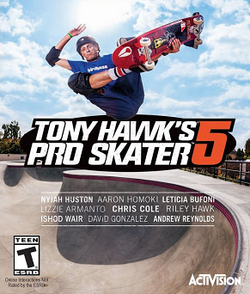

If you remember the early 2000s Tony Hawk games as tight, twitchy, joy-inducing combo machines, playing Tony Hawk's Pro Skater 5 on PS4 feels like trying to ollie while someone keeps fiddling with your shoelaces. The title promises a return to arcade-style skating: link grinds, flip tricks, manuals and big multipliers. What it actually delivers is a curious mix of old-school scoring logic, new fiddly inputs, and a buffet of technical problems that turn some of the intended challenges into chores. This review looks specifically at the challenge aspects and the player skills the game asks of you - for better and for worse.
On paper THPS5 still speaks fluent Pro Skater: chain aerials, flips, grinds, lips and manuals to build score, fill a special meter and then unleash the high-value tricks. The scoring system rewards time-on-trick, rotations, landmark hits and combo length, so dangerous combinations and spatial awareness remain central. If you approach the game as a puzzle about momentum economy and risk management, the core idea is intact: layer tricks without bailing, maintain manuals, and squeeze the maximum multiplier out of every line. Where light-speed reflexes and rhythm used to win the day, THPS5 throws in a handful of curveballs. The most notable is the stomp mechanic - a new input that lets you slam to the ground mid-air to reach rails or smash objects. In theory stomp adds tactical depth: it extends reach and creates options for creative lines. In practice the stomp shares buttons with grind functions, which means your attempts to pull off elaborate grind-to-manual-to-aerial sequences are frequently interrupted by the game thinking you wanted to stomp instead. That ambiguity turns what should be precise timing into an exercise in input diplomacy. Instead of focusing purely on combo planning, skilled players must now also micro-manage accidental command collisions. The special meter works as a familiar risk/reward loop: fill it to pull off special tricks that multiply your score. The meta skill here is meter management - balancing safe scores to keep momentum versus deliberately stacking risk so you hit the meter and finish with an enormous trick. However, because of altered flip mechanics (double/triple flips changed) and missing features like flatland tricks and grind-switching previously used to salvage combos, the set of viable trick strings is narrower. Players with strong spatial memory and classical sequence-building skills will still find ways to milk combos, but they'll be doing more improvisation to patch holes where the mechanics used to let you seamlessly link moves. Level design was intended to be bite-sized nostalgia, but the maps are smaller, simpler and often derivative. Challenge becomes less about carving clever, multi-stage routes and more about memorizing where objectives sit and optimizing a handful of predictable lines. For players who thrive on route discovery, that's a disappointment. For those who like execution challenges - nailing timing, landing long manuals, and precise flip rotations - the basic arcade core still offers bite-sized tests of skill. Patience and repetition are rewarded, but sometimes the repetition is sour: many in-level tasks are unskippable, and some objectives require jump-through-hoops steps that feel like rote busywork rather than satisfying feats of skate control. The online and always-on aspects add another layer to the challenge: persistent connections cause framerate drops and server dependency that can interrupt runs. A skilled player aiming to set a high score or string a world-beating line might find their rhythm ruined by stutters or sudden server failures. If you're the kind of person who relishes the purity of a perfect run, carving through a level with no hiccups, THPS5 asks you not only to master the game's controls but also to master misery-resistance: learn to disconnect, to accept odd glitches, and to keep grinding (sometimes literally) when the tech isn't cooperating. Create-a-Park is present, and that's where some clever, design-oriented players can exploit the sandbox to craft true challenges. If you want to test your own skills, building routes that require long manuals, tight bead-like grind transitions, or trampoline-style launches can be rewarding. The game's ten levels and power-up features (double jump, gigantism, elemental skateboards) can spice up self-made runs, but the core limitation remains: the toolkit for trick variety and seamless sequencing is weaker than it used to be. So what skills does THPS5 actually demand? Timing and rhythm remain king - landing trick chains, keeping manuals alive, and executing special tricks all hinge on millisecond timing. Spatial memory and route planning are crucial, because levels reward planning a score-optimized line. Adaptability is now higher on the priority list than in previous entries: you must adapt to clunky new controls, occasional frame hiccups and a stomp mechanic whose behavior sometimes feels like it's out of phase with your intentions. Finally, patience and troubleshooting are accidental skills you acquire - learning to accept server flakiness, to disconnect when necessary, and to replay objectives until the game behaves, are sadly part of the experience.
Graphically THPS5 is an odd, defensive animal. After early footage was panned for being dated, the developers shifted late in development to a cel-shaded look to try and mask uneven visuals and chase a stable frame rate. The result is not offensively ugly, but it's also not the visual feast you expect from a modern PS4 title. Levels look bland and simplified; they often lack NPCs and environmental personality, which hurts readability and makes route discovery less inspiring. Performance problems - framerate drops and stuttering tied to online features - undermine the otherwise arcade intent. For players focused on challenges, clarity of visuals matters: you want to see rails, ledges and gaps at a glance. THPS5 sometimes provides that clarity, but more often the world feels slapped together, with a level geometry that emphasizes functional placement over imaginative flow. In short: the graphics don't add to the challenge in a meaningful way, and sometimes they make your job harder by offering less visual feedback when you desperately need it.
If you're a skills-first player who lives for flawless combos, perfectly timed manuals and chaining trick classes into a single glorious score, Tony Hawk's Pro Skater 5 contains the bones of that thrill but buries it under a pile of execution hurdles that weren't intentionally designed as difficulty - they're bugs, awkward inputs and design shortcuts. The game still requires timing, spatial planning and creativity, and the Create-a-Park mode offers a sandbox to craft real challenges. For the patient and the masochistic - the kind of skater who will learn the odd stomp timing, forgive server problems, and re-run objectives ad nauseam - there are moments of joy. For anyone expecting the polished, flowing challenge of classic Pro Skater entries, this is a frustrating detour. It asks a lot from your skillset: better reflexes than it rewards, more patience than it deserves, and a tolerance for technical nonsense you didn't sign up for. Consider this a cautionary tale: the core combat of skating is still fun, but the obstacles you have to get past are mostly the game itself, not its levels.
 NHL Hitz Pro on PS2
 Pro Yakyū Spirits 2019 on PS4
 Online Pro Wrestling on PS2
 Accolade Sports Collection on Xbox Series X/S
 Deca Sports DS on DS
 Alan Hansen's Sports Challenge on PS2
 Olympic Games Tokyo 2020 - The Official Video Game on Switch










 Another SquareThought Site