

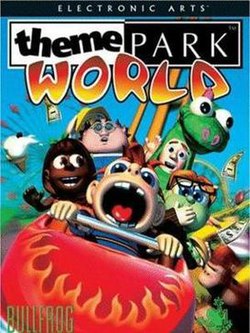

Theme Park World arrived on PlayStation at a time when the idea of a fully 3D management sim still turned a few heads. Bullfrog's original concept - build attractions, micro-manage staff, and coax delight (and coin) out of pixelated crowds - was given a facelift with a 3D engine and a new behavioural AI layer. The PlayStation version, ported by Climax Studios, tries to keep the PC ambition intact while shoehorning it into the console's CPU, RAM and controller realities. That compromise defines the PlayStation experience: it's the same bright, cartoonish theme-park microcosm, but translated into the language of limited memory budgets, sprite impostors and context-sensitive button menus. For technical-minded players the interest lies less in the cotton-candy aesthetics and more in the engineering choices - how the game models guests, how rides are represented, and how much of the original PC feature set survives the migration to a 32-bit console.
At its core Theme Park World is proper management-sim plumbing. You lay paths, place rides and shops, hire mechanics, cleaners, entertainers, guards and researchers, and then obsess about queue lengths, guest needs and revenue-per-square-meter. Where the PlayStation release becomes interesting from a systems perspective is in the behavioural AI and the abstraction layers used to compress PC complexity into controller-friendly operations. The visitor AI is one of the more technically ambitious pieces. Instead of a single monolithic 'happiness' number the game gives guests a profile of needs and behaviors: hunger, hygiene, entertainment preference, patience, and so on. These facets combine to produce thought bubbles and a visible happiness meter. The AI is goal-driven and reactive: guests pathfind to attractions, choose queues based on perceived wait times, and alter behaviour if facilities are poorly laid out or prices are wrong. The queuing system in particular is engineered to be visible and believable; Ben Board (credited with the behavioural system) focused on making long queues look alive rather than static lines. That requires keeping individual guest state and positions, which is CPU-expensive, especially on a PS1-class CPU - so the port balances fidelity with batching and simplification so that rendering and logic don't fight for cycles. Mechanically, staff operate as service agents with training and rest cycles. Mechanics patch reliability problems and scientists research ride upgrades; research is the game's gating mechanic for progression. Rides can be upgraded for reliability, capacity and speed, and track-based attractions accept additional components like loops and jumps. From a simulation perspective this separation of reliability/capacity/speed is clean: it lets the designer tune ride throughput versus guest thrill, and the game gives clear feedback on the variables. Shops and kiosks have quality settings that influence guest purchase habits - another variable to tune for optimal earning-per-visit. Controller constraints force UI decisions. The PlayStation conversion leans on context-sensitive menus and button cycling rather than the hotkey-rich desktop UI of the PC version. The interface attempts to be 'laptop-like' in places (a small windowed control layout), but critics pointed out that navigating nested screens with a D-pad and face buttons is never as quick as a mouse. Climax compensated by beefing up minigames and making certain features easier to access, but the overall effect is a user experience that occasionally fights the player. Constructing complex roller-coaster tracks is one of the more fiddly actions: the editor is functional, but the precision you can achieve with analogue mouse input isn't perfectly replicated with a digital pad. One interesting design decision is feature gating. First-person ride and park touring modes exist, yet the PlayStation version locks them behind golden-ticket currency in some builds. This is technically reasonable: first-person camera playback requires higher bandwidth for continuous viewpoint updates and more memory for animating ride cars and camera motion, so gating them reduces sustained CPU/memory pressure and keeps framerate stable in busy parks. Mini-games also receive special treatment on the console. The PlayStation lacks the integrated internet sharing service of the PC version, so the port adds playable minigames tied to rides - short-form diversions that let you 'play' your attractions and earn small rewards. From a systems perspective, minigames are a smart trade: they provide content variety without adding continuous simulation load, and they reuse art assets while shifting control demands away from the main simulation loop. The economic simulation itself is straightforward and stable. You can take loans, buy extra land, and unlock new parks by earning golden keys. The tasks that award golden tickets (visitor counts, happiness targets, yearly profit) scale in difficulty as you progress. The in-game advisor provides guidance via voice lines and tooltips - voice acting that many players loved and some found repetitive. For a technical reviewer the advisor is a convenient UX layer that reduces the cognitive load of raw numerical displays, but if you want to 'see the math' you'll find it modest compared to hardcore sims that expose supply-chain and stock-market systems, which were intentionally trimmed from Theme Park World to broaden appeal. Performance and gameplay pacing are crucial. The PlayStation's limited RAM forces frequent scene-level memory management, so expect occasional pop-in of sprite detail and simplified LOD behaviour for crowds. The trade-off preserves a stable framerate during typical play, but when you push the park size and guest count the simulation axiomatically reaches the platform's limits: fewer simultaneously simulated physics events, coarser pathfinding updates, and more aggressive batching of visitor animation frames.
Graphically, Theme Park World is a study in 'convincing compromise'. Bullfrog moved away from 2D tile art into a 3D environment with sprite-based guests and simpler geometry for buildings and rides. The engine was explicitly designed to eliminate the need for a 3D accelerator on PC, and the PlayStation version inherits that design ethos: modest polygon counts, clever textures and sprite impostors to represent crowds. Sprite billboarding - the technique that keeps 2D guest sprites facing the camera - is widely used, and it cuts down on polygon budget while preserving readable silhouette and animation. The trade-offs are most obvious in zoomed-in views. Sprites do not dynamically gain detail as you zoom; close-up faces and costumes become pixeled and blocky. IGN's description of a 'pixeled horror' in close up is fair if you're used to modern LOD systems. From an engineering standpoint, increasing sprite resolution or swapping to 3D character models at close range would have increased texture memory and vertex processing beyond the PS1's feasible bounds. Ride and environment art is colorful and very readable at typical camera distances. Themed worlds (Lost Kingdom, Wonder Land, Halloween World, Space Zone) reuse ride assets with different skins - which is an efficient use of memory and artist time, but it also draws criticism for visual repetition across worlds. Animations are joyful when visible; particle effects and simple lighting are used sparingly to avoid GPU/CPU overload. On the PlayStation 2 the same game was reported to be smoother, but on PS1 the engine emphasizes consistent frame pacing over high-detail fidelity. Audio remains one of the game's technical highlights. The composer James Hannigan and the sound team won a BAFTA for Sound, and the implementation makes good use of the PlayStation's CD-quality audio channels. Music and environmental audio cues are mixed to prioritize important events and feedback - queue shouts, ride noises, and advisor lines - which improves player situational awareness without distracting from the simulation. The advisor voice acting is compressed but clear, and the quality won praise even from critics who grumbled about its repetitiveness.
Theme Park World on PlayStation is a case study in pragmatic porting. The original's simulation DNA is preserved: guest AI, staff roles, research and upgrade loops, and a satisfying feedback loop of building and reward. The console constraints are visible in sprite LOD, interface complexity, and some fiddly construction tools, but the porting team makes sensible trade-offs - adding minigames, gating first-person features, and reworking the UI for button-driven navigation. For players who care about underlying systems, the game remains addictive: the queuing logic, throughput/ride-thrill tradeoffs, and the way staff efficiency changes with training are all clear and tunable. For players who want graphical fidelity or precision construction with a mouse, the PS1 limitations (pixelated sprites at close range, controller-driven track editing) will feel like compromises. Technically competent, entertaining, and audibly excellent (a BAFTA winner), the PlayStation Theme Park World earns its place as a strong console interpretation of a PC management classic. It isn't perfect - the UI and sprite zoom behaviour show their age - but its simulation backbone and clever engineering decisions make it more than a nostalgia trip. If you want a management sim with personality, approachable complexity, and audio that actually got an award, this port is an enjoyable and technically interesting ride. Strap in, accept that you won't get pixel-perfect zooms, and enjoy the satisfaction of watching your guest-AI-driven economy hum - even if the occasional puking clown is the only way your roller coaster proves it's working.
 Harvest Moon: One World on Switch
 Nobody Saves the World on Xbox Series X/S
 Tennis World Tour on Switch
 Theme Aquarium on PlayStation
 Pro Evolution Soccer 2015 on PS4
 Power Pro Kun Pocket 13 on DS












 Another SquareThought Site