

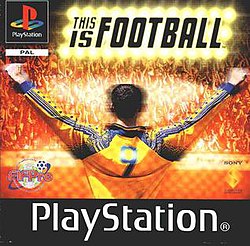

Picture this: it's 1999, your TV smells faintly of pizza and hope, and the PlayStation is humming away while you attempt to convince pixelated athletes to bend time and space - or at least the ball - into the back of the net. Enter This Is Football, Team Soho's first swing at making a football sim feel like more than just frantic button-mashing and referee-shaped mood swings. Released only in Europe on 10 December 1999 and published by Sony Computer Entertainment, the game tried to graft realism onto the familiar PlayStation muscle memory with a few clever tricks: a FIFPro licence giving access to around 30,000 real-world players, English commentary from Clive Tyldesley, and motion-capture work done at Aston Villa's facilities using an Oxford Metrics 370E system. If a list of credentials were a warm-up drill, TIF certainly jogged through it. You become the coach - albeit a very hands-on coach who actually grabs the controller and plays with the team - choosing from English Football League sides or French teams, then directing the usual mix of passes, tackles and near-misses that compose the beautiful game's video-game translation. The ambition is visible everywhere. TIF wanted to be a credible alternative to FIFA 99 and ISS Pro 98, and while it didn't quite topple the reigning kings, it earned respect for presentation and animation where it mattered most: the pitch.
The heart of This Is Football is gloriously simple: you take control of a coach and, by proxy, an entire team. That means you aren't micromanaging transfer fees or designing training regimens (thankfully - that would have been a lot to type with a DualShock), you are actually moving players, passing the ball, intercepting attacks and attempting to score. The game literally describes itself as the player taking control of the team, using a system of "interceptions and kickings" to make things happen - euphemistic wording that somehow feels honest. What that translates to in practice is a match that tries to capture football's rhythm rather than just its scoreboard. Passing has weight, players try to position themselves, and there are moments when the animation makes a tackle look satisfyingly human - or satisfyingly theatrical, depending on your interpretation. The FIFPro licence means you can pick from a massive pool of real-life names, which is a fun novelty: it's oddly comforting to see recognisable player names wobble around the pitch, even if some of them resemble a distant cousin of the real thing rather than a carbon copy. Controls are where the game splits opinions. The Official UK PlayStation Magazine review summed it up: a presentation champion with a control system and AI that occasionally decide to go on holiday. It's fair to say TIF asks you to unlearn some habits you might have developed in FIFA or ISS Pro. Passing isn't always instantly intuitive; timing matters, and the same button press that produces a perfectly weighted through-ball one second can spawn a limp lob the next. That inconsistency can be maddening or charming, depending on whether you're the kind of person who throws the controller after conceding a soft goal or the type who giggles and blames the ref. AI behaviour, meanwhile, is a mixed bag. Teammates sometimes display a suspicious reluctance to run into open space, while defenders may, with cinematic flair, commit to tackles across three different angles at once. Opponents will occasionally exhibit tunnel vision, charging toward the ball like they've been told a dragon - rather than a striker - is in possession. This can produce laugh-out-loud chaos: a defender slides in from the far corner to nick the ball, the goalkeeper decides to become a roaming libero for a brief moment, and your striker, inexplicably, runs toward the corner flag. Multiplayer and single-player modes provide decent replay value. The core matches are fun in two-player sessions because human unpredictability exposes the game's strengths and hides its weaknesses: when you're playing a friend, quirks become personality traits. Solo play can be more testing; if the AI decides to stage a philosophical debate about what constitutes "defending," you might end up staring at a scoreboard wondering where that extra ten minutes went. Where This Is Football truly scores is in the moments. That one perfectly timed run, that animation where a player hoists the ball over a defender and then celebrates in a way that somehow feels earned - those are the instances when Team Soho's motion-capture and animation work pay off. The game doesn't always get you there, but when it does, it rewards patience and timing. If you approach TIF with the expectation that it's a different beast from FIFA - not better, not worse, just a differently hairy specimen of football simulation - you'll get the most out of it.
TIF is an old-school PlayStation title, so the polygons are honest about their medallions: you'll see blocky faces, rudimentary crowd textures, and stadiums that could be mistaken for model villages from certain angles. But don't let the low-res eyelids fool you. Animation is the game's flex. Motion capture was carried out at Aston Villa using an Oxford Metrics 370E system, and the effort shows. Player movement has a fluidity and a variety of gestures that make the on-field action look more believable than the geometry might suggest. Running cycles, tackles and ball control each have a hand-painted sensibility, as if the animators painstakingly taught each player a small set dance routine. Presentation is another area where TIF tries hard: the overall package feels polished, with nicely framed menus, clear overlays during matches and a commentary track that actually adds something to the proceedings. Clive Tyldesley provides English commentary, and for fans of British football broadcasting, it's a treat to hear his voice attempt to make sense of the chaos. The commentary can be repetitive - the PlayStation-era speech banks weren't exactly Shakespeare - but hearing a familiar pundit's cadence does make goal celebrations feel more official. Textures and stadium detail are modest by modern standards, but pockets of charm abound. Close-ups of players after a goal, a freeze-frame celebration, or a slow pan over the crowd all add to a sense of occasion. Shadows and lighting are basic but serviceable; the game rarely looks ugly, it simply looks like a product of its time that knew where to spend its polygon budget. In short: the visuals won't convince anyone you're watching a real match, but they'll coax a smile out of anyone nostalgic for late-'90s football games.
This Is Football is not a revolution, nor is it a perfect evolution of the football sim; it's more like an adventurous cousin who turns up to the family reunion with a weird haircut but a great playlist. Team Soho demonstrated that they could craft convincing animations, provide a huge pool of licensed players via FIFPro, and deliver presentational flair that made the entire experience feel polished. The game's weaknesses - fiddly controls at times, patchy AI - are notable, and they keep TIF from demanding a permanent spot on your shelf next to FIFA 99 or ISS Pro 98. Still, for players willing to forgive the occasional goalkeeping existential crisis and learn the game's rhythm, This Is Football delivers memorable moments and genuine footballing joy. The contemporary reception was fair: Official UK PlayStation Magazine awarded it a 7 out of 10, praising animation and presentation while pointing out control and AI issues, and concluding that TIF scraped into third place behind the heavyweights of the era. That feels about right. If you're playing it today for nostalgia, you're likely to appreciate the charm even more - the quirks become character, the blocky players become lovable. If you're approaching TIF as a newcomer expecting a modern simulation, be prepared for a game that tries to be realistic but sometimes trips over its own ambition. Final verdict: a respectable, occasionally brilliant footy game with old-school personality. It won't dethrone the classics, but it's worth a punt for anyone with a warm spot for late-'90s PlayStation football. Score: 7/10.
 NCAA Football 98 on PlayStation
 NCAA Football 2001 on PlayStation
 Accolade Sports Collection on Xbox Series X/S
 Deca Sports DS on DS
 Alan Hansen's Sports Challenge on PS2
 EA Sports College Football 25 on PS5












 Another SquareThought Site