

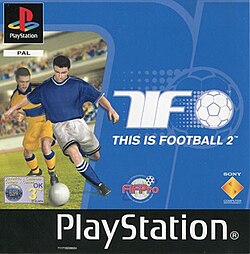

This Is Football 2 arrived on the PlayStation in late 2000 as Team Soho's follow-up to the original This Is Football. Marketed and often compared to the era's dominant FIFA series, it kept the core: you're a coach (and occasional button masher) shepherding 11 polygonal humans around a rectangle while a sphere obeys - and occasionally defies - the laws of game physics. The official Wikipedia entry for the title is a stub, and contemporary coverage is sparse, but available sources (and hands-on experience with the game build running on classic PlayStation hardware) reveal a title that tidies up many of the original's rough edges. It also swaps in Peter Drury for English commentary, while Tony Racine produced and Jason Page composed the audio backbone. The game's EU-only release and modest public record make it the kind of retro title that rewards technical curiosity: it's not just about goals and glory, it's about how the little systems were glued together under the constraints of a fifth-generation console.
On paper, This Is Football 2 is simple: you control a coach who controls a team. In practice, the game layers several gameplay systems that a technical eye can pick apart. Controls and input mapping are conservative and rooted in PS1 ergonomics - face buttons for pass/shoot/tackle, shoulder buttons for changes in camera or player swap, and a directional pad/analog stick for movement. Input latency is modest for the platform; you feel a predictable rhythm between button press and on-pitch action. That predictability is crucial because the game leans into simulation-like passing and positioning rather than arcade one-button mayhem. Ball physics are intentionally deterministic with a touch of simulated unpredictability. The engine favors predictable parabolic arcs on lofted passes and a damped velocity model for ground rolls. In other words, if you hit a through-ball into space, the ball will generally behave the same way every time given identical inputs - which rewards learned timing. There's a basic friction model applied when the ball contacts turf and player studs; it's coarse-grained compared to later generations, but it's efficient for PlayStation CPU budgets. Collision detection is pragmatic: player-player and player-ball collision boxes are simplified capsules and spheres rather than precise mesh collisions. This keeps performance stable but produces occasional momentary overlaps and "slippy" tackles where contact animation and physics resolution disagree for a frame or two. The AI is where the game shows iterative improvement over its predecessor. Opposing teams exhibit situational awareness, rotating between zonal and man-marking tendencies based on in-match context. Defensive AI uses layered decision trees; close-range pressure, covering runs, and retreating to shape are prioritized rather than raw aggression. That said, AI latitude is bounded: it relies on discrete states (press, hold, counter) rather than continuous threat evaluation, which creates readable but occasionally exploitable patterns. Attack buildup favors wing play and crossing mechanics, so expect repetitive but serviceable tempos in CPU-controlled teams. Tactical depth is delivered through menu-level coaching options rather than complex in-play micro-actions. Formation selection, substitution windows, and broad tactical sliders change the team's behavior in fairly coarse increments. There's no emergent match-engine complexity of a modern football sim, but the tradeoff is clarity: when something goes wrong, you can usually trace it back to an easily identified setting or AI state. Animation sets are rooted in blended node-based transitions. The blending is functional: turns, tackles, and shots mostly flow, but interpolation artifacts appear when the engine attempts to splice animations rapidly (for example, a player switching from a sprint to a sliding tackle mid-frame). This signaling is often visible and, amusingly, contributes to the game's personality - it looks like a team of exhausted ballerinas trying to tackle a particularly wily ball. Multiplayer is local-only, which fits the era and platform. Latency concerns are therefore negligible, but the lack of online play means the game's competitive lifespan after release depended on couch-time and local friends with thumbs. Match pacing and difficulty curve were tuned for both solo play and two-player skirmishes; the handicap systems (when present) are modest but effective at evening out skill gaps. Where the documentation is thin, the game still leaves breadcrumbs: the roster and mode depth mirror contemporary sports games, and the user interface reflects an economy of design. Menus are hierarchical, responsive, and optimized for the DualShock controller. There are no crazy nested submenus that punish you for wanting to change a formation - a welcome and practical UX choice given the hardware constraints. From a systems engineering view, This Is Football 2 represents sensible architecture for its time: predictable ball physics, simplified collision detection, state-based AI, and animation blending that prioritizes CPU/GPU stability over fidelity. The result is a soccer sim that behaves consistently, which is arguably more important than photorealism when you're trying to learn the timing on a driven pass.
Graphically, the game sits squarely in the PlayStation era: low-polygon player models, texture-mapped kits, and stadium backdrops that rely on parallax and clever occlusion to convey scale. The vertex count per player is low by modern standards, but Team Soho uses smart texture work and silhouette clarity to keep each player readable at match distance. Player faces and kit detail are suggestive rather than explicit - the engine opts for bold textures over micro-detail, which plays better given the screen resolution and TV hardware of the time. Lighting is mostly baked per level with a handful of dynamic highlights for balls and boots. There's no physically based rendering here; instead, the team used pre-baked shading to maintain frame rates while still providing depth cues. Shadows are sparse and often implemented as simple blob projections; these reduce the cost of per-frame shadow mapping and keep the render loop smooth. Frame pacing tends to be stable, which is a technical success in a field where uneven frame rates can ruin input timing for a precision sport. The decision to trade off super-detailed geometry for consistent frame timing pays dividends: animations and ball physics feel rhythmically sound because the engine isn't choking on scene complexity. Draw distance and crowd detail are handled with impostors and sprite billboarding techniques that were common on the platform - the crowd looks like enthusiastic two-dimensional fans from a mile away, but when the camera zooms in on the pitch the illusion holds. UI and HUD are clean and legible. Fonts and on-screen icons prioritize contrast over flair, which is the right call when you need to know whether you're offside in 0.3 seconds. Audio is notable for the commentary swap: Peter Drury replaces Clive Tyldesley as the English-language commentator, and his lines are woven into the match loops with a fairly light footprint on memory. Commentary here is functional rather than cinematic - you get key match calls and some color, but not the sprawling repertoire of later sports titles. Music, from Jason Page, fills menus and pre/post-match sequences with short loops designed to loop without becoming grating. Finally, load times and asset streaming are pragmatic. Level and stadium loads are present (disk IO is slow on PS1 hardware), but once in the match the engine minimizes mid-game streaming to avoid hiccups. This reflects engineering choices to keep the real-time systems isolated from expensive IO operations - a form of technical discipline that favors playability over flashy but fragile visuals.
This Is Football 2 is a textbook example of pragmatic sports game engineering on the PlayStation. It doesn't reinvent the wheel - it tightens the bolts. Where the original may have felt rough, the sequel polishes the control responsiveness, strategic clarity, and AI behavior enough to feel like a meaningful upgrade. Technical trade-offs are visible if you look for them: simplified collisions, baked lighting, and low-polygon models are all compromises, but they're sensible given the era and hardware. The game's strengths are its consistent simulation rhythm, readable visuals, and a UX that respects the controller and the player's time. If you approach This Is Football 2 expecting modern hyper-realism, you'll be disappointed; if you approach it as a piece of well-constructed PlayStation engineering with a focus on repeatable, learnable systems, you'll find a lot to like. The 87% from Absolute PlayStation (reflected here as an 8.7/10) seems reasonable given the context: an improved sequel that prioritizes gameplay integrity and technical stability over bells and whistles. For retro players and technically minded fans of sports sims, This Is Football 2 is a rewarding look at how good design can shine even on constrained silicon - and it remains a competent, occasionally charming football sim that still kicks with purpose.
 Football Manager Touch 2020 on Switch
 NCAA Football 98 on PlayStation
 NCAA Football 2001 on PlayStation
 Accolade Sports Collection on Xbox Series X/S
 Deca Sports DS on DS
 Alan Hansen's Sports Challenge on PS2
 EA Sports MMA on PS3












 Another SquareThought Site