

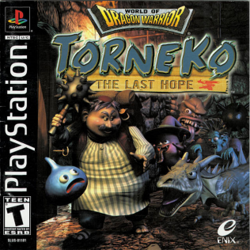

There is a particular brand of console RPG that wears its pedigree like a comfortable, slightly moth-eaten vest: familiar, dependable, occasionally smelling faintly of dragon scale. Torneko: The Last Hope is that vest. A spin-off from the Dragon Quest stable and the second Mystery Dungeon outing to make its way outside Japan, Torneko shoulders the role of an increasingly eccentric shopkeeper-adventurer and sets out into randomly generated mazes in search of goods, wealth and, if you're unlucky, an early grave. Released for the PlayStation in 1999 in Japan and a year later in North America, the game offers a curious mix of old-school roguelike discipline and Dragon Quest polish - Akira Toriyama's character designs on the box, Koichi Sugiyama's familiar musical sensibilities on the disc - wrapped in two-dimensional sprites that stubbornly refuse to pretend it's anything but a dungeon crawl.
The core of Torneko's experience is mercilessly simple and, depending on temperament, either deliciously addictive or maddeningly cruel. The screen is presented in a top-down, two-dimensional style; you move in single-tile increments and every action is a discrete turn. Monsters move when you move. You search, you fight, you loot, you starve - yes, the game has a hunger meter that will chew away at your hit points if you neglect to feed Torneko a slice of bread. Combat can be melee, ranged, or magical: swords, bows and arrows, wands and scrolls all play their expected roles. The dungeon floors are assembled by an algorithm every time you descend, meaning your map-reading skill is replaced by pattern recognition and careful inventory management. The Mystery Dungeon formula is uncompromising in Torneko: die and you pay a steep price. When Torneko embarks upon a dungeon run he can bring items with him and, crucially, store salvaged goods in his hometown storehouse. But there is a punitive reset baked into the design - after certain failures Torneko returns to base in a humbled state and may be reduced to level one, stripped of equipment until he re-gathers resources to rebuild his shop's stock. The game allows temporary mid-dungeon saves on occasion, but those saves are ephemeral; resume the game and that temporary sanctuary evaporates. This is not meant to be a leisurely, hold-your-hand JRPG; it is a roguelike in console clothing. The hunger meter, permadeath-ish penalties and random layouts conspire to create tension and reward exploration only to the disciplined and the patient. Chunsoft and Matrix Software populated the title with one hundred and thirty hand-drawn monsters, each bearing the familiar charm of Dragon Quest creature design. The variety provides both challenge and humor - a sequence of unfortunate encounters can empty your pockets faster than a traveling tuba player at a town fair. The game is light on a traditional narrative compared to full-fledged Dragon Quest entries: the plot is serviceable - Torneko returns home, finds his village afflicted with a curse and must root out the cause - but it exists mainly to justify the next spiral of dungeon floors. For players whose appetite is for carefully balanced risk/reward loops rather than cinematic storytelling, Torneko delivers. For those who came to the PlayStation expecting sprawling 3D epics and branching tales, the randomly generated dungeons and sparse story beats will feel like penance. Critical reactions at the time reflected that bifurcation. Some reviewers praised the addictive loop and the game's music, while others found it primitive and unforgiving. A few outlets flagged it as 'frustratingly difficult' while acknowledging an addictive core; others dismissed it as outdated in a market moving decisively toward cinematic spectacle. The truth sits somewhere in the middle: if you like methodical, tactical exploration where every loaf of bread counts, you'll find yourself playing 'just one more level' until dawn; if you prefer plot-driven progression and safe saves, Torneko will remind you of quieter, harsher times.
By 1999 standards, Torneko looked like a love letter to 16-bit sensibilities rather than a showcase for the PlayStation's 3D potential. The game uses two-dimensional, hand-drawn sprites across an overhead perspective. The presentation is unapologetically conservative; stray polygons and FMV sequences were not invited to this party. That conservatism is not without merit. Akira Toriyama's character designs lend the cast a charming immediacy and each of the 130 monsters has clear silhouette and personality. Animation is functional rather than fluid; a goblin's stab and a dragon's roar are conveyed in a handful of frames but backed by crisply composed sprite work. Aesthetically, the game trades flashy technical bravado for readability and charm. Where more modern console RPGs of the era were touting pre-rendered backgrounds and polygonal heroes, Torneko kept its focus on clear icons, readable menus and environments that let the gameplay breathe. This decision was polarizing. Outlets accustomed to PlayStation-era innovations called the visuals primitive; Japanese press, most notably Famitsu, rewarded the title with high marks and praised its execution. The soundtrack by Koichi Sugiyama shores up the visuals, giving dungeon floors a sense of place and providing musical cues that match the mood: jaunty when you're flush with loot, portentous when a floor feels like a death sentence. The original PlayStation soundtrack saw a standalone release in January 2000, which was no small thing for players who found the music an equal partner to the gameplay.
Torneko: The Last Hope is a peculiar artifact - a serious roguelike wearing JRPG finery, released at a moment when the industry was racing toward cinematic spectacle. It earned plaudits in Japan, selling respectably and receiving lofty scores from publications such as Famitsu, and it won the hearts of a niche of players who loved its merciless but fair loops and memorable monster design. In North America it landed awkwardly: localization was reportedly a labor of love undertaken on a tight budget and tighter deadline, and American critics and consumers reacted with a mix of bafflement and irritation. Aggregate scores hovered in the middling range, mirroring the split between those who admired the game's purity and those who saw it as an anachronism. If you approach Torneko as a modern PlayStation museum piece, or better yet, as a concise demonstration of the Mystery Dungeon formula, you will find much to admire: considered design, a soundtrack with real gravitas and a game that rewards patience. If you want a sweeping narrative, frequent checkpoints and a forgiving learning curve, this is not the title to bring home. Much like the character of Torneko himself - louche, entrepreneurial and prone to getting chased out of dungeons with nothing but a single copper coin - the game is stubborn, eccentric and oddly endearing. For roguelike purists and Dragon Quest nostalgics it remains a worthwhile excursion; for everyone else, it is an instructive relic from an era when games still dared to be difficult for the sake of it.
 ACA Neo Geo: The Last Blade on Xbox One
 Last Window: The Secret of Cape West on DS
 Combat Elite: WWII Paratroopers on PS2
 The Banner Saga 2 on PS4
 Arcania: The Complete Tale on PS3
 Gnosia on Xbox Series X/S












 Another SquareThought Site