

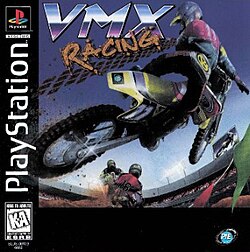

VMX Racing might have marketed itself as a dirt-bike racer, but watching it in motion feels less like MotoGP and more like a midseason character study where everyone keeps falling off their emotional bikes. Developed by Studio e and published by Playmates Interactive for the PlayStation in 1997, VMX is a compact title with a surprisingly clear set of personalities - the Player, the Bike, the Terrain, and a chorus of faceless Rivals. This review approaches the game like an obsessed soap-opera critic dissecting arcs, growth, and dramatic beats. The meta-plot is simple: enter a race, avoid the litter of environmental triggers, and try not to meet the unwelcome kiss of a tumble. The game also carries the baggage of critical scorn - a GameRankings aggregate of 35% and individual reviews ranging from faint praise to outright condemnation - which colors our reading of each character's journey.
If VMX Racing were a novel, the central thesis would be 'commitment to the throttle as character development.' The Player is the protagonist with agency: you accelerate, you brake, you attempt tricks. Their arc is short and violent; the Player learns early on that grass, snow, and gravel are not mere scenery but the game's moral code - touch them and the bike and rider are unceremoniously ejected into shame. This mechanic turns every lap into a morality play about boundaries. You are either a saint of the tarmac, blessed by traction, or a heretic rolling in foliage. The Bike is both companion and reflection of the Player's competence. It responds to throttle inputs in ways that let the game claim some depth - Next Generation and others noted the ability to pull maneuvers and tricks by manipulating the throttle. That mechanic is the Bike's only real character development: a glimmer of skill, the possibility of flair. It suggests potential for a redemption arc where player mastery transforms a clunky mount into a graceful steed, but VMX rarely follows through. The Rivals are unnamed and interchangeable, which is probably an artistic choice to emphasize the loneliness of the racer's path. They exist primarily to be passed, crashed into, or used as excuses for the Player's failure. Multiplay options introduce social dynamics, but the AI opponents offer no dialogue, no taunting gestures, nothing beyond positional updates on the leaderboard. The Terrain, by contrast, is the villain with a clear motive. Grass, snow, and gravel are traps; their presence rewrites the rules of racing into a fearful dance. A single wheel in the wrong place and the narrative cuts to black: tumble, resume, pretend the tumble had emotional resonance. Modes are functional rather than theatrical: single-player campaigns and multiplayer tiffs. The gameplay loop is short and repetitive, which contributes to the sense that character arcs never have room to breathe. Early previews and some publications reacted with hope, even praise, for the tricks and throttle nuance, but critical consensus turned sour once reviewers had spent more time with the game. GameSpot's savage 1.6/10 and GameRevolution's F suggest that the story beats - the potential arcs of player skill and bike mastery - collapse under mechanical clumsiness and a lack of supporting systems. VMX offers seeds of a story about becoming better through risk and control, but it leaves those seeds unwatered.
If you judge characters by their wardrobe, VMX's cast looks like they raided the bargain bin of late-'90s polygon fashion. The riders and bikes are blocky classics of early PlayStation geometry, and the tracks are functional sets rather than immersive worlds. The visual design reinforces the narrative limitations: anonymous Rivals, unvaried trackside details, and textures that occasionally smear together like a hastily written subplot. There is no radiant character animation to sell emotional transitions; crashes are abrupt and final, lacking the melodramatic slo-mo tumble that would make them tragicomic rather than merely mechanical. The camera and presentation do not do favors for dramatic beats either - the game rarely frames a moment to feel consequential. On the technical side, this aesthetic was typical for many 1997 PlayStation titles, but where contemporaries were sometimes saved by charm or exceptional controls, VMX's visuals act more like an indifferent stage crew. One positive note, reflected in some contemporary reviews, is that the throttle-based trick system is readable enough visually to let you know when something cool is happening, even if those moments are fleeting and rare. In short, the graphics are competent in the 'this is a 1997 PlayStation game' sense, but they don't deepen any of the characters' arcs; they simply put them on a minimally dressed stage.
Reading VMX Racing as a character study is both charitable and oddly revealing. The game presents a handful of clear figures - the hopeful Player, the temperamental Bike, the merciless Terrain, and the vacant Rivals - but fails to pull them into a satisfying narrative. There is an acknowledged mechanic capable of becoming a character-defining trait: throttle tricks. Critics like Next Generation offered that as the title's lone redeeming feature. Unfortunately, VMX seldom scaffolds the rest of its systems around that kernel of identity. Reviews were mostly negative, with GameRankings aggregating a meager 35% and harsh takes like GameSpot's 1.6/10 highlighting the gulf between potential and realization. A few voices, such as GameFan, found something to cheer in the chaos, producing outlier praise, but those cheers felt like clapping for a single stunt while the stage burned. For an 18-year-old looking for a racer with personality, VMX provides a weirdly intimate glimpse into failure. It teaches the grim lesson that having a concept (do tricks with the throttle!) does not equal having a game. If you want to experience a short, occasionally interesting attempt at throttle-based trick mechanics wrapped in the brittle shell of late-'90s PlayStation graphics - and you enjoy contemplating how characters with so much potential can squander their arcs - then VMX is a minor curiosity worth a rental or a cheap digital browse. If you prefer a full narrative or a polished mechanical evolution where player skill palpably transforms character and machine, steer clear: VMX crashes on the first patch of grass and then asks you to pretend it was a meaningful choice.
 Team Sonic Racing on Switch
 Garfield Kart: Furious Racing on Switch
 Ben 10: Galactic Racing on PS3













 Another SquareThought Site