

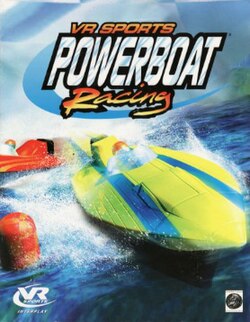

VR Sports Powerboat Racing is the kind of game that promises high-speed water chaos and then hands you a handful of slippery controls and an optimistic camera angle. On paper it has everything that should make a hydrodynamic heart sing: 16 different craft to master, water physics that attempt to simulate turbulence and wakes, and multiplayer split-screen carnage for up to four players. In practice it's a treadmill of twitchy steering, blind corners caused by aggressive pop-up, and a sky-happy camera that loves the clouds more than your actual race line. If you like your challenges pure and fair, be warned: this one mixes legitimate skill demands with a generous dash of developer-induced frustration. If you enjoy banging your head against a learning curve while laughing at how terrible the UI choices are, you might have a weird kind of fun.
At its core Powerboat Racing asks you to do two things simultaneously: read water and fight the controller. The 16 craft are differentiated by engine size and handling, so choosing your boat already demands a basic self-assessment of risk tolerance. Do you want a screamer that rockets off the line but snaps in turbulence, or a porkier, more forgiving hull that keeps you calm when wakes decide to play bumper boats? The game's headline mechanical ambition is the water physics. Turbulence and wakes are supposed to make each lap unpredictable, and they do - often with vindictive enthusiasm. A key skill here is anticipation. Unlike flat-surface racers where you can lean on predictable grip models, Powerboat rewards players who scan further ahead and factor in how the water will shake their boat three seconds from now. That means learning to read the surface for chop, estimating where an opponent's wake will intersect your line, and pre-emptively counter-steering before the hull does something embarrassing. Controls are a frequent punching bag in reviews, and for good reason: they're oversensitive. The game will happily translate the slightest thumb twitch into an aggressive yaw, so fine motor control and restraint are essential. You need to develop delicate throttle and steering inputs - full bore isn't always the solution. There's a tactile skill to feathering the throttle through a choppy section to avoid launching into a spin, and mastering the balance between speed and stability becomes the core competency for competitive play. Camera and sightlines introduce another layer of challenge. The default upward-angled camera loves the sky and hates your course, which forces players to rely on memory, peripheral cues, and prediction rather than raw sight-reading. When pop-up is active and obstacles materialize when you're already committed, the game effectively converts some sections into memorization tests. The solution is to learn each track's photos and ghosts: memorize choke points, practice timing for turns where a wall might not exist until it does, and choose lines that give you the longest reaction window. This makes the training loop almost mandatory; casual pick-up play will feel more like punishment than education. Multiplayer amplifies both the fun and the required skill set. With split-screen up to four players, wakes become strategic weapons. Learning to use your wake offensively - nudging opponents into turbulence - is a high-level trick, while defending against wake abuse becomes an exercise in trimming and stability. Multiplayer also exposes the game's forgiving modes and frenetic pace: chaos reigns when humans are involved, and the required skills shift from track memorization to psychological timing and opportunistic aggression. If you're racing against friends, situational awareness and wake management can win you races even if your raw handling isn't the tightest. Platform nuances also affect what skills make sense. On PC the steering wheel input option reportedly works best, which flips the balance toward precise analog control and reduces the twitchy thumb problem. On PlayStation you're stuck massaging the joystick, which means refining thumb technique and patient practice. The Windows version's odd UI choices, like scrolling alphabet name entry despite keyboard availability, are not skill tests so much as palate cleansers of irritation. If you want to 'git gud' here, focus on three pillars: memorization of tracks to mitigate pop-up surprises; micro-input discipline to cope with oversensitive controls; and wake literacy - both using and negating wake impacts. Master those and the game's rough edges become less punishing and more like quirks to exploit.
Visually, Powerboat Racing courts nostalgia for late 90s polygonal ambition, but the implementation betrays a budget. Water effects, the very centerpiece of the experience, look cheap by contemporary standards; spray and chop are often represented by blocky textures and uninspired particle work, which undermines the immersion and makes it harder to read subtle surface cues. The camera's obsessive sky coverage further compounds the problem by hiding upcoming features of the track and forcing players to rely on memory or frantic corrective steering. Pop-up is a practical and aesthetic issue. When track geometry or hazards pop into existence only when you're alarmingly close, the resulting blind corners feel less like a challenge and more like a cheap trick. The combination of middling draw distance, aggressive pop-up, and a high camera angle creates a visual environment where course-reading must occur mentally as much as visually - a neat test of cognitive mapping if you squint and call it intentional design. Character models, boats, and UI are plain and functional. There's an irritating voice-over commentator that tends toward repetition, which adds noise without contributing meaningful feedback. When the visuals are this modest, clarity in the HUD and camera options would have been a welcome balm. Unfortunately, camera control is limited, and the limited polish makes some of the visual shortcomings feel magnified.
VR Sports Powerboat Racing is a textbook example of a game with credible mechanical ambition hamstrung by rough execution. The water physics and wake interactions create a legitimate skill ceiling: you can become a master of throttle finesse, wake tactics, and track memory. Those are real, satisfying competencies that reward patient practice. The problem is the game layers self-inflicted difficulty on top of those skills - oversensitive controls, an upward-tilted camera obsessed with the sky, and nasty pop-up that cheats your line of sight. That combination turns many races into exercises in frustration rather than displays of mastery. If you're a completionist who enjoys wrestling with an awkward control scheme until it snaps into place, or if you have friends for split-screen mayhem and like channeling competitive spite into wake warfare, this game can still yield a few guilty-pleasure hours. For most players, though, the learning curve tilts from challenging to punishing because some of the obstacles feel arbitrary rather than skill-based. Take the 16 boats and water physics as an appealing core, but know you'll be paying extra in patience and pain for the privilege. Rent it first; only buy it if you genuinely enjoy polishing rough diamonds with thumb sweat and stubbornness.
 Deca Sports DS on DS
 Roary the Racing Car on DS
 Team Sonic Racing on Switch
 Garfield Kart: Furious Racing on Switch












 Another SquareThought Site