

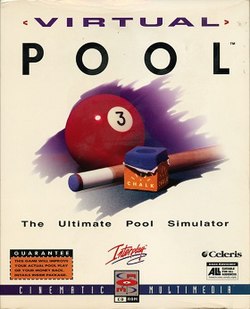

There are games that sell you arcade thrills and there are games that sell you patience, geometry and a somewhat unhealthy respect for the angle of incidence. Virtual Pool, first released on PC in 1995 and belatedly ported to PlayStation in 1997, belongs squarely to the second category. Developed by Celeris and published by Interplay, the title arrived in an era when multimedia CD-ROMs promised to teach you everything from shark biology to how to tie a Windsor knot. What Virtual Pool actually teaches you, with unnerving effectiveness, is how to make the cue ball behave like an obedient billiard servant. Seen through the squinty, earnest eyes of a mid-90s reviewer, Virtual Pool was a rare breed: a niche sim that aspired to be more than a party trick. Where previous billiards games offered a godlike overhead view or wonky ball physics, Celeris presented pool from a first-person perspective and built a physics model that made the table behave like a stubborn, wooden teacher. The PlayStation cartridge-er, disc-brought the same ambitions to consoles, but also the console's limits. This review examines whether the game's precise heart survives the translation to Sony's grey box, and whether the compromises are forgivable in the name of realism.
Virtual Pool's fundamental accomplishment is its control of the cue-ball relationship. The shot mechanics use a mouse-forward motion on the PC; on the PlayStation this control scheme was reinterpreted for the DualShock and, if you were faintly insane or very committed, the PlayStation Mouse. Players can alter pace, side (English), angle and raise the butt of the cue for swerve shots. The game even lets you 'walk' around the table in first-person, lean in to inspect an angle or step back for that all-important visual recalibration. For a simulation purist, these are not gimicks but tools-little rituals players perform before attempting that 90-degree cut that will either become legend or the most comedic scratch in their gaming history. There are four core rulesets: straight pool, eight-ball, nine-ball and rotation. These cover the competitive canon without pretending to be exhaustive, and they pair nicely with a selection of nine AI opponents that range from apologetically clumsy to ruthlessly efficient. Multiplayer options include local competitive play and the very 1990s promise of modem-based online matches-a feature that sounds quaint now, but at the time suggested evenings of competitive clacking over a telephone line. Instructional content distinguishes Virtual Pool from mere time-wasters. The game recruits the talents of Lou "Machine Gun" Butera, who offers video tips and teaches over 30 trick shots. The instructional videos and practice drills are genuinely useful: reviewers and publications of the day noted that the game could actually improve a player's real-world pool. Interplay even offered a peculiar confidence booster-a refund if you hadn't improved within 45 days and returned the CD-ROM. That level of bravado tells you two things: the publisher trusted the simulation, and marketing departments in the 90s loved dramatic refund policies. Controls on the PlayStation are the game's most controversial element. A standard gamepad's analogue precision is a poor substitute for a mouse's subtle forward motion. Critics of the time recommended the PlayStation Mouse for those who wanted to retain the PC feel, and their advice is practical: with the pad the aiming can feel imprecise and the finesse shots turn into a test of frustration tolerance. The physics engine, by contrast, remains the game's star. Balls react believably to spin, pace and cushion contact-the gameplay reward is mastering nuance rather than mashing buttons. Sound and soundtrack are competent if unremarkable. The game pairs rock and country tunes with a soundscape of satisfying ball clacks and the occasional rail thud. These audio cues serve gameplay more than atmosphere, reinforcing the game's identity as a practiced simulation rather than a living, breathing billiard hall.
Virtual Pool arrived on PlayStation wearing the visual fashions of an earlier generation of PC 3D: flat-shaded polygons, modest texture detail and an overall aesthetic that reads as 'functional' rather than 'photogenic.' By 1997 standards the visuals looked dated; critics at the time were unanimous that the PlayStation port offered graphics largely identical to the PC original and, as a result, appeared stale against newer console releases. Where the game tried to impress-multiple camera viewpoints including an overhead option and close-up first-person inspection-the execution was hampered by occasional frame-rate slowdowns. Slowdown is the PlayStation port's guilty party: it robs the experience of fluid camera movement and makes delicate, timing-sensitive shots feel sluggish. Still, graphics are less important here than geometric honesty. The table, balls and pockets are rendered simply but clearly; you always know where the cue ball is headed and how the cushions will respond. In sports simulations, visual fidelity is a luxury-predictable, consistent visual feedback is the necessity. On that measure Virtual Pool mostly succeeds. The trade-off is that the title looks like it was pulled from the bargain bin of 3D rendering rather than the glossy showroom, and that matters if you expected your pool sim to come with mood lighting and photorealistic felt.
Virtual Pool on PlayStation is an odd little relic: a brilliant simulation hamstrung by an ageing visual engine and the limitations of console input. If you prize accuracy of physics, a thoughtful approach to cue control and instructional depth-complete with Lou Butera's trick-shot clinics-you will find a rewarding, sometimes sublime billiards simulation. If you prize slick visuals, buttery frame rates and a controller that lets you micro-manage English with the delicacy of a neurosurgeon, this port will occasionally frustrate. In the context of the late 90s the game earned plaudits on PC-Best Sports Game from PC Gamer US and glowing write-ups from publications-yet the PlayStation release was reviewed more cautiously, with complaints about slowdown and dated graphics balanced against praise for the core gameplay. Practical advice for prospective players in 1997 would have been: buy it for the realism, consider the PlayStation Mouse, and be patient with the visuals. Today, Virtual Pool stands as an instructive snapshot of what simulation gaming aimed to be in the CD-ROM era: earnest, slightly awkward, but committed to teaching you something useful. For that dedication, it still deserves respect and a solid 7.5 out of 10.
 Virtual On: Cyber Troopers on PS3
 Virtual Golf on PlayStation
 Pure Pool on PS4
 Accolade Sports Collection on Xbox Series X/S
 Deca Sports DS on DS
 Alan Hansen's Sports Challenge on PS2












 Another SquareThought Site