

 Aug 2025
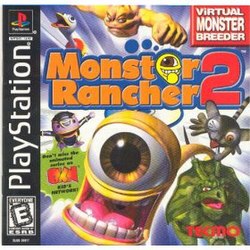

Monster Rancher 2 arrived on the PlayStation in 1999 and earned a reputation for being one part monster-management sim, one part weird disc-based summoning ritual. The Switch release comes as part of the Monster Rancher 1 & 2 DX compilation, officially bringing Tecmo's idiosyncratic breeding-and-battling loop to a modern portable. If you care about systems more than spectacle, MR2 is catnip: it's a tight feedback loop of training inputs, stat progression, and discrete competitions that rewards planning, timing, and a little bit of luck. This is not a shallow pet simulator where your creature's only job is to look cute while a meter fills. It's a deterministic-ish ecology with human-driven scheduling, finite resources, and explicit rank gates - the sort of design that will appeal to players who enjoy tuning variables until their numbers line up and then watching a mathematically inevitable stomp unfold. The Switch build simply packages that loop onto a handheld you can take to a coffee shop, and the DX release bundles it with its predecessor for historical context and convenience. For anyone expecting Fortnite-level visual thrills, temper your expectations: the game's strengths are in architecture, not shaders.
At its core Monster Rancher 2 is a state machine driven by weekly cycles, tournament calendars, and the life stages of a roster of monsters. The player is never visually represented in the world; instead you interact through a menu-driven interface with the assistant Colt and Joy the toucan. That might sound old-school, but it's deliberate: the UI funnels decisions into the training/travel/tournament loop without forcing you to babysit an avatar. The simulation variables are the usual suspects - stats (strength, intelligence, speed, etc.), condition (fatigue, stress), and an action economy embodied by 'guts' during combat - but MR2 layers interesting mechanics on top. Combat itself is not an action-button mashing minigame: moves cost guts, guts regenerate incrementally during battle, and each action has a required distance window to be usable. That positional requirement is a small but meaningful design choice because it introduces spatial state into what might otherwise be a simple resource-management fight. A monster that learns a heavy-damage, long-range move must be trained to maintain distance and control the knockback interplay. Conversely, short-range moves benefit from being able to close and use knockback to land follow-ups. The game's AI and deterministic knockback physics make these interactions feel like predictable mechanics you can master rather than random chaos. Training is the primary method for moving those stat sliders. The game employs explicit training exercises that target specific stats and can unlock new moves. There is risk management embedded in training choices: overtrain and your monster accumulates fatigue or injuries; undertrain and tournaments become unwinnable. The calendar introduces time pressure and long-term planning: you cannot grind indefinitely between IMa Official Cups (there are four of those per year), and higher ranks require you to win specific cups. That creates a pacing loop where you must decide whether to push stats aggressively now and risk condition penalties, or pace yourself and potentially miss a rank gate. Progression is gated by rank in a way that avoids purely numerical power-scaling. Wins in the IMa Official Cups and ascent through ranks unlock access to the higher-tier tournaments, which in turn unlock the ability to fight the Big Four - the four highest-ranked battles in the game - and ultimately the Legend Cup for champion-tier competition. The structure encourages breeders to specialize monsters for particular roles and to plan breeding/combination strategies to achieve those performance envelopes. Monster acquisition and breed variety are where MR2's design gets clever. Beyond the starter roster, additional breeds are unlocked through plot events, expedition and errantry systems, and by acquiring items that enable new combinations. Historically the series' signature mechanic was summoning monsters from CDs; when a breed becomes 'discovered' via item-generated combination, that breed then becomes available to generate from discs. On Switch and modern ports this disc mechanic is emulated rather than relying on physical media, but the gameplay consequences remain: discovery is incremental, and adding new breeds systematically expands the solution space of viable builds. Breeding/combination is not simply level-bumping. Items and combination rules can produce new base breeds with different stat curves and move pools, effectively enabling players to curate a corpus of chassis with desired growth profiles. That turns roster management into an exercise in meta-design: which base breeds should be targeted for combination, which moves to preserve through inheritance, and how to time retirements so that veteran skill transfers are maximized. The overall balance leans toward skillful microplanning rather than luck. There are stochastic elements - expedition results and some combination outcomes have random aspects - but the systems reward players who learn the underlying equations (stat growth per training, guts regen rates, move ranges and cooldowns). For players who enjoy treating a game as a system to be profiled, MR2 is fertile ground. For those who want instant gratification, the calendar gates and gradual compound growth can feel slow. One design quirk to note: the trainer character never speaks for themselves and the entire UX is mediated by Colt and Joy. That keeps interaction lean, but it also results in a lot of menu text and passive events. If you measure engagement in frequent interactive diversions, MR2 intentionally deprives you of them in favor of concentrated decision points (training schedules, tournament entries, breeding choices).
Visually MR2 is unapologetically late-90s: polygonal monster models on static backgrounds, simple UI elements, and low-resolution textures. On Switch, everything is functionally identical to the spirit of the originals with the advantage of modern display scaling. The game's aesthetic isn't trying to sell realism; it's optimizing legibility. That means monster silhouettes, hit effects, and range/position feedback are crisp enough to serve the underlying mechanical needs - you can see exactly when a move can be executed or when knockback will create space. For a detail-oriented player that's the right tradeoff. The DX release packages both games together but does not radically overhaul the visual pipeline into something contemporary; instead it preserves the original rendering while making the presentation usable on modern resolutions. From a technical standpoint the important graphical choices are those that support gameplay: clear animation cues for move startup and recovery, visible position states so you can reason about range windows, and unobtrusive UI overlays that let you see guts and move lists without losing sight of the combat field. These are implemented competently. If your enjoyment hinges on high-fidelity character art or cinematic choreography you will be disappointed; if you want visual clarity that complements a simulation, MR2 gets the job done.
Monster Rancher 2 on Switch is best evaluated on its own design terms: it's a meticulously constructed systems game where the fun comes from planning, executing, and observing a tuned build outperform opponents within a deterministic-ish engine. The guts-and-range combat, rank-gated tournament lattice, and combination-based breed discovery form an interlocking puzzle that rewards analytical players. Reception at release reflected this - solid aggregate scores (Metacritic ~83/100) and praise from outlets like GameSpot and IGN - and the DX compilation simply makes that package more accessible on modern hardware. There are compromises. The pace is deliberate; the UI is menu-heavy; and the visuals are of their era, not the present. But those are tradeoffs, not flaws, for the audience this game targets. If you enjoy dissecting stat curves, designing breed lineups, and optimizing seasonal training cycles, MR2 offers a deep sandbox with visible cause-and-effect. If you treat games as snackable dopamine dispensers, this one asks you to settle in with a notebook and a spreadsheet mentality. Score: 8.3/10 - a design-forward classic with enduring mechanical appeal, wrapped in retro presentation and modern convenience via the DX compilation on Switch.
 Monster Rancher Hop-A-Bout on PlayStation
 Monster Rancher on PlayStation
 DX Jinsei Game V on PlayStation
 Fantasy Life i: The Girl Who Steals Time – Nintendo Switch 2 Edition on Switch 2
 Fantasy Life i: The Girl Who Steals Time on PS4
 Jinsei Game DS on DS










 Another SquareThought Site