

 May 2020
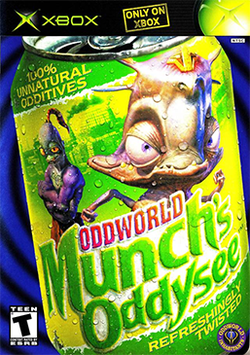

Oddworld: Munch's Oddysee has always been that weird cousin at the family reunion - part environmental parable, part slapstick sadism, and somehow wearing a lab collar. On Switch, the 3D leap the series took back in 2001 is still on full display: ambitious, occasionally brilliant, and also a little clumsy. What keeps Munch afloat more than its platforming is its commitment to characters - grotesque, lovable, outraged and conniving - who carry most of the game's heart and satire. This review is less about jump timings and more about what happens when a lonely frog-like Gabbit meets an oracular Raisin and an exasperated Mudokon named Abe: how their arcs play out, how mechanics force you into empathy, and whether the Switch port's technical hiccups get in the way of the narrative's bite.
If you want to understand Munch's Oddysee, start with who you control. The game hands you two narratively charged puppets: Munch, the last known Gabbit, and Abe, former scrubbing-slave turned accidental revolutionary. Gameplay is built around their relationship. Mechanically you switch between a sonar-equipped amphibian who can swim and manipulate machinery, and a chant-possessing Mudokon who can become a spiritual marionette for NPCs. But mechanically driven as those tools are, they were conceived as emotional levers. Munch is the 'last of his kind' trope anthropomorphized and then made kebab by corporate science. He begins as a captive, hooked to a device designed to turn living beings into obedient grabs of productivity. That device, which grants him odd powers when he rips it off, turns his arc into one of reclamation: he goes from specimen to agent. The act of picking up Fuzzles and coaxing them into safety isn't just a fetch quest - it's a constant reminder of extinction's human-sized regret. Each rescued creature is a small narrative victory for Munch; the game's systems reward the player with psychic agency and story beats that underline his loneliness and sudden responsibility. Abe's arc in Munch's Oddysee is one of reluctant mentorship. He arrives not because he wants another adventure, but because an oracle tells him to. Where Abe's earlier stories framed him as the underdog rising to moral action, here he's older and more world-weary, but still the glue that holds the mission together. The possession mechanic - reimagined as a controllable energy orb earned through collecting 'spooceshrubs' - literally puts the player into other characters' heads. That mechanic aligns with Abe's growth: he must understand, manipulate, and sometimes pity the industrialists and creatures he controls. It's a storytelling tool disguised as a puzzle. Controlling a Glukkon for a moment and seeing corporatized decision-making from the inside makes the satire hit harder. The antagonists are deliciously named and well-cast for satire. The Glukkons (smoking, greedy, and grotesquely luxuriant) and Vykkers (clinical, detached researchers) embody different flavors of cruelty: profit-driven extraction versus 'science for its own sake'. Lady Margaret the Glukkon queen is a caricature of aristocratic entitlement, while Vykkers researchers like Humphrey and Irwin offer cold, methodical horror in place of blatant villainy. Neither is cartoon-flatly evil; they represent systems that treat life as inventory. Lulu - the minor Glukkon who becomes a pawn of Abe and Munch - has one of the game's more satisfying arcs: social climbing manipulated into bankruptcy, exposing the fragility of status in a system that values property over lives. The Fuzzles and Gabbits are compact tragedies. Fuzzles are experimental puffballs, prone to aggression because of their mistreatment; their behavior in-game can flip from cute allies to antagonists depending on your 'Quarma' tally. This Quarma system is where gameplay and story converge in a moral pressure test: your rescue percentage shapes the ending. Fail to save enough creatures and you get a darkly comic but genuinely upsetting end - Abe and Munch become trophies and spare parts. Save most of them and you witness liberation and systemic collapse. The stakes are blunt and emotional: the game won't pretend it's neutral about extinction, corporate malfeasance, or the mundane horror of being commodified. But the marriage of narrative and mechanics isn't flawless. The 3D shift demanded puzzles and camera work that the original team, excellent in 2D, learned on the fly. Possession and switching are smart ideas that often force cooperative thinking between two character types, but repetition sets in. The spooceshrub collection and similar gating mechanisms can feel like padding, and some puzzles reuse the same solution template with different skins. Also, the Switch port carries over several of the original's control and camera quirks: clunky angles and occasionally uncooperative locks that undercut emotional beats by turning rescue-priority sequences into finicky chores. Still, when it clicks - when Munch's sonar is used to boom a sequence of Snoozers into obedience while Abe corrals a transport of eggs - the game delivers a satisfying narrative puzzle: it makes you feel like part of the world you're trying to save.
Munch's Oddysee was Oddworld's first foray into 3D, and the ambition shows. The character designs are gloriously odd: Gabbits are mournful amphibian sketches, Mudokons are raggedly expressive, and Glukkons are the kind of corporate caricatures you wish you could unsee. The art direction earned praise (and an award nod for animation) for taking risks in character moves and expressions. However, the move from the 2D, hand-painted backgrounds of Abe's games to full 3D cost the developers some visual richness. Backgrounds and environments lack the same textural detail and depth you could get from pre-rendered art, and some environments feel a touch flat. On Switch, the visuals are serviceable but not show-stopping: character models retain charm, but occasional pop-in and camera framing issues remind you this was a product of a transitional moment for the studio.
If you're playing Oddworld: Munch's Oddysee for lore and character, the game mostly delivers. Munch's status as 'last of his kind' yields a quietly effective arc of reclamation; Abe's older-but-still-stubborn heroism provides the moral compass; the villains embody systems rather than two-dimensional malice. That ambition to fuse satire, character, and gameplay is admirable and often moving. The game's weaknesses - repetition in puzzle design, a sometimes-unwieldy camera, and the Switch port's lingering bugs - do blunt the experience. For a Switch player who loves worldbuilding and emotionally charged oddities, this port is recommended with caveats: you'll forgive the rough edges if you care about these characters. Score-wise, Munch sits comfortably as a 7/10: brave, sometimes brilliant, and occasionally hamstrung by the very ambitions that make it worth revisiting.
 Oddworld: Abe's Oddysee on PlayStation
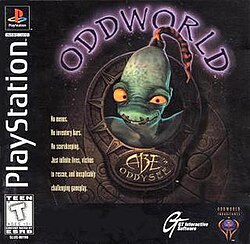 Oddworld: Abe's Exoddus on PlayStation
 The Wacky History of Platform Games
 Roblox on PS4
 Toki Tori on Switch
 PlayStation Home on PS3










 Another SquareThought Site