

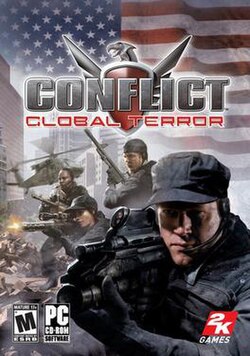

In an era when the PlayStation 2 still commanded many living-room battlefields, Conflict: Global Terror arrives like a leather-jacketed veteran who has seen better tours of duty. Pivotal Games dusts off the four familiar faces from its Desert Storm lineage-Bradley, Foley, Connors and Jones-adds a new sniper, Carrie Sherman, and sends them on a globe-trotting, policy-complicating series of missions from the Colombian jungle to the heights of Kashmir. This is not a reflex-only shooter: the game is billed, correctly, as a tactical shooter. It expects you to think for more than the duration of a single grenade cookoff. The concept is straightforward and, on paper, comforting to anyone who grew up reading big glossy previews in '90s magazines: control one member of a four-man special forces team in third person; issue orders to the others; swap control on the fly. The game promises the slow, methodical pace of a squad-based operation rather than the twitch scrapbook of run-and-gun contemporaries. If you want explosions by themselves, you can certainly find those elsewhere. If you want coordinated fire, flanking and the occasional last-second extraction, Global Terror at least puts those toys on the table. Critical reception at launch was, as the box art might suggest, mixed. The Metacritic aggregate clings to the low 60s across platforms, and individual outlets hovered around the same weather: respectable in places, uneven in others. The question for a 2005 PS2 owner then-and for anyone who picks up a copy now for the sake of nostalgia-is whether the tactical promise is fulfilled and whether the game's rougher edges subtract more than the team-play adds. This review tries to answer that, from the standpoint of an old-school reviewer who still remembers when magazines printed frame-by-frame screenshots and spicy editorials about how kids today have no patience.
Global Terror's most defensible feature is its commitment to squad tactics in a mainstream console package. Gameplay unfolds from a third-person perspective but borrows the sensibilities of a first-person shooter's control scheme, meaning that movement and aiming feel familiar to action fans while accommodating a layer of order-giving. The player controls one team member at a time but can swap to any of the four operatives on the fly, issuing commands to the others. This is the heart of the game: the swapping mechanic encourages players to choreograph engagements, position a sniper, punch through a door with a breacher and then switch to the suppressed rifleman to sweep the room. The artificial intelligence is written with the right intentions. Teammates will advance when prompted, take cover, throw grenades and withdraw when wounded. Enemies behave well enough to make cover and flanking meaningful; firefights are not solved by sheer recoil control but by choosing who to move where and when. That said, the AI is a double-edged sword. Pivotal has tuned squad behaviour to look competent in isolated skirmishes, but on the larger mission scales the same systems sometimes reveal brittle seams. Allies occasionally lose line-of-sight on obvious threats, and scripted moments-particularly ambushes or capture scenes-can produce awkward pauses where the team waits politely for the game to catch up. Missions are varied by geography and objective, which helps the pacing. The opening HALO insertion in Colombia sets a tone of high risk: Red Team is captured, a rescue unfolds and early on you feel the fragility of command. From there the campaign threads weave through providing executive protection in South Korea, securing a pesticide plant in Ukraine where sarin gas is in production, raiding a Chechen compound to seize gas tanks and disabling anti-aircraft arrays in Egypt so an airstrike can be called. The narrative spins its way through betrayal and vengeance: Strachen, a traitorous figure, leaves a trail to the Philippines and finally to a climactic mission in Kashmir where the stakes jump to a nuclear threat intended to ignite a Pakistan-India conflict. It is reasonable to praise the game for ambition. Pivotal wants cinematic set-pieces-hostage rescues, stealth insertions and open firefights-and largely delivers them. The structure encourages players to think like a commander: leave the sniper in overwatch, clear rooms systematically and use cover to trade space for lives. The multiplayer modes exist, but the single-player focus is where the tactical mechanics are most satisfying. The campaign is not flawless. Mission design occasionally lapses into repetition; escorting NPCs and defending zones crop up with weary frequency. Enemy patrol patterns and objective layouts can feel formulaic after several hours, and on PS2 the draw distances and level complexity are limited by hardware, which nudges designers toward corridors and choke points. Still, for players who enjoy planning and the quiet satisfaction of a well-executed breach-and-clear, Global Terror offers more strategic meat than many of its console peers.
On the PlayStation 2, Global Terror looks like a late-era title that never quite got to flex the system's full muscle. Character models are serviceable rather than stunning, animations are competent but not lavish, and environmental detail varies from the believable-muddy Colombian undergrowth, sun-bleached Kashmiri ridgelines-to the unremarkable, with some interiors feeling boxy and utilitarian. Lighting is used effectively in isolated moments: the harsh glare of desert sun, the rain-streaked ambiance of an urban night raid and the smoky glow of burning wreckage are all rendered well enough to sell the mood. Textures occasionally betray the PS2's constraints. Close inspection reveals soft edges and repeated detail tiles, and distant geometry can pop as the camera crosses a threshold. These are the small betrayals of a title that prioritises gameplay systems over visual flash. Explosions still have weight-grenades and vehicle blasts feel impactful-and the game's particle effects, though modest by modern standards, produce memorable combat beats when allies and enemies take shelter behind the same wall. The interface follows the pragmatic tack of the rest of the design. HUD elements are clear and informative, telling you which operative you currently control, the available commands and the status of your squad. There are no pretensions to cinematic invisibility; the game wears its tactical scaffolding on its sleeve and expects you to read it quickly in the heat of combat. If you measure graphics solely by how many polygons a face can support, Global Terror will disappoint. If you measure by how effectively the visual presentation supports tactical clarity and atmosphere, it does a competent job. For the veteran console player of 2005 the package felt adequate; today it reads as functional nostalgia with flashes of the era's aesthetic.
Conflict: Global Terror is a study in reasonable compromises. It never aspires to be the prettiest or the most polished tactical shooter on a shelf, but it commits to the squad-based idea with enough earnestness to make the experience worthwhile for players who prefer strategy over spectacle. The game's strengths are its teamwork mechanics, its breadth of theatres-from Colombia to Kashmir-and the occasional thriller of a well-run operation. Its weaknesses are predictable: repetition in mission structure, moments of brittle AI and visual limitations inherent to the PlayStation 2 era. A contemporary critic from the 1990s might have lauded Pivotal's attempt to place a tactical experience in hands used to arcade shooters and added a caveat about polish. The reception at the time-mixed reviews clustered in the low 60s-was fair. Global Terror will not convert fans of flashier, faster shooters, but it will reward those who enjoy planning, switching perspective between team members and watching a coordinated plan unfold. If you are shopping in a bargain bin or revisiting the PS2 library for a tactical diversion, this is a competent tour worth a Saturday or two. As a coda, the series did continue: only Paul Foley returned to star in 2008's Conflict: Denied Ops, a reminder that Pivotal still saw narrative and character value in this quartet of operators. Global Terror is not a masterpiece, but neither is it a waste of ordinance; it is a solid little arsenal for squad-play fans, neatly packaged in slightly scuffed PS2 plastic.
 Five Nights at Freddy's: Help Wanted on Switch
 Dead Space on PS5
 PixelJunk Shooter 2 on PS3
 Tom Clancy's Rainbow Six: Vegas on PS3
 PixelJunk Shooter on PS3












 Another SquareThought Site