

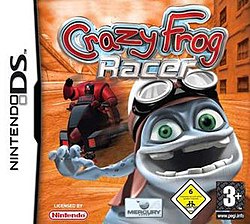

Crazy Frog Racer is a curious relic of mid-2000s meme culture given a steering wheel. Published by Digital Jesters and developed by Neko Entertainment, the PlayStation 2 version drops you into a tiny, loud, and very persistent world populated - in the PS2 build - almost entirely by one character: the Annoying Thing, more commonly known as Crazy Frog. If you are expecting a character drama on par with modern narrative-driven games, you will be disappointed. If you are expecting something resembling a competent kart racer, you will likely be disappointed as well. What you will not lack is personality: the titular amphibious noise machine is, inexplicably, front and center, and the game's design constantly reminds you of that fact. This review takes the intentionally silly step of treating the game like a soap opera and examining what little character development exists, how the roster behaves (or doesn't), and whether the game's mechanical choices support any kind of satisfying arc.
At its mechanical core, the PlayStation 2 version of Crazy Frog Racer is an aggressively minimal racing game. You play exclusively as the Annoying Thing, hurtling across four tracks while picking up coins for points and temporary bonuses. Those coins are worth 500 points each, and their presence gives the races a twin purpose: come first and collect currency. The game offers four modes that present themselves as different episodes in the same, short season: Single Race for casual competition (up to two players), Time Trials to test your lap times, Chase where the Annoying Thing flees from swarms of Drones, and Arena, which is basically a gladiatorial dust-up for two players. Viewed as a character arc, the Annoying Thing's story is astonishingly subtle because it is practically nonexistent. The entire narrative thrust of the PS2 game is "Annoying Thing goes fast and collects coins." But subtlety is a form of voice, and in that sense the game is remarkably consistent: the Annoying Thing starts every race as the embodiment of sheer kinetic bratitude and finishes it the same way, slightly dirtier and perhaps slightly more ornamented with bonuses. The Chase mode is the closest the game gets to dramatizing growth. Here, our protagonist is not the pursuer but the pursued. For a fragile handful of minutes you can imagine an arc: the Annoying Thing learns to run smarter, using shortcuts and bonuses to outfox the Drones. The truth is the mode is mostly endurance and chaos, but emotionally you can pretend he begins to respect the concept of danger after being chased a few times. The game's roster - or lack thereof on PS2 - is the next act of this peculiar micro-drama. Whereas the Game Boy Advance adaptation expands the cast to include Big Elk, Dream Boy, Puschel, Rasta Dog, Punk Girl, Mafia Hen, and Toro, the PS2 release keeps a tight focus. This choice feels like an artistic decision to center a single character study, albeit one made under significant budget constraints. If the GBA were the ensemble sitcom spin-off, the PS2 game is the single-camera mockumentary focused on an overenthusiastic radio host who never gets to leave the studio. Mechanically, the coin economy is both character motivation and gameplay lever. Coins give you points that can be used for bonuses during the race. This means the Annoying Thing is constantly driven by acquisitiveness - a surprisingly human trait for a ringtone mascot. The modes alter the stakes: in Time Trials the Arc of Competence is foregrounded (you improve through repetition), Arena offers interpersonal conflict in two-player combat, Single Race is the classic "prove your superiority to your rival" narrative, and Chase flips the script so the protagonist's survivability is the only arc you track. None of these modes crafts a classical three-act structure or any lasting transformation of character, but they do provide mini-arcs inside each race: tension, action, payoff. Maybe it's a generous reading to call these 'arcs,' but that's the fun part of anthropomorphizing a maniacal frog. The PS2 version's limited track count (four tracks) and single-character focus mean that replay value must come from the modes and local multiplayer rather than character evolution. Two-player Single Race and Arena are where the game pretends to be a party title, but since only two human racers are supported, the party is inevitably small. If you treat each match as its own micro-story - winner gloats, loser plots revenge - you can make the game feel longer. That's less about clever design and more about your own willingness to role-play. Controls are straightforward in the way low-ambition games often are: acceleration, steering, and a few bonuses consumed with the coins you collect. The GBA version's closer mechanical kinship with Mario Kart's formula is notable in the source material, but on the PS2 the experience is closer to a proof-of-concept: functional but lacking nuance. The power-up usage is underdeveloped; during races you rarely have the kinds of dramatic, swing-the-race moments that good kart games deliver. Instead the bonuses feel like marginal speed tweaks or small nuisances - thematically appropriate for a property built around annoyance, but not deeply satisfying from a gameplay-first perspective. A brief word about the GBA roster since it illuminates what the PS2 could have been: the extra characters in the handheld version hint at archetypal backstories (Big Elk as the lumbering gentle giant, Punk Girl the abrasive antihero, Mafia Hen the comic thug), and the multiple engine classes (50cc to 150cc) provide a clearer progression arc. On PS2 we see only one protagonist, which makes for a narrower, almost monastic exploration of a single joke. That joke is loud, repetitive, and occasionally fun, but it rarely evolves beyond its premise.
Crazy Frog Racer's visual story is a short one. The documentation for the PS2 version confirms a focus on the Annoying Thing and four tracks, and the game's graphical ambitions match that confined scope. The models are serviceable for the era but lack the polish that made contemporaneous kart racers feel alive. Textures and track detail are basic; the environments are more playground than painted world. This visual sparseness feeds into a particular narrative reading: the Annoying Thing exists in a deliberately thin, cartoonified reality where everything else is background noise for his chaotic energy. There is a thematic logic to the graphical choices. The protagonist is a small, brash, audibly grating creature - the visuals mirror that by making the world itself uncomplicated enough that Crazy Frog's personality dominates. If you want lush, painterly tracks and high-fidelity effects, this is not the game to show off your PS2. If you want a visual stage where one character's swagger is the primary spectacle, the designs accomplish that. Critically, reviewers panned the PS2 release overall, and the modest graphical work no doubt contributed to that consensus: the presentation rarely convinces, and the limited track variety makes the visual repetition obvious quickly. The GBA's expanded roster implies greater visual variety on that platform, but on PS2 the aesthetic commitment is to repetitiveness - which, once again, can be read as either a flaw or an oddly faithful creative choice for a game about a single, incessant mascot.
Crazy Frog Racer on PS2 is an oddity: less a full kart game and more an animated bumper sticker with buttons. As an in-depth character study the title is hilariously thin; if you insist on narrativizing it, the Annoying Thing's arc is a loop: he starts obnoxious, drives obnoxiously, and finishes with slightly more points and the same level of obstreperousness. The game's real attempt at variety comes from its different modes (Single Race, Time Trials, Chase, Arena), and the Chase mode offers the best momentary emotional spike by making the Annoying Thing the hunted rather than the hunter. The documented poor critical reception (a GameRankings aggregate of 28% for the PS2 release) is not undeserved. The game feels rushed, limited, and shallow compared with contemporaries that offered both mechanics and character variety. If you are reviewing Crazy Frog Racer purely as a cinematic experiment in how little you can give a character and still have them headline a product, admire its chutzpah. If you want a satisfying racing experience, there are better ways to spend a PS2 evening. Buy the GBA version if you genuinely want more characters and a Mario Kart-like progression, or treat the PS2 disc as a museum piece: a snapshot of early internet virality shoved into a console cartridge. It's loud, oddly charming in very small doses, and mechanically stingy - the kind of thing you bring out for ten minutes at a party to make people laugh, not to spend an entire night with. Final verdict: a curiosity with sparse mechanics and negligible character growth, deserving of a low score but still oddly memorable. Score: 2.8/10.
 Plane Crazy on PlayStation
 Arcade Archives: Crazy Climber on Switch
 Roary the Racing Car on DS
 Team Sonic Racing on Switch
 Garfield Kart: Furious Racing on Switch
 Ben 10: Galactic Racing on PS3
 Adiboo & Paziral's Secret on PlayStation
 Puddle on PS4
 Code Lyoko: Quest for Infinity on PS2
 Cocoto Funfair on PS2
 Cocoto Fishing Master on PS2












 Another SquareThought Site