

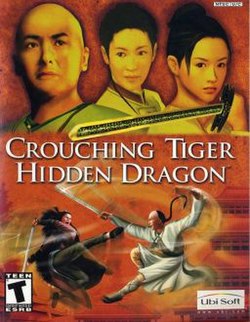

Licensed games live in a weird zone: they inherit the IP's atmosphere and expectations, but they also inherit harsh scrutiny. Crouching Tiger, Hidden Dragon on PS2 arrives with cinematic pedigree - Ang Lee's film, Tan Dun's score and Yo-Yo Ma's cello - and a promise of graceful wuxia acrobatics translated into controller inputs. The finished product is a textbook case of good source material meeting mediocre technical execution. Metacritic placed the PS2 version around 48/100, and the contemporary press was unforgiving. This review dissects why the game struggles, emphasizing engine behavior, control fidelity, camera logic, AI and audiovisual integration rather than plot recitation. Playable characters include Li Mu Bai, Yu Shu Lien, Jen and Lo; the title is single-player only and mixes beat 'em up combat with platforming sequences. If you're looking for a mechanically rigorous take on a licensed quarrel with gravity and bladed jewelry, read on - the swordplay gets snapped under a microscope.
At the mechanical core this is a third-person beat 'em up with platforming tacked on; that combo sounds promising until you test how the systems interact. The fundamental problems originate in input-to-action latency and ambiguous hit registration. The PS2 controller maps attacks, blocks and a jump/acrobat button in a straightforward layout, but the game's responsiveness undermines that simplicity. Inputs often feel buffered or lost when the engine is resolving animation transitions, which results in a clog of intended combos. In a well-tuned beat 'em up, animation-cancelling or interruptible moves let you string attacks fluidly; here the animation state machine is conservative, forcing you to wait for animations to finish before the next action starts. The result is a combat rhythm that feels more like medieval waltzing than lightning-fast swordplay. Collision detection and hitbox tuning compound the problem. Enemies and the player occupy interaction volumes that sometimes mismatch visible models, leading to swings that look like they should hit yet do no damage, or conversely, phantom hits that clip through geometry. For a game that borrows the film's aerial choreography and arcs of sword motion, inconsistent hit detection fractures any illusion of kinetic grace. The platforming elements - vaulting, balancing, timed leaps - reveal the engine's tolerance for imprecision. Jump arcs are wide and forgiving in narrative moments, but tight platforming sections require pixel timing; combined with the input lag and camera drift (more on that below), platforming feels brittle rather than cinematic. Enemy AI is serviceable on paper but shallow in design. Combat encounters often rely on waves of generic opponents with predictable patterns: approach, telegraph, attack, repeat. Without adaptive reaction or group tactics, enemy response is primarily a function of spawn placement and HP scaling. That predictability lets experienced players cheese encounters but also highlights the lack of emergent combat scenarios. Boss encounters sometimes attempt to break the monotony with scripted phases, but the scripts are tightly choreographed rather than reactive. Where the film suggests spontaneous exchanges of timing and counterplay, the game serves preordained beats. Level design is functional but uninspired. Levels channel the film's sets - courtyards, teahouses, mountain ridgelines - but the geometry tends toward corridorization: narrow paths that funnel combat into linear encounters rather than open arenas that allow aerial maneuvers and tactical positioning. Platforming checkpoints and backtracking are adequate but not optimized; a couple of long loading boundaries and respawn placements remind you that single-player pacing is being handled by a mid-tier runtime. The game's single-player-only mode avoids networking headaches, but it also removes a potential outlet for depth: cooperative encounters or duel arenas might have given the combat loop more longevity. From a systems perspective, there are hints of ambition. The character roster lets you approach fights with different stat curves and move sets, and the soundtrack - authentic Tan Dun with Yo-Yo Ma cello solos - supplies an atmospheric veneer that often outperforms the on-screen action. But when the mechanical systems and engine constraints aren't synchronized, small design wins can't rescue the overall player experience. Reviews at the time reflected these structural issues: IGN gave the PS2 release a score in the mid-to-low range, GameSpot landed around 5.3/10, and several outlets singled out control and camera flaws as major drawbacks. The gameplay loop works sporadically and never coheres into the elegant martial poetry fans might expect.
Graphically the PS2 release aims for a faithful, film-inspired aesthetic rather than flashy polygonal bravado. Character models are recognizable and the textures capture period clothing and set dressing reasonably well for the hardware of 2003, but the rendering pipeline shows its age in lighting, LOD and particle budget. Character silhouette fidelity is acceptable at close range, yet when camera distance scales up for environmental shots, LOD popping becomes noticeable. Textures on geometry have a mid-range resolution profile - detailed enough in cutscenes but noticeably smeared in gameplay when the camera zooms out. The game's use of the PS2's GPU and fillrate is conservative. Dynamic lighting is present but baked in many places, giving interiors and exteriors a flatter appearance than the film's chiaroscuro. Particle effects for dust, smoke and sword slashes exist but are low-budget: they often have short lifetimes and little interaction with scene lighting, which undermines the perceived impact of hits. Framerate behavior fluctuates depending on scene complexity. During crowded encounters or particle-heavy moments, frame pacing stumbles; these dips translate into jerkiness that compounds the perceived input-lag. The visual experience thus interacts negatively with gameplay responsiveness - when the display doesn't update smoothly, player commands and animation cycles feel further removed. Camera behavior is one of the most critical technical critiques. The camera attempts to be cinematic, drifting to capture set pieces and flaring to accommodate platforming sequences, but its collision avoidance and player-centering heuristics are brittle. In tight sections, the camera can clip into geometry or swing to awkward angles that occlude enemies, forcing the player to manually reorient the view or rely on lock-on behavior that sometimes doesn't prioritize the most immediate threat. A robust third-person camera should be both predictable and informative; here it toggles between 'cinematic director' and 'oblivious spectator.' For a combat system that expects visual telegraphing and spatial awareness, poor camera fidelity is a critical fault. Audio is the game's strongest technical asset. Leveraging Tan Dun's score and Yo-Yo Ma's solos gives battles and exploration a sonic gravitas unmatched by the visuals. The soundtrack is mixed to foreground cello lines during introspective or dramatic moments and to swell during encounters, which helps mask other flaws. Sound effects for sword clashes and ambient effects are serviceable, though occasionally under-prioritized in the mix compared to the music. Voice acting and localized audio were criticized in some reviews of licensed releases at the time; while this title's documentation emphasizes the film score, reviewers focused more on the mismatch between audio quality and gameplay polish rather than outright failures in the sound department.
Crouching Tiger, Hidden Dragon on PS2 is an instructive example of how a game's technical scaffolding determines whether cinematic intent becomes playable poetry or a clumsy stage imitation. The developers had the right reference material - an evocative soundtrack, iconic characters and wuxia set pieces - but executing fluid, high-fidelity martial arts on aging hardware requires exacting engineering in input handling, animation blending, collision/HITBOX design and camera systems. Where the game most noticeably falters is in the interaction of those systems: input latency meets stiff animation transitions, hit detection meets inconsistent collision volumes, and an indecisive camera meets narrow level geometry. The press consensus at release reflected these core problems: multiple outlets gave the PS2 version subpar scores and Metacritic averaged around 48/100. If you approach this release as a historical artifact - a licensed tie-in that tried to channel a major film on mid-2000s consoles - it has curiosities worth revisiting: the soundtrack is legitimately good, and character models and environments occasionally capture photographic details from the film. But if you're looking for robust beat 'em up mechanics, responsive platforming, or emergent combat built on a reliable engine, this PS2 version underdelivers. Its problems are technical and structural rather than conceptual; with tightened animation state logic, improved hitbox alignment and a more predictable camera, the core idea could have landed closer to the cinematic grace the license promises. As it stands, it's a middling footnote in licensed-game history, more admirable for ambition than for execution - and priced accordingly: enjoy the soundtrack, but don't expect to find poetry in the controls.
 Dragon Blaze on PS4
 Hidden Folks on Switch
 Dragon Blaze on Switch
 Primal Carnage: Extinction on PS4
 Doodle God on PS3
 BPM: Bullets Per Minute on PS4












 Another SquareThought Site