

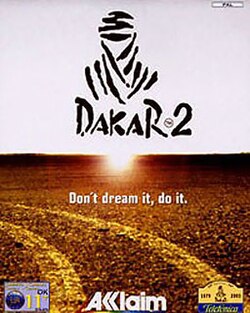

If you're expecting fully voiced emotional monologues and branching dialogue trees, you're in the wrong desert. Dakar 2: The World's Ultimate Rally is a racing game that, on paper, offers three vehicle classes and a series of dusty ordeals from Paris to Dakar. On the page where modern games list NPC biographies, Dakar 2 has bikes, cars and trucks. Turn down the HUD, crank the engine noise up, and what you actually get is an oddly satisfying opportunity to treat three metal-and-rubber archetypes like characters in a coming-of-age epic. This review will unabashedly anthropomorphize them, because the game's personality lives in how those classes handle, survive and learn to live with sand in their carburettors.
Dakar 2 rigs its narrative on a linear progression: a starting shout in Paris, eleven or roughly a dozen stages of environmental hazing (the sources are self-aware enough to disagree), and a triumphant, sandy finish on a Dakar beach. The game offers three main cast members. Think of them as the hero trio in a road-tripping indie film where every scene ends with a cloud of grit. Bikes: The Reckless Child Bikes arrive on stage as the reckless teenager of the trio. They're light, loud and proud, and the documentation helpfully tells us they "will oversteer when in sharp turns." In character terms, that translates as raw charisma plus a steep learning curve in humility. On narrow village tracks the bike flaunts nimbleness - you can thread through broken fences and slip between trucks like a fast, caffeinated eel - but give it a sharp turn in the dunes and the bike performs a textbook adolescent tantrum, skidding wide and flirting with ruin. Those tantrums are part of the arc: early-game bravado, mid-game consequence, late-game skill. The player who learns the bike's temper invests in handling and accepts the oversteer as personality, not bug. The narrative payoff is genuine - when a bike finally learns to read sand, it becomes poetry: a wheeled tightrope walker carving the desert with confidence. Cars: The Working-Class Underdog The cars in Dakar 2 are pickup trucks pretending to be rally legends. They are the relatable middle-class hero: not the fastest, not the flashiest, but adaptable. Gameplay frames them as the class for customization. Because courses "have certain features, so the players have to customize their vehicle to match the conditions," the car's arc is about growth through preparation. A stock truck on sand will suffer, but the same chassis with adjusted suspension and tires becomes the game's pragmatic protagonist. This arc suits a different player psychology. Where the bike wants to be loved for raw talent, the car earns it. Stages that throw up villages, rocky mountain passes across the Atlas, or open Sahara plains reward the player who treats tuning like a montage-wise arc: a handful of tweaks, a few checkpoint lessons, and suddenly the underdog outruns the hotshot. Trucks: The Stoic Veteran Trucks are big rigs powered by diesel, and they are the grizzled mentor of the trio. They have narrative weight: reserve, slow advances, and an endurance-based heroism. Driving a truck in Dakar 2 feels like embodying a seasoned expedition leader who remembers every crossing and is quietly unimpressed by your flashy wheelspin. Because the game includes tracks that vary from villages to deserts, trucks get drama from terrain, not speed. Their arc is about patience and the dignity of persistence. They plod through sandstorms, shrug at checkpoints, and are rewarded for not flipping over a dune like a subplot villain. The truck's endgame is a slow, dignified arrival - and in a game where split-second timing matters, that is quietly satisfying. Race Structure as Plot Mechanic Dakar 2's staging is where all three arcs intersect. The game recreates the Dakar event across a sequence of tracks ranging from pastoral European villages to the merciless Sahara and the jagged Atlas Mountains. Each course offers a different challenge and demands different priorities in vehicle setup. The progress meter - a five-part bar that changes to blue as you pace between checkpoints and then to red or green depending on your timing - acts like a heartbeat monitor for each character. Blue is steady traveling, green means your heroism matched the race's existential minimum, and red is either panic or a plot twist. Customizing vehicles is equivalent to character development. Picking a shock setup, tire compound or gearing is like deciding whether your protagonist will train for strength or learn patience. The game forces choices without melodrama; there are no loading screen monologues, only the mechanical consequence: wreck a checkpoint and your meter goes red and shrieks like a Greek chorus. Multiplayer and Single-Player: Side Characters and Rivalries Dakar 2's modes let you bring your character into different dramatic contexts. Single-player is the loner road narrative; you, the player, forge arcs with your chosen vehicle class against AI. Multiplayer introduces rivalries - brief, combustible interactions where the bike's youthful bravado meets the truck's desire to simply finish. These skirmishes play like barbs in a buddy movie: snappy, physical, and often ending with someone stuck in a sand pit while the other drives by, hand raised sarcastically. In short, the ontology of Dakar 2 is less about human drama and more about mechanical personalities. Give each class agency and history, and the game becomes an anthology of small personal victories achieved by tuning, timing and a profound disrespect for maintenance schedules.
Graphically, Dakar 2 is vintage early-2000s PlayStation 2 tech, and it wears that era like a sunburn. The landscapes are broad and emphatic, the sort of vistas that are more about scale than texture fidelity. Paris and the villages feel compact and human-scale; the Sahara and Atlas shots aim for the grandiose, with dunes rolling into the horizon and a sense of distance the hardware can only suggest. Textures are economical. Sand looks like sand at a glance, but under close inspection it is a mosaic of smudges and tiling. Vehicle models are serviceable - you can read the pickup's bumpers and the truck's big rig cab, and that is all you really need when you're watching them from a cockpit or a chase cam. Lighting does a decent job of selling the time of day: dawn across a dune will cast long shadows and make the gritty engine roar feel cinematic. Performance and design choices feel deliberately pragmatic. The game focuses on functional clarity over photorealism: track features are readable, the progress meter is obvious, and environmental hazards register without epic particle effects. On PS2 this was a sensible trade-off - the game chose legibility and playable space over trying to be a postcard. For a reviewer who prefers seeing where the next checkpoint lies over admiring a single grain of sand, Dakar 2's visual priorities are defensible and even charming. There are limitations, of course. Draw distance sometimes makes distant objects pop into being, and close-up fidelity can betray its era with blockier edges than modern players expect. But the artistic direction - large open spaces that feel stage-like - fits the game's thematic ambition: it wants you to feel small against the route, not to scrutinize the paint job. Audio deserves a short paragraph for character acting of its own. Engine noises, the crunch of gravel, and the faint ambient wind create a convincing atmosphere. There isn't an emotional soundtrack trying to narrate your inner life; instead you get mechanical honesty and intermittent crowd or village noises that imply life exists off-track. The result is immersive in a utilitarian way, like a mechanic's radio left on during an all-night drive.
Treating Dakar 2 as a straight racing sim sells it short. Its heart is in the little stories the game tells through handling, tuning and terrain. Bikes are youthful daredevils who must learn restraint; cars are the industrious underdogs who are rewarded for smart preparation; trucks are the stoic veterans whose victory is survival. If you accept that premise, the relatively modest presentation and PS2-era graphics are part of the charm rather than a flaw. Gameplay is the decisive element. The progress meter and checkpoint pacing force choices that feel meaningful even without human faces to attach them to. Customization matters, tracks are varied enough to keep setups interesting, and the multiplayer mode offers quick, combustible rivalries. The game's fidelity to the idea of the Paris-Dakar event - from European roads to Saharan deserts - gives it a shape that racing fans can appreciate. There are limits: the visuals show their age, and the abstraction of characters to vehicle classes won't satisfy players who want human drama. For those who enjoy car handling, tuning for terrain, and the tiny triumphs of getting a sand-tendered bike to behave, Dakar 2 is a respectable and occasionally touching expedition. Final verdict: the game is a solid, slightly rugged rally experience - a 7 out of 10. It's not a masterpiece, but it's a game with personality if you understand where to look: not in voice acting or cutscenes, but in the scars on your radiator and the way a diesel truck refuses to be hurried. If you own a PlayStation 2 and you miss that era's focused, hardware-aware design, Dakar 2 will reward a patient driver's attention. Pack your toolkit, learn your vehicle's temperament, and try not to flip the narrator - because in Dakar 2, the narrator is a five-segment progress bar and it will judge you.
 Colin McRae Rally 2005 on PS2
 ACA Neo Geo: Thrash Rally on Xbox One
 Roary the Racing Car on DS
 Team Sonic Racing on Switch
 Garfield Kart: Furious Racing on Switch
 Ben 10: Galactic Racing on PS3
 RC Revenge on PlayStation
 Alias on PS2












 Another SquareThought Site