

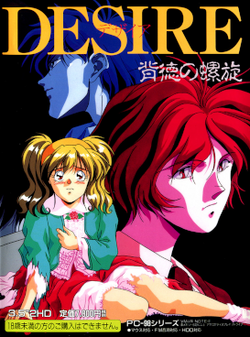

If you like your mysteries served on a lonely island with a side of melodrama and synthy atmosphere, Desire is a deliciously old-school treat. Originally born as a 1994 PC-98 eroge and later ported across a ridiculous variety of platforms, Desire eventually made its way to PlayStation 2 in 2004 - a brave move for a game whose roots are very much in the 90s Japanese visual-novel scene. The writing comes from Hiroyuki Kanno and the music from Ryu Umemoto, which is basically a seal of 'this will be moody and probably emotionally manipulative' among fans of cult VN history. On paper the premise is elegantly simple: a mysterious research project on a remote island called Desire, staffed by people who seem to know less about what's actually happening than your average office intern after three cups of coffee. You pick a lens through which to watch the slowly unfolding drama - either Makoto Izumi, the chief engineer with technical competence and questionable luck, or Albert Macdgul, her intrepid reporter boyfriend, who is better at poking around than he is at subtlety. From there you get branching narratives, conspiratorial whispers, and the kind of interpersonal complications that make islands suddenly feel overcrowded.
Desire is what happens when an adventure game and a visual novel have a very talkative child. Don't expect twitchy action or puzzle-room mania; this is a game that wants you to sit down, listen, read, and occasionally choose which way the story will lean. Mechanically, most of your time is spent in conversations and internal monologues, punctuated by decision points where your choice nudges the plot along one branch or another. One of the game's clever hooks is the dual-perspective structure. Playing through Makoto's route gives you access to the technical side of the island - lab jargon, procedural memory, and the kinds of quiet discoveries only someone who knows the building's wiring diagram might make. Switching to Albert flips the lens to investigation and human curiosity: talking to staff, asking blunt questions, and getting the dirt that never reaches official memos. This isn't just a thin reskin: some scenes change relevance depending on whose eyes you're seeing them through, so the two routes complement one another like two halves of a badly photocopied map. If you want the whole picture, you'll be replaying sections, collecting details, and enjoying that satisfying 'oh, so that's why' feeling when plot threads start knitting together. Choices matter, but they're not always telegraphed with neon signs. Expect moral grey zones, withheld information, and a slow-burn tension that prefers suggestion over outright explanation. The original game was an eroge, meaning it had adult content in early releases; many later ports and the PS2 version removed or toned down explicit scenes, focusing more on the mystery and character work. That choice makes Desire more accessible to a broader audience, but if you came for scandal, the game will instead give you interpersonal drama and ethical discomfort - which, in many cases, is more interesting anyway. The pacing favors atmosphere over fireworks. Some gamers will find portions a little too radio-play-ish; dialogue can linger and the priority is on building psychological unease rather than hitting a constant beat. If you enjoy parsing motives, hunting through dialogue trees, and getting gradually more suspicious of every lab coat you meet, this is your jam. If you treat the PS2 version like a glossy interactive novel with occasional detective work, you'll be happier than a castaway who just found a fresh paperback.
Graphically Desire wears its 90s pedigree like a retro jacket - a little dated, but strangely charismatic. The PS2 release updates assets compared to the NEC PC-98 and Saturn versions, leaning into cleaner portraits and more polished backgrounds while still preserving the moody, hand-drawn aesthetic that fans remember. The later remaster by El Dia, and the remake assets based on the Sega Saturn artwork, show that the core visual identity is strong enough to survive a few technological upgrades. Character art is expressive when it needs to be and restrained when the scene calls for tension. Backgrounds of the island and the sterile lab spaces do a solid job of hinting at secrets without shouting them. Animations are minimal - this is a visual novel after all - but small touches like voice snippets or music swelling at the right moment do a lot of heavy lifting. If you were expecting PS2-era polygonal bravado, this won't satisfy; if you appreciate evocative, story-focused visuals, the game's look serves the writing well. The remastering choices aim to respect the original tone rather than repaint it in high-definition neon, which will either delight purists or annoy folks who only care about resolution.
Desire on PS2 is an experience for players who like to be entangled in stories rather than blasted out of them. It's moody, character-driven, and built around slow-burn revelation rather than puzzle-hunt satisfaction. The dual-perspective design is the star here - it rewards curiosity and repeat playthroughs, and the way Makoto's technical view and Albert's reporter's instincts dovetail feels intentionally crafted. The game's ancestry as an eroge is part of its history, but the PS2 version and later ports mostly emphasized narrative and atmosphere over explicit content, which broadened its appeal. Critically the reception was middling-to-positive, with Japanese magazines like Famitsu and Sega Saturn Magazine giving it scores clustered around the sevens and eights, and Saturn Fan offering a similarly respectable score - not blockbuster numbers, but enough to prove Desire found its audience. Musically and narratively, the Kanno-Umemoto pairing gives the title an emotional backbone that still matters today; it's the kind of game you recommend to someone looking for a compact, well-written island mystery rather than a blockbuster. Score-wise, I'd peg it at a solid 7.5 out of 10: not perfect, but richly atmospheric, clever in structure, and a neat slice of visual-novel history that rewards patience and attention. If you're into weird labs, interpersonal tension, and the satisfying click of plot pieces falling into place, Desire is worth a late-night playthrough - preferably one where you have snacks and absolutely no pressing obligations the next morning.
 Knytt Underground on PS3
 Assassin's Creed Valhalla on PS5
 Coloball 2002 on PS2
 Press Your Luck on PS3
 Tintin: Destination Adventure on PlayStation
 Mom Hid My Game! on Switch












 Another SquareThought Site