

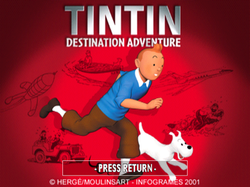

Tintin: Destination Adventure arrives late in the PlayStation's life cycle as another licensing gambit from Infogrames. The title is built around Hergé's famous boy reporter, and on paper it promises a leisurely stroll through classic European comic-book adventure. This is not a reinvention of the wheel: the game leans hard on the formula established by Infogrames' previous Tintin titles (Prisoners of the Sun and Tintin in Tibet). What sets Destination Adventure apart - and what keeps it from being a mere re-skin - is its shift into full 3D spaces and a few vehicle-driven sequences. The result is a familiar, serviceable single-player experience with the faint whiff of both nostalgia and missed potential.
If you have played Infogrames' earlier Tintin outings, you will feel instantly at home. Tintin: Destination Adventure follows the same adventure structure: exploration, puzzle-solving, and a string of set-pieces stitched together by the thin connective tissue of Tintin's trademark globe-trotting. The core loop is conservative by design - this is an homage to the franchise rather than an attempt to reconstruct it for the modern era. Mechanically the game does what it needs to. Interaction revolves around examining the environment, picking up items and using them in expected ways, and moving between locations to push the story forward. Puzzles are fashioned to be more thoughtful than punishing; they rarely demand pixel-hunting or convoluted inventory gymnastics. For players who prefer a steady, uncomplicated adventure rather than a brain-melting enigma, Destination Adventure will be agreeable company. The two headline changes from Infogrames' earlier efforts are worth underlining. First is the move into full 3D. Where Prisoners of the Sun and Tintin in Tibet were more classically sprite- or pre-render-driven affairs, Destination Adventure plants Tintin into three-dimensional locales. The camera, acting more like a theatrical spotlight than an omniscient narrator, occasionally requires manual adjustment; this can be both freeing and fiddly. The promises of 3D are fulfilled in the sense that spaces have depth and geometry matters, but it also exposes the game to issues the earlier titles avoided by design: awkward angles, occluded pick-ups, and the occasional collision headache. Second is the inclusion of vehicle segments. These sections open up the pace, inserting brief adrenaline notes into an otherwise placid melody. You will find yourself operating a handful of vehicles in scripted sequences that alternate between straightforward steering and light reflex tests. They are not full-fledged driving simulations, nor are they the kind of endurance races that eat your save files. Instead they function as interludes, a change of scene to remind the player that Tintin's adventures sometimes involve speed and danger. The single-player focus keeps the narrative tight. There is no multiplayer padding, no side modes to inflate playtime. This austerity is both blessing and curse: it keeps the focus on the crafted episodes but leaves completionists wistful for extra content. Controls are serviceable - tuned for the PlayStation pad - and the underlying systems are conservative enough that players will rarely be confronted with baffling mechanics. If you come to Destination Adventure expecting bold redesigns or radical innovation, you will be disappointed; if you want a dependable Tintin stroll, it will sate you. One of the game's quiet strengths is how it respects the IP. Infogrames and the designer credit, Moulinsart, show evident care for Hergé's source material. The game reads like a licensed adventure that wants to be faithful: locations, mood and pacing are geared to conjure the comics' spirit. For fans of Tintin, that fidelity is an easy point to reward. For those who judge games on boldness, this means Destination Adventure is more conservator than trailblazer.
Graphically, Tintin: Destination Adventure is notable mainly for its embrace of full 3D. In the context of the PlayStation era this is a reasonable move: polygons and texture maps replace the static backdrops of older licensed games and give the player room to breathe in the environments. The visual style aims for clarity rather than photorealism; character models and set pieces trade fine detail for stylized resemblance to the comics. This is sensible, given the subject matter. Polygons are handled with the economy common to late-PlayStation production. Environments are functional, sometimes charming, and occasionally plain. There are moments when the 3D conversion illuminates the Tintin universe with newfound dimensionality - a bustling port, a cramped interior, a rooftop shot that actually feels elevated - but these highs are balanced by flatter rooms where textures repeat and lighting is pragmatic rather than expressive. The camera sometimes behaves like a postal clerk on break: competent but inclined to place things just off-center, forcing adjustments. Textures and color palettes stick to a readable, comic-friendly range. You will not be dazzled by next-generation bloom or dynamic shadowing, but you won't be squinting to find Tintin in the middle of a muddied color soup either. The essential elements of the scenes are always legible, which is crucial in an adventure game where examination and interaction are key. Audio deserves a short note. Pierre Estève is credited as composer, and the soundtrack performs the job of underscoring mood and pacing without drawing attention away from the action. The score supports exploratory sequences and ramps modestly for vehicle and action scenes. Sound design is functional: effects and voice work - where present - are aligned with the game's clear, conservative aesthetic. Again, fidelity to tone matters more here than bombast. If you were shopping for a graphical showcase in late 2001, Destination Adventure would not be your pick. If you want a Tintin-flavored 3D adventure that keeps the presentation coherent and faithful to the comics, the game delivers enough visual charm to be pleasant company.
Tintin: Destination Adventure is an exemplar of late-era licensed adventure: careful, conservative, and faithful to its source. Infogrames made two deliberate choices that define the package - moving the series into full 3D and peppering the experience with vehicle sections. Both changes expand the franchise's vocabulary, but neither flips the script entirely. The game feels like a courteous adaptation rather than a bold reinvention. For aficionados of Tintin, Destination Adventure has clear virtues. It respects Hergé's universe, it avoids needless complication, and it provides a tidy single-player outing that can be enjoyed in a handful of sittings. For players who judge games on innovation, technical bravura, or sprawling value-add features, it will likely feel middling. The PlayStation hardware is treated with the kind of competent thrift one expects from late-period licensed titles: solid enough to do the job but not anxious to impress. If you shop with nostalgia in mind - if you remember flipping through comic pages while the CD-player runs in the background and you want a videogame that behaves like a companion piece to the books - Tintin: Destination Adventure will fill that niche. If you are chasing revolutionary mechanics or graphical jaw-droppers, look elsewhere. The score reflects this balance: a respectable 6.0 out of 10 for a game whose strengths are fidelity and steadiness, and whose weaknesses are a cautious design philosophy that keeps it from reaching greater heights. In short: Tintin: Destination Adventure is a polite, competent adventure that honors its pedigree. It does not reinvent Tintin for the 3D age, but it delivers a playable, recognizable take on the world's favourite intrepid reporter - one that will satisfy fans and mildly entertain newcomers who appreciate straightforward, old-school adventure pacing.
 The Adventures of Tintin: The Secret of the Unicorn on PS3
 Taiko no Tatsujin: Dokodon! Mystery Adventure on Switch
 Taiko no Tatsujin: Don to Katsu no Jikū Daibōken on Switch












 Another SquareThought Site