



DoDonPachi Dai-Ou-Jou arrived in arcades in 2002 as the fourth entry in Cave's DonPachi lineage and landed on PlayStation 2 in April 2003. For players who like their screens full of prettified death, this is the canonical 'more bullets, more math' iteration: it preserves the chaining complexity of earlier titles while adding the Hyper system and a tidy handful of interface/feature improvements on the PS2 port. If you care about mechanics as much as flash, Dai-Ou-Jou is a textbook in how to sculpt chaos into a scoring system. My verdict for the PS2 release: a faithful, feature-rich conversion that prioritizes gameplay clarity over visual excess - with a difficulty curve that will either humble or addict you, depending on how many lives you keep on hand.
At the microscopic level this is DoDonPachi: two firing modes (shot and laser), spread bombs and laser bombs, and collision boxes that demand millimeter precision. The PS2 port preserves the control schema from previous Cave shooters, which is critical: responsiveness is everything when the screen turns into a kaleidoscope of lead. Input-to-action lag is minimal enough that the shot/laser dichotomy retains its tactical weight - you can meaningfully alternate between grazing with lasers to inflate chain meters and strafing with shots for concentrated damage. The chaining system is Dai-Ou-Jou's central technical beast. Every enemy destruction fills a chain meter and the timer starts to count down; destroying another enemy before it empties extends the chain and boosts score. For larger enemies you can 'hold' the meter by locking a laser onto them, letting the system increment hits while the meter stability yields sustained chains. That implementation is elegant because it forces players to balance aggression (close-range combos) with deliberate target prioritization. The meter-based chain design also scales across stage layouts - it's possible to craft one continuous chain across any of the five stages if you understand enemy spawn timing and laser-hold mechanics. Element Dolls are a practical example of how small rule changes can massively alter player optimization. The PS2 release retains Shotia (shot-focused), Leinyan (laser-focused), and EXY (balanced but limited bombs). Each doll tweaks base firepower, laser strength, and starting/maximum bomb counts: Shotia can start with three bombs and reach a max of six, Leinyan starts with two and caps at four, EXY starts with a single bomb and caps at two. These differences aren't cosmetic; they change how you engage wave patterns and when you choose to cash in on hypers. EXY's high damage across both shot and laser makes it the 'high-risk, high-reward' option: you trade bomb utility for raw on-demand power. The Hyper system is the other major mechanical addition and it's where the game's scoring model becomes an optimization puzzle. Filling the Hyper meter requires building large combos, getting close to enemies (grazing), and collecting bee medals while a combo is active. Activating a Hyper cancels all enemy bullets on-screen (a soft 'panic button') and temporarily amplifies shot and laser power while accelerating combo accrual. Technically this is brilliant: Hypers function as both defensive resets and combo-multipliers. On bosses, a filled Hyper meter also converts on-screen bullets into score bonuses, which tethers survivability mechanics to scoring incentives. The Hyper mechanic creates discrete decision points: use it to survive a pattern, or hold it to farm a massive boss-chain conversion. The PS2 port also introduced several presentation and mode changes that affect gameplay practice. Death Label mode (exclusive to the console release) is essentially a boss-rush with pre-granted max firepower and full Hyper before each boss; it mimics the second-loop intensity and redesigns boss patterns. This mode is a stress-test for skill and pattern memorization - top players note Death Label's final boss (two Hibachis simultaneously) as one of the most brutal encounters in the series. The port's Simulation (training) mode with replay saving is a big quality-of-life technical feature: replay data lets you analyze input timing and route choices, which matters when you are grinding for micro-optimizations in chain sustain. The PS2 also bundles a gallery and recorded high-score footage, useful for learning and for appreciating high-level strategies. From a systems perspective, the PS2 port is faithful to the arcade's logic: enemy HP, chain thresholds, and Hyper behavior match expectations, so strategies developed on the console transfer well to arcade units. The only real differences are added console modes and UI conveniences, not mechanical rebalancing; that preserves the integrity of the original design while making it more study-friendly.
Graphically, Junya Inoue and team moved away from the steampunk wash of Progear into a hard sci-fi palette and design language. On the technical side the visual choices are pragmatic: bullets are rendered primarily in blue and pink and many backgrounds are intentionally flattened. This isn't lazy art direction - it's a readability-first decision that trades background depth for bullet visibility, which is crucial in bullet-hell design. Collision boxes in Cave games are famously tight; Dai-Ou-Jou's color and background contrast makes tiny hitboxes readable to the human eye, which is a subtle but important optimization for high-precision play. Ship art leans into visual familiarity, recalling the shapes from the original Dodonpachi to maintain visual anchors as the screen fills with hostile geometry. Enemy and boss sprites are detailed without being photorealistic - the level of detail is tuned to ensure that visual complexity never obscures priority targets. On PS2 the port includes galleries and enhanced presentation elements, but crucially doesn't attempt to over-process particle effects in a way that would interfere with gameplay clarity. The net result is a presentation that looks like it respects both your aesthetic sensibilities and your survival time: pretty, but not at the expense of function.
DoDonPachi Dai-Ou-Jou on PS2 is a textbook example of a console port that understands what made the arcade original tick and preserves those elements while adding features that benefit practice and longevity. From a technical standpoint it gets the essentials right: low input latency, intact chain mechanics, consistent Hyper behavior, and deliberate visual choices to aid bullet discrimination. Death Label mode and the Simulation/Replay features are welcome additions for players who take score optimization seriously. If you want a shooter that rewards system mastery rather than button-mashing bravado, this is an excellent pick. The learning curve is steep - Cave shooters are designed to be unforgiving - but the PS2 package gives you the tools to climb that mountain. A couple of quibbles: the game isn't trying to hide its difficulty spikes, and those who want a 'look-at-me' graphical overhaul will find the presentation conservative. If you enjoy mechanical depth, precise control, and a scoring model that reads like a math problem you can solve with enough practice, Dai-Ou-Jou is a near-essential entry. Score: 8.5/10 - because it's mechanically superb, faithfully ported, and ruthlessly honest about rewarding skill.
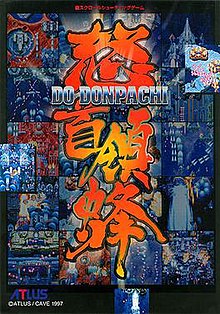
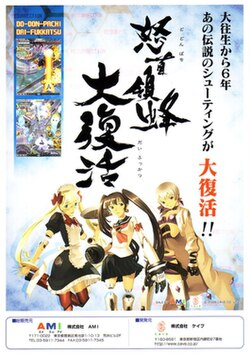 DoDonPachi on PlayStation
 Dai-2-Ji Super Robot Taisen on PlayStation
 Touhou Gouyoku Ibun ~ Sunken Fossil World on Switch
 Green Hell on Xbox Series X/S
 Constantine on PS2
 Painkiller: Hell and Damnation on PS3












 Another SquareThought Site