

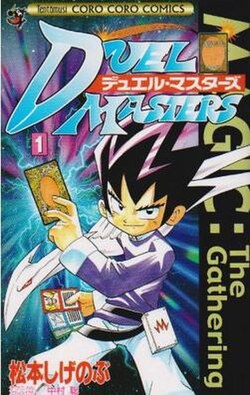

Duel Masters: Birth of Super Dragon is the PlayStation 2 entry stamped with the Duel Masters franchise seal and released in Japan in March 2005 by Kids Station. If you know the franchise, you know the rulebook: five civilizations (Light, Water, Darkness, Fire, Nature), monsters that feel like they might leap off the cardstock, and a hero narrative about becoming a champion. This PS2 title tries to be the console's handshake with the tabletop-bringing deck-building, card interactions, and anime flavor to a living-room-screen format. This review looks at how it approaches that task from a technical and mechanical standpoint, with the mild snark of someone who's played too many card games and still insists on optimizing his mana curve.
At its core, the game is an adaptation of the Duel Masters card rules and aesthetic, so the obvious first technical requirement is accurate rule enforcement. The title leans heavily on the five-civilization system described in franchise material-Fire, Water, Nature, Light and Darkness-and centers around creature summoning and combat priorities rather than arcade action. Deck construction is the primary meta: cards have civilizational tags, costs and effects that interact in the standard way, so the engine behind the scenes needs to resolve triggers, attack declarations, and state changes in a deterministic order. From a systems perspective, the most important design choices are the representation of hidden information, the turn-resolution engine and the feedback loop for the player. The game does sensible things here: hidden zones (hand, shuffled deck) remain private, the battle zone is visually distinct, and the turn phases are laid out clearly in the HUD. When a card ability resolves, the UI presents a brief text box that summarizes the effect-useful shorthand for newcomers and useful audit log for veterans. The game's rule engine appears to maintain a consistent resolution stack for effects, minimizing ambiguous timing conflicts that notoriously plague TCG-to-digital conversions. AI is where the rubber meets the meta and, sadly, also where the PS2 era limitations show. Opponents follow heuristics based on card type priority and board state evaluation rather than deep probabilistic planning. They can read a threat and respond, but complex plays-multi-step combos or subtle discard-synergies-are more hit than precision. This isn't outright broken; in fact it keeps many single-player matches brisk and approachable, but it does cap replayability for players who want a ruthless, tournament-grade digital opponent. Progression and gamification are practical rather than flashy. You unlock cards and presumably campaign chapters by beating CPU characters drawn from the Duel Masters cast. The reward economy is conservative: wins unlock useful cards, but the grind isn't aggressively monetized (it's a 2005 console title, not a live service), so the feedback loop encourages experimentation with deck archetypes rather than pay-to-win desperation. Input mapping is straightforward: the DualShock layout maps to confirm/cancel actions, card navigation and quick-sorting of library/hand. This kind of mapping sits well on a controller once you accept that a controller will never be as fast as a mouse for fiddly deck editors. The developers mitigate that with contextual sorting and filter shortcuts, so building a deck is tolerable instead of teeth-grinding. An omission worth noting is the absence of deep online play or competitive matchmaking-no surprise for a Japan-only Kids Station release of the era, but a technical limitation that reduces the game's long-term competitive appeal. The game's pacing decisions are also technical design calls: animations for summoning and battles are present but skippable, strikes against the impatience of seasoned players. Load transitions between menus and duels are typical of mid-2000s PS2 titles-noticeable but not prohibitive. Overall, the gameplay is a faithful console translation of a complex tabletop system that errs on the side of accessibility, with AI and lack of networking keeping the trophy shelf modest.
Presentation is a PS2-era bridge between function and fan service. Character portraits and card art borrow heavily from the established Duel Masters visual language, which is helpful because where the engine can't wow you with polygonal spectacle, it can at least remind you why you like these dragons and knights. The card art renders crisply in the card-view screens and the UI scales card textures appropriately so text and icons remain legible even on standard-definition televisions. The battle animations are serviceable: simple 2D or low-poly 3D effects punctuate important moments (summons, evolution, victory) without trying to sell the console on cinematic fidelity it doesn't have. The tradeoff works for a card game because visual clarity matters more than splashy shaders: you must always be able to read the battlefield state at a glance. Technically, the game adheres to the PS2's performance profile. Frame pacing during static menus and card browsing is rock-solid; during animated duels there is more variance but nothing that threatens rule integrity. Texture pop-in and occasional UI stutters occur on older hardware, which is par for the course for the console generation. Resolution targets are aligned with SD output and letterboxing is handled cleanly. There's no stereoscopic trickery or HD swap; this is a title meant for TVs of its time. Audio design complements the visuals in predictable ways. The soundtrack favors high-energy cues during matches and more ambient loops in menus. Effects for card plays-metallic clangs for summoning, roaring woofs for dragons-are mixed cleanly and give satisfying tactile feedback. Voicework is likely in Japanese (the game is Japan-only), and character queues are short but adequate for the niche: they punctuate the dramaturgy of a big play without getting repetitive. Where the graphics suffer is not in technical competence but in ambition: by 2005 the PS2 catalog included genre titles that pushed animation and rendering hard. Birth of Super Dragon chooses not to compete there and instead focuses on readable presentation and faithful art reproduction. That is a defensible choice for a TCG adaptation, but don't buy this expecting a showcase of the console's finest visuals.
Duel Masters: Birth of Super Dragon is a technically competent PS2-era adaptation of a complex card franchise that prioritizes rule fidelity, clear UI and approachable deck-building over cutting-edge audiovisuals or competitive multiplayer. The rule engine is robust enough to resolve the franchise's civilization interactions and specialty effects, the UI is controller-friendly, and the art remains faithful to the source material. The chief compromises lie in AI depth, the absence of online play and the console-bound limitations of presentation. If you're an enthusiast who wants a console-accessible Duel Masters experience that preserves the feel of five civilizations and creature-centric combat, this title delivers a tidy single-player package. If modern expectations are your yardstick-deep AI, online laddering, or high-end production values-you'll find the PS2 limitations more noticeable. Given its Japan-only release and the Kids Station production credit, it's best appreciated as a period piece: a mid-2000s console bridge between cardboard and animation. Score: 6.5/10. It gets the mechanics and presentation right where it counts, but technical and competitive limitations keep it from ascending to the kind of must-own conversion that defines a franchise's digital legacy.
 Dragon Ball: Sparking! Zero on PS5
 Power Pro Kun Pocket 10 on DS
 How to Train Your Dragon on PS3
 Coloball 2002 on PS2
 Press Your Luck on PS3
 Game Dev Story on PS4
 Mom Hid My Game! on Switch












 Another SquareThought Site