

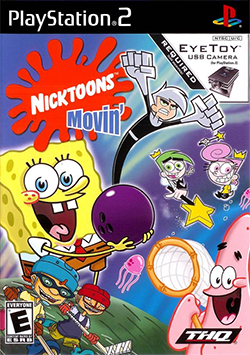

In an era when toys attached to consoles were the latest hallmarks of technological progress, Nicktoons Movin' arrived wearing the EyeToy like a badge of honor. This is not the workmanlike platformer that decorates late-night rental bins; it is a compact collection of thirteen EyeToy minigames built around the rubber-faced, high-energy universe of early-2000s Nickelodeon. Developed by Mass Media and published by THQ, Movin' requires the EyeToy camera and trades thumb-work for upper-body choreography. If you remember the first time someone shoved a webcam at your sofa and told you to 'wave your arms', you know the thrill it promised. I approached Nicktoons Movin' as a reviewer who cut his teeth on ink-and-paper previews, who remembers the satisfying thud of a fresh review copy on a magazine editor's desk. This is a party title at heart: turnkey, short, and loud. It allies SpongeBob SquarePants, The Fairly OddParents, Danny Phantom, Rocket Power, and The Adventures of Jimmy Neutron, Boy Genius under one plastic umbrella, spinning them into bite-sized gameplay moments. The game wears its television origins proudly: menu screens are punctuated by commentary from SpongeBob and Patrick, and short clips from the shows contextualize the minigames. Neon and nostalgia are stitched into Movin', and while it seldom aspires to be anything more than that, there is an honest, if modest, charm to what it tries to do.
Nicktoons Movin' borrows the fundamental logic of other EyeToy compilations: the camera reads your silhouette and translates movement into onscreen interaction. Like EyeToy: Play or Sega Superstars, the experience is a string of minigames-thirteen in total-each using upper-body motion to hit targets, dodge hazards, or manipulate objects. There is no button-mashing ballet here; instead, the player becomes the controller. Move an arm to swat, step to dodge, or plunge your hand into the camera's field to grab an item. The simplicity is by design: these are short, frenetic bursts of play meant to be understandable in seconds. The game splits its life between single-player score-chasing and a multiplayer mode that is its true raison d'etre. Two to eight players can compete across one to thirteen rounds, and the structure is mercifully straightforward. After each minigame, the winner has the privilege of choosing the next contest and can opt to spin a point wheel for extra spoils. This wheel, predictably, plays the role of party-game drama-sometimes you bank points, sometimes you weep into your punchbowl. Round length and the number of rounds are configurable, which means an evening can be a quick two-game skirmish or a full-blown tournament of flailing limbs. Movement fidelity is the perennial challenge for camera-driven titles, and Movin' handles it as conservatively as the tech allows. The EyeToy reads large, obvious motions well; fine, precise gestures are less reliable. For the target market-children and families gathered in a living room-this is acceptable. The developers acknowledge the limitations by keeping minigames broad and forgiving rather than demanding pixel-perfect precision. Menus are navigated with motion, but for players of a more traditional bent, certain screens permit DualShock 2 navigation. This concession is practical: while the EyeToy is the point, not everyone wants to flail through every configuration option. The game's presentation leans heavily on show-sized personalities. SpongeBob and Patrick provide commentary in menu screens-short, characterful quips that keep the tone buoyant when you are not actively already flapping at the camera. Video clips from the corresponding animated episodes play before some minigames, which is clever packaging; it gives a narrative pretext for the activity and rewards fans with a little televised context. Importantly, the minigames themselves do not pretend to be deep: they are designed to be immediate, repeatable, and competitive. That structure is both Movin's strength and limitation. It is delightful when the room is full of people and a throat-clearing 'best of five' match gets underway. It feels thin and repetitive during solo stretches. For anyone expecting an adventure, an RPG, or even a cohesive single-player campaign, disappointment awaits. The game offers high-score chasing and light unlocks, the same bread-and-butter of early EyeToy compilations. It can be praised for what it attempts: translating familiar Nickelodeon IP into a social, kinetic format. It must be criticized for not doing more with the licenses. The characters are window dressing in many games; their personalities are present in the menus and clips but rarely change the mechanics. If you adore the shows, you'll enjoy the familiar faces and the occasional laugh. If you approached this for enduring, solo gameplay, the novelty will wear off after an afternoon of play.
By the standards of the PlayStation 2 mid-cycle, Nicktoons Movin' is functional rather than flaunting. The graphics aim to be faithful to the animated properties; the environments and character flourishes are cartoony and brightly colored, calibrated to match the source material's visual identity. The most interesting visual work is not the polygonal fidelity but the way the UI and video clips integrate actual television content with interactive elements. These clips are the game's small fireworks-brief pockets of the shows that remind you why you signed the kids up for Saturday morning cartoons in the first place. When the EyeToy is active, the screen becomes a collage of silhouettes and decals-your shadow dancing across SpongeBob's underwater spatula or Jimmy Neutron's laboratory. The camera's limited resolution renders your avatar as a rough cutout; that is expected. The developers design around this, with large targets, big color contrasts, and bold animations that react clearly to your presence. On a professional CRT or a mid-2000s LCD, the presentation is crisp enough for its intent. There are moments where compositing of live video and game elements feels slightly squeezed-the overlay can lag or misalign if your room lighting is imperfect-but again, this is a known quirk of consumer webcams of the period rather than a creative failing. Aesthetically, Movin' succeeds when it leans into cartoon physics and Nickelodeon flare. It never aspires to push the PS2's hardware envelope with complex shaders or dense geometry, and it doesn't need to. The visuals are a competent stage for the real attraction: motion and personality.
Nicktoons Movin' is a time capsule of a particular moment in gaming history when cameras promised to replace controllers and family rooms were theatres for lurching performance art. It is not ambitious; it does not attempt to be. It exists to make people move, and for that aim it does an honest job. The thirteen minigames are cleverly constructed for broad, immediate appeal, and the inclusion of SpongeBob, Jimmy Neutron, Danny Phantom, Rocket Power, and The Fairly OddParents gives the package a credible, crowd-pleasing license backbone. The EyeToy is both the toy and the limitation: when lighting and space cooperate, the experience is lively and social; when they do not, the novelty frays. Critically, the game received middling attention upon release-IGN scored it 6.0 and Official PlayStation Magazine offered a 3 out of 5. Those figures are fair. For parents, party-players, or anyone looking for a one-evening diversion with recognizable characters, Movin' is a worthy rental or a low-priced purchase. For solitary players seeking depth, or for those who demand pixel-perfect input fidelity, this will feel like a curiosity best left on the shelf. As a reviewer who learned to parse hype from substance in the magazine racks of the '90s, I will say this: Nicktoons Movin' captures the exuberance of its source material and the social spark of EyeToy's promise. It is not a classic, but it is sincere, and sometimes sincerity is exactly what you need in a party game. If you own an EyeToy and a living room full of willing participants, plug it in, dim the lights, crank the TV, and let the chaos commence. If you asked me whether to recommend it to a single, stern gamer seeking the next great PS2 epic, the answer would be no. For its intended audience, however, it's a competent, occasionally amusing piece of licensed fun.
 Nicktoons: Battle for Volcano Island on PS2
 Nicktoons Racing on PlayStation
 Onimusha: Dawn of Dreams on PS2
 Action Man: Operation Extreme on PlayStation
 Super Mario Party Jamboree – Nintendo Switch 2 Edition + Jamboree TV on Switch 2
 Door Kickers: Action Squad on Switch












 Another SquareThought Site