

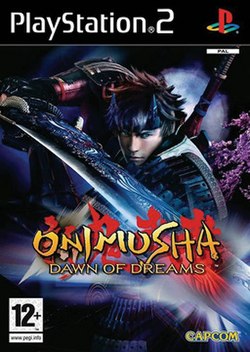

Onimusha: Dawn of Dreams is the PS2 swan song of the Onimusha action-RPG lineage that decided to stop looking at fixed camera angles and start fighting in full 3D like a samurai who finally figured out how to pivot. Capcom Production Studio 2 shipped this one in 2006 with the explicit goal of turning the series from quasi-cinematic beat-'em-up with fixed vantage points into a proper, mechanically denser action game. The team leaned hard into action - more moves, more weapons, more systems - and designed the title to appeal to skilled players rather than the casual sword-swinging tourist. That ambition shows: Dawn of Dreams is technically interesting, sometimes brilliant, occasionally bumpy, and a compelling study in late-PS2-era trade-offs. From a technical standpoint the most visible shift is the move away from prerendered backdrops to a fully rendered 3D world with player-controlled camera for most situations. That change alone reorients design priorities: collision, camera logic, enemy AI, target switching, and framerate budgeting all become far more central than in earlier entries. Capcom's stated goal was to keep the graphical fidelity of prior Onimusha games while running a smooth 60 frames per second, and the team implemented a set of mechanical additions - lock-on refinements, dual-character control, and co-op - to capitalize on the freedom the new camera provided. The result is an action-RPG that tries to be smart about player agency and systems, even when the underlying hardware occasionally reminds you that it's still 2006 PlayStation 2 silicon.
Dawn of Dreams grafts traditional Onimusha tropes (soul absorption, magical skills, Oni transformations) onto a more contemporary action-RPG frame. The player mainly controls Soki, with a party system that brings several companions with distinct utility - Jubei (small and nimble), Ohatsu (bombs and grappling), Roberto (brute force), Tenkai (spirit interaction) - and the option of issuing commands to the AI teammate via the directional pad. That command-and-switch architecture is the game's central mechanical hook: you can tag between characters on the fly or hand off specific tasks to AI, and a second human can join in local co-op for the first time in the series. From a systems perspective, the game blends action input precision with RPG progression. Characters level up to gain skill points and new moves, weapons are upgradable with demon souls, and consumables/accessories create a lightweight equipment economy. Souls harvested from Genma enemies serve dual roles: upgrade currency and resource for health/magic restoration. Soki's Oni mode is a half-burst power-up unlocked mid-campaign that temporarily boosts stats and changes move properties; it's a classic risk-reward designer tool that forces the player to manage timing and resources instead of mindlessly mashing. The combat itself leans toward responsiveness and variety. Numerous attack strings and weapon types mean encounters can be approached differently depending on loadout. The lock-on system is central to this, reducing the headaches that a free camera introduces for melee targeting in a 3D environment. Capcom improved the lock-on clarity and mapped target switching to the right analog stick so that target cycling is quick and intuitive - a crucial implementation detail when dealing with crowds and aerial enemies. Enemy AI is competent enough to create pressure, but as contemporary reviews noted, it's not always clever: foes rarely display creative tactics beyond flanking or simple combos, which makes learning patterns more viable for the player but also reduces emergent AI drama. Exploration and level design take advantage of the free camera. Stages are larger and more connected than in earlier Onimusha installments, and the game explicitly encour ages backtracking: after finishing a stage you can revisit earlier areas with a chosen partner to unlock new items or secrets, enabling Metroidvania-lite progression where abilities or partner-specific traits open new paths. This design increases playtime organically and rewards system mastery, but it also demands consistent map and asset streaming. Capcom addressed that by concentrating set-piece fidelity in the areas you'd be revisiting most, and by sacrificing a little visual polish in cutscenes and some textures to sustain frame delivery. Puzzles are present but treated as optional friction rather than mandatory gatekeepers. Producer Yoshinori Ono disliked forcing players into long-winded puzzle sections, so many puzzles can be bypassed by destructible objects or alternate approaches, reducing tedium but slightly diminishing the puzzle-as-pause design role. There's also the Dark Realm, an optional gauntlet that grants superweapons when cleared; it's a nice example of optional endgame content giving mechanically meaningful rewards without bloating the main loop. Co-op and AI support are both double-edged swords. Local two-player mode is novel for the series and fun in bursts, but early criticism noted some awkwardness in its implementation - camera priority, shared resources, and enemy scaling sometimes break flow when two humans occupy the space that AI otherwise navigates cleanly. The single-player experience, with direct AI commands, is subtler: directional-pad orders let you position allies for tasks or tactical maneuvers, but AI pathing and decision-making occasionally frustrate precision-heavy players. Under the hood, the team's emphasis on action required careful CPU/GPU balancing on the PS2. Maintaining frame consistency at 60 fps with a free camera, dynamic enemy counts, physics for destructible geometry, and multiple characters on screen is non-trivial. The game sometimes trades off cutscene resolution and certain texture details to keep gameplay smooth, which leads to mixed impressions: the gameplay feels tight, but presentation fidelity wobbles.
Graphically, Dawn of Dreams is a textbook example of late-PS2 pragmatic design. The move to fully rendered 3D environments is successful for the moment-to-moment exploration and combat: camera control, lighting on dynamic models, and environmental geometry provide tactile feedback during fights and traversal. Character models are expressive, and the switch from basing protagonists on celebrity likenesses to wholly original designs gave the art team freedom to push for 'cool' silhouettes and motion that match the heightened action focus. Capcom aimed to keep the graphical quality of earlier Onimusha titles while adding the benefits of dynamic rendering; in gameplay this pays off with consistent character animation and smooth combat animations that make hit detection and spacing feel fair. The camera logic, while mostly solid, still resorts to fixed angles in a few tight rooms where cinematic framing was preferred. This occasional mix of fixed and free cameras feels deliberate - a stylistic holdover - but it also exposes the complexity of managing camera collision and occlusion in older engines. Cutscenes are the weak link. Several reviews and players noted blurry, low-resolution prerendered sequences or compressed in-engine cutscenes that betray the memory limits of the platform and the decision to reserve headroom for 60 fps gameplay. The orchestral cutscene scoring by Jamie Christopherson and the in-game compositions by Hideyuki Fukasawa lift the presentation substantially, and the Ayumi Hamasaki opening/ending themes give the package a glossy commercial polish. Voice acting quality varies by region: North American releases retained the Japanese audio track in some territories, while the European release lacked it, leading to criticism from purists. Technical achievements include the stable frame budgeting during combat situations and the responsive lock-on/target-swapping implementation that uses the right analog for retargeting. These are subtle but high-impact engineering choices: they make the difference between playable chaos and coherent action. The trade-off - lowering cutscene fidelity and accepting occasional texture compression - is an understandable engineering choice for the PS2 hardware envelope.
Onimusha: Dawn of Dreams is an intriguing technical pivot for the franchise. It trades some of the series' cinematic presentation for systemic depth and mechanical responsiveness, and for players who value clean input loops, meaningful upgrades, and varied party mechanics, that trade is often worth it. Capcom's ambitions - a 60 fps action-RPG with free camera, multi-character synergies, and local co-op - were largely realized on the PS2, and the game's Metacritic standing (~81/100) reflects that critical approval. Commercially it underperformed, shipping roughly 325,872 units in Japan in 2006, which makes it a borderline cult classic rather than a runaway success. If you play it today, expect a tightly tuned combat core, enjoyable partner-based mechanics, and moments of production variance where cinematic resolution was sacrificed for frame-rate and gameplay. The AI and enemy design occasionally lack ingenuity, some voice and localization choices are uneven, and the cutscene fidelity shows its age. Still, the title rewards technical players: mastery of combos, switching characters at the right time, exploiting the Dark Realm, and revisiting stages with new tools all provide long-tail satisfaction. For anyone who cares about the engineering of action games - camera systems, lock-on ergonomics, CPU/GPU trade-offs, and party-AI command design - Dawn of Dreams is worth studying and, more importantly, playing. It's an ambitious PS2-era attempt to evolve a series towards modern action-RPG sensibilities while staying within the constraints of the hardware, and in many ways it pulls that off. If you want the Onimusha formula with more mechanical teeth and fewer cinematic crutches, this one bites back in the best possible way.
 Onimusha 2: Samurai's Destiny on PS2
 Onimusha Blade Warriors on PS2
 PlayStation Home on PS3
 Ōkami on PS2
 Crash Bandicoot: The Wrath of Cortex on PS2
 Persona 5 on PS3
 The Misadventures of Tron Bonne on PlayStation












 Another SquareThought Site