

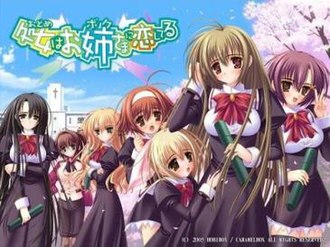

Otome wa Boku ni Koishiteru on PS2 is the wholesome-but-weird cousin at the visual-novel family reunion. You play Mizuho Miyanokouji, a disturbingly pretty high school guy who, by the terms of his grandfather's will, must cross-dress to attend Seio Girls' Academy, a private all-girls school founded by his ancestors. The premise is equal parts soap-opera tradition and romcom absurdity: a boy in a girl's school becomes not just popular, but elected the 72nd Elder, a ceremonial 'Onee-sama' figure adored by the student body. From that oddly regal starting point, Otoboku spins six heroine routes (plus a handful of sub episodes) that are less about scandal and more about the slow, patient unspooling of adolescent wounds, loyalties, and the way people try on identities to figure out who they actually are. The PS2 version trims the adult content present in the original Windows release, which changes the tone more than you might expect. Where the PC original sometimes leaned on erotic closure to punctuate routes, the PS2 port forces the writing to find emotional payoffs instead. If you want sex as narrative punctuation, get the other edition. If you want character arcs that must land on feelings, promises, or bittersweet acceptance, the PS2 version often does a better job simply because it has to. The game is not flawless; the male-in-female-school conceit gets recycled, and some routes lean into archetypes. But when it hits, it hits with a surprising tenderness. Also, there is a ghost who talks very fast, which is a plus in my book.
On the surface, Otoboku's gameplay is classic visual-novel fare: read, click, choose. The PS2 edition keeps the branching plot structure intact, but the differences from the PC original matter. Route choices still appear at key junctions, and each heroine has a dedicated scenario composed of eight monthly 'episodes', an interlude, and an epilogue. To see everything you must replay and steer decisions toward different partners, which is tedious on purpose: the game wants you to sit in each relationship and watch it evolve. The PS2 release also reorganized and added sub episodes; Alchemist commissioned extra material from Kiichi Kanō, which pads some routes and shifts the balance of attention among characters, a welcome change if you felt certain side characters were cheated in the original. There are six main heroines and each arc is an exercise in focused emotional excavation. Mariya Mikado is the childhood friend who doubles as transition coach and firebrand sidekick. Her arc is about loyalty and the cost of wearing a mask for someone you love. Mariya's energy is a thermostat for the story: she ranges from blunt force to surprisingly vulnerable, and the best Mariya scenes make the writer explain why she needs to be the person in motion rather than the person acted upon. Shion Jujo is the quiet enigma. She discovers Mizuho's secret early, which sets up a relationship based on the neatest power balance imaginable: knowledge without leverage. Her backstory includes a hospitalization in the prior year after being elected Elder, which gives her route a slow-burning, haunted quality. Shion's arc is a study of risk aversion wearing itself out; the game shows how silence can be protection and how trust can be the surrender that heals. On the PS2, without erotic punctuation, Shion's personal breakthroughs rely on simple domestic tenderness and carved-out moments of mutual vulnerability, which make her path feel more like a slow-released sigh than a melodramatic reveal. Kana Suoin is obsessive in the sweetest way: Mizuho becomes her Onee-sama on Day One, and she worships with both practical servitude and earnest naïveté. Kana's arc deals with admiration that flirts with idolization. The route challenges Mizuho to respond without defaulting to being adored, and the payoff is about agency: Kana learns to be loved for who she is, not only for the echo of Mizuho's kindness. Yukari Kamioka is a track-and-field underdog whose self-esteem issues are framed through athletics and the 'Oneesama' relationship with Mariya. Her route asks whether confidence is built from external praise or internal work, and Otoboku handles this with a light touch. Yukari is a character that benefits from episodic structure: you watch incremental improvements over months, which makes her growth feel earned rather than scripted. Takako Itsukushima, the student council president and perennial foil, is the adult-in-training. Stern and disciplined, her arc is a slow decomposition of hauteur into responsible affection. She reads like the rational plot anchor the game needs: when everyone else is fluttering in adolescent chaos, Takako is the hand that polishes the rules and asks what leadership actually means. When her armor cracks, it's because she had to decide what to protect and who to let inside. Ichiko Takashima is the curveball: a hyperactive ghost living in Mizuho's room who speaks at a verbal Usain Bolt pace and whose previous Elder love interest is revealed to be Mizuho's deceased mother. Ichiko adds both comic relief and an odd, elegiac strain. Her presence reframes Mizuho's participation in the school as not just obligation but as continuation of family ties. The ghost's speed-talking is comic, but the emotional beats she triggers are surprisingly layered. Mechanically, the PS2 changes remove visual sex scenes and, in doing so, recalibrate the routes to emphasize dialogue, small gestures, and the emotional consequences of choices. That means some paths feel cleaner, less sensationalized. The episode structure (one month per episode running June through March) gives each route a calendar-like cadence that supports the school's traditions, including the Elder election. The election itself (75% plus needed, and Mizuho wins with 82% in the first round) is used not simply as a gimmick but as a pressure cooker that forces characters to define their feelings in public. If you enjoy character-driven narratives where secrets, responsibilities, and the weight of tradition collide, PS2 Otoboku uses its visual-novel system conservatively but effectively.
Graphically, Otoboku is not trying to win E3; it's trying to make you care. Norita's character designs give the cast a soft pastel harmony that reads winningly on a TV screen even now. The PS2 port preserves the original art direction while swapping out the most explicit CGs from the Windows release. The super-deformed chibi art, drawn by Yoda, appears in menus and special episodes to lighten the mood, and those moments are delightful little palate cleansers when a route threatens to become melodramatic. The PS2's presentation benefits from stable voice work and some newly added scenarios that include voice, helping give emotional beats extra punch. Backgrounds are serviceable school and dorm settings, detailed enough to ground the story without drawing attention away from the characters. If you need dazzling polygons or texture streaming, look elsewhere; if you want consistent character sprites, expressive CG moments, and charming chibi extras, the visuals do their job and do it with personality.
Otome wa Boku ni Koishiteru on PS2 is a curious hybrid: it wears the livery of a harem romance but behaves like a collection of character studies. Removing the adult content forced the game into a purer examination of commitments, identity and leadership inside the microcosm of Seio Girls' Academy. Mizuho's situation is an engine more than a gag; every route turns around who gets to be seen, who gets to be responsible, and how people learn to be loved honestly. Some heroines suffer from archetypal shorthand and some episodes are padded with fanservicey detours, but overall the writing finds unflashy ways to let characters grow. The PS2 version benefits from added scenarios and a focus on emotional payoff, even if that focus occasionally leads to a safe, predictable cadence. If you want an emotional visual novel that trusts small moments, favors character over shock, and is content to let a ghost and a student council president steal scenes, Otoboku on PS2 is a comfortable chair to sit in. If your tolerance for trope-laden school settings is low or you want modern pacing, be ready for slow revelations and a calendar-based drip-feed of feeling. For players who pick it up for the cast rather than the gimmick, the game is genuinely rewarding: Mariya's fierceness, Shion's quiet bravery, Takako's responsible crumble, Kana's adorational growth, Yukari's steady climb, and Ichiko's bittersweet levity create a small ensemble that lingers after the credits roll. Charming, sometimes silly, frequently sincere, and anchored by an oddly effective Elder election drama, Otoboku on PS2 earns its 7.5 with the kind of soft authority that befits an ex-Elder.
 Boku no Natsuyasumi on PlayStation
 Infinite Stratos 2: Ignition Hearts on PS3
 Tokimeki Memorial Drama Series Vol. 3 Tabidachi no Uta on PlayStation
 Oshiete! Popotan on PS2
 Pachislot To Heart 2 on PS3
 Tomoyo After: It's a Wonderful Life on PS3












 Another SquareThought Site