

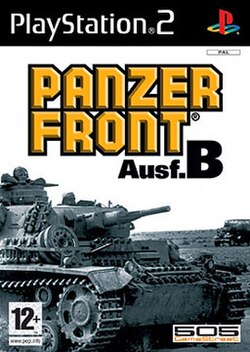

Panzer Front Ausf.B is the kind of game that treats you like a tank commander first and a couch potato second. It politely refuses to hold your hand, expects you to learn how to read a battlefield, and makes you answer for every rash decision with exploding steel and the occasional helpless clatter of tracks. Set mostly in the dust-choked deserts of early North African campaigns (with a single outing in the 1940 invasion of France), the game drops you into historical encounters-think Beda Fomm and Fort Capuzzo-where dozens of units on each side move, shoot and try to ruin each other's day. If you want arcade pew-pew and unending respawns, this isn't it. If you like slow-burn tactical puzzles where a single well-placed shot or a disabled crew can swing a mission, then tighten your helmet strap.
Panzer Front Ausf.B is a simulation that leans on realism in ways that punish sloppy play and reward battlefield literacy. The player commands the lead tank of a formation varying between two and five tanks; you can split formations into sub-units, hand control to different tanks, or even flip to command the opposing force. That flexibility hides the core challenge: you're not just driving a big metal box with a gun. You're balancing situational awareness, gunnery skill, crew management and logistics. Situational awareness is king. Battles routinely involve over thirty units per side-infantry, gun emplacements, and tank platoons-so the map is a living thing that changes fast. The main view is outside the tank, giving you a tactical overview, but you also have access to the commander's hatch binoculars with variable zoom and internal vision devices with an aiming reticule. Mastering when to pop the hatch, sweep with the binoculars and then dial down into the gunner's sight is a learned rhythm. Zooming in without scanning the surroundings first is a classic way to get flanked by an Australian cruiser while you're admiring a distant Matilda. Gunnery in Ausf.B is a lesson in applied physics and humility. Different weapons have unique sounds, recoil and ammo types. The 88mm plays a different tune than the machine gun, and you'll need to learn range estimation, leading moving targets and angling shots to exploit armor weak points. Damage modeling is detailed: hits vary by range, angle and armor composition. A lucky-or unlucky-shot can tear a track, jam a turret, blow a gun mount or kill individual crew members. When a loader or driver is wounded, your tank's effectiveness craters; a dead commander can mean garbage visibility. These mechanics force players to think like actual tank crews: flank when you can, avoid head-on duels with superior guns, and always protect your rear. Tactical command skills are tested too. You can call in high-explosive or smoke artillery and request support aircraft. But the game doesn't hand these to you on a silver platter; timing and target selection matter. Smoke can save a pinned unit or mask a retreat, while artillery is best used to break hardened positions or disrupt enemy formations before you close. Using support poorly is like bringing a chef's knife to a gunfight: it looks cool but won't save you. Logistics and repairs are another layer. There are repair/reload areas where crew can be replaced and damaged systems fixed. Getting to those spots under fire requires planning-do you commit to keep a wounded lead tank in the fight, or withdraw to repair and risk losing ground? Scoreboards at mission end track enemy kills and points, but you only save them if you use default units and vehicle types, which nudges the game toward historical fidelity rather than optimization-by-exploit. The missions themselves demand flexible skill-sets. Most are drawn from the Western Desert Campaign, so you'll face tactics unique to open, flat terrain: long-range engagements, ambushes behind ridgelines, and the constant threat of being outmaneuvered. Playing different sides (Afrika Korps, Italian Tenth Army, British Eighth Army, Australian 6th Division) changes unit composition and tactical options, so good players learn to shift mindset instead of muscle memory. Overall, Ausf.B rewards patience, map reading, deliberate aiming and the discipline to protect your crew and machinery. If you enjoy slowly mastering systems and then seeing those tiny improvements flip a battle in your favor, this game will feel like earned victory. If you prefer instant gratification and modern hand-holding, the difficulty curve will test your willpower.
The visuals aren't out to win any awards, but they deliver the practical clarity a simulation needs. Tanks and vehicles are modeled on real 1940-1941 units-the Panzer III, Cruiser Mk III, Matilda II and others-so identification matters and the look helps you learn what you're facing. The main external camera gives useful tactical panoramas, while the sight views provide the zoom necessary for gunnery. Dusty battlefield textures, basic terrain variation and large unit counts mean the screen is often busy, which serves gameplay more than glamor. The sound design does a surprisingly good job: different guns feel distinct through noise and recoil effects, and the thump of a disabled engine or the pop of a crew member's death punctuates mistakes. In short, Ausf.B's presentation prioritizes function over flash-exactly what a simulation of this stripe should do-so don't buy it for eye candy, buy it if you want a readable battlefield.
Panzer Front Ausf.B is a niche simulation that will charm tactical purists and frustrate players who expect modern comforts. Its realism-crew injuries, detailed damage modeling, formation management and support calls-creates a demanding puzzle where observation, planning and disciplined gunnery are the paths to success. The missions' historical settings and authentic vehicles give context to the challenge, making every decision feel meaningful. The game's mixed reception is understandable: it asks a lot from the player and rewards patience rather than polish. If you're into slow, crunchy tank sims that punish the careless and reward the meticulous, Ausf.B is worth digging up from the PS2 bin. If you want instant thrills and forgiving tutorials, consider something with fewer mechanics and more explosions per minute.
 Panzer Bandit on PlayStation
 Panzer Front on PlayStation
 Pro Evolution Soccer 2015 on PS4
 MotoGP 19 on Switch
 Power Pro Kun Pocket 13 on DS
 Theme Park World on PlayStation
 RPG Maker MV on Switch
 The Magician's Academy on PS2












 Another SquareThought Site