

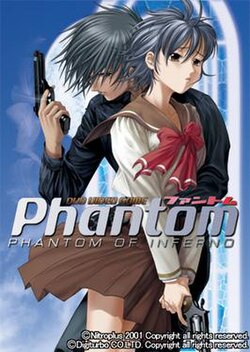

If you're in the mood for a visual novel that treats you like an undercover agent with chronic identity issues rather than a dating-sim extra, Phantom of Inferno is the sort of dark, twisty ride that will happily rearrange your expectations. Originally a 2000 PC eroge from Nitroplus, Phantom got the DVD treatment (voice acting added; sex scenes excised) in 2001 and then rolled onto the PlayStation 2 in 2003 as a port based on that cleaner, voice-acted DVD build. The PS2 version therefore presents the story in a more console-friendly package: still morally ambiguous, still full of assassins with German number names (Zwei, Ein, Drei - because apparently the organisation ran out of imagination after numbers), but minus some of the adult-only content that kept the original strictly for bedrooms with a lock on the door. The game opens with a perfectly ordinary (read: unsuspecting) fifteen-year-old Japanese tourist who witnesses a hit and gets immediately promoted to 'kidnapped protagonist.' His memories are wiped, he's renamed Zwei, and he's trained by the cold and inscrutable Ein - the titular 'Phantom'. From here, the narrative levers the player through a criminal international circus known as Inferno (described in-game as a kind of 'United Nations of crime syndicates'), a cast of manipulative executives, a sadistic scientist called Scythe Master, and multiple tangled relationships. The PS2 release keeps the three-act structure intact: three chapters, branching routes, and enough endings to make your save files look like confessionals.
Phantom isn't a shooter or a stealth-action game pretending to be an art film; it's a choose-your-own-adventure novel with good production values and terrible people choices. Gameplay boils down to narrative decisions that steer Zwei through a web of loyalties, betrayals and gunfights that read like the love child of a noir thriller and a soap opera with excellent subtitles. The game is split into three chapters, each with distinct routes and outcomes. Chapter one turns Zwei from blank-slate recruit into a functioning killer and offers the two principal early routes: Ein's route or Claudia's route. These early choices cascade into chapter two, where the plot thickens, new players (like Cal, who becomes Drei) enter the stage, and loyalties get tested like overloaded safes. What makes Phantom addictive (and occasionally exasperating in the best way) is how interleaved the narrative is. Unlike many visual novels where you pick one character and follow them to a neat conclusion, Phantom demands a memory for what you did in previous chapters and rewards completionist habits. Cal's route is notoriously strict - one wrong answer and the game pretends Cal never existed, as if she went shopping and simply forgot to come back. There are multiple notable endings: 'Southbound' (a bittersweet escape for Ein and Zwei), 'From Atop the Hill' (a long con involving power grabs and the Zahlen Schwestern), 'Road of the Cerulean Sky' (Ein's true ending), 'Dusty Desert Trails' (Cal's true ending), and many more. The branching system leads to outcomes ranging from quietly tragic to full-blown melodramatic, and the Integration PC update later added yet another endpoint for completionists. On PS2 the experience is voice-acted (the DVD version that the PS2 port is based on added voice work), which helps sell the emotional texture of characters like Claudia - equal parts syrupy charm and clandestine manipulator - and Ein, who speaks like an assassin with a resting poker face. Since the PS2 version mirrors the DVD, however, it lacks the explicit adult scenes from the original PC release; this doesn't dilute the drama - if anything, it makes the moments of emotional violence land harder because the game leans on action and dialogue instead of adult shock value. If you like replay value, Phantom is your kind of masochism. Choices aren't always signposted, the game punishes casual play with dead-end outcomes, and unlocking chapter three often requires very specific conditions (complete both Ein and Cal's paths, confirm the sniper, find out who attacked the harbor, etc.). This is a title that begs for multiple saves and a vague relationship with patience. On the bright side, the PS2 release gives you the voice-acted production values without the PC eroge baggage, which for many players is the best of both worlds: a serious crime story that you can show to people who haven't yet sworn off visual novels.
Visually Phantom is very much of its era, but that age has charm. Expect static CGs for key moments, expressive character art in a moody, pseudo-anime style, and cinematic framing during major scenes. The PS2 port didn't reinvent the wheel - it polished it just enough to avoid squeaks. Character portraits do most of the emotional heavy lifting; Ein's blank stares and Claudia's smile are rendered well enough to make some scenes genuinely chilling. Backgrounds tend to be functional rather than flashy, which fits a story that prefers shadowy alleys and hotel motels to neon spectacle. The DVD/PS2 voice acting elevates the presentation: hearing key lines performed makes betrayals sting and reunions ache more than the silent text alone. Sound design and music are used sparingly; when a tune swells it underlines a turning point without trying to drown the scene. Fans of later remakes will note that character redesigns were given a facelift in the Xbox 360 and 2013 PC remaster, but for PS2-era eyes this version has a gritty, atmospheric look that suits the narrative weight rather than flashy modern polish.
Phantom of Inferno on PS2 is a rare console visual novel that treats you like someone who can handle moral ambiguity and plot branching without hand-holding. It's dark, occasionally overwrought, and proudly melodramatic in all the right ways. The PS2 port keeps the strong writing and branching complexity while trimming the adult-only bits, and the added voice acting makes the emotional beats thump harder than they would on a silent page. If you're into twisted crime family dynamics, assassins with number names, and endings that make you question every romantic subplot you've ever rooted for, Phantom is a gratifying, replay-hungry experience. It's not perfect: the strict requirements for some routes can be frustrating, and the visuals won't win any awards against modern VNs, but the storytelling is clever and the payoff - the endings and the way decisions ripple across chapters - feels earned. For players who want a mature narrative on the PS2 (that still lets you feel like a pseudo-philosopher-assassin), this Nitroplus classic is worth the save-load grind. Score: 8/10 - equal parts tragic, tactical and surprisingly touching, with enough branching to keep you coming back until you've memorised everyone's names in German numbers.
 Alone in the Dark: Inferno on PS3
 Avatar: The Last Airbender – Into the Inferno on DS
 Tokimeki Memorial Drama Series Vol. 3 Tabidachi no Uta on PlayStation
 Oshiete! Popotan on PS2
 Rewrite on PS4
 Pachislot To Heart 2 on PS3












 Another SquareThought Site