



Police 24/7 (released in Japan as The Keisatsukan: Shinjuku Ni Juu Yo Ji and originally an arcade title called Police 911) is a peculiar Konami experiment in translating the spectacle of arcade light-gun shooters into a physically interactive package. What sets it apart from the typical point-and-blast lineage (think Lethal Enforcers or Time Crisis) is that it insists you move your body - not just waggle a trigger finger. The arcade version used infrared motion sensing to track player position relative to a floor pad and cabinet-mounted sensors; the PS2 port tries to replicate that experience with a USB motion-sensing camera peripheral and a handful of minigames. From a technical perspective, Police 24/7 is best evaluated as an exercise in input innovation and port fidelity rather than a traditional controller-driven shooter.
On the input and systems side, this is where Police 24/7 earns its engineering stripes. Instead of relying solely on a light gun's aim or a foot pedal/cover button, the arcade cabinet registers player position via infrared sensors and a standing pad: you dodge by shifting your knees across the pad, duck to take cover (and reload), and lean out to squeeze shots past obstacles. This is not choreography for show - the game's cover system is literally embodied. Taking cover is performed by physically ducking; re-emergence is governed by the same physical motion, and the game continues to fire on you while you're in cover, which makes timing and partial exposure a tactical consideration rather than a binary safe/unsafe state. That design decision produces a risk/reward loop: stay hidden too long and the mission timer punishes you; pop out too early and you get clipped. The interplay between the continuously running timer (a la Time Crisis) and the motion-based cover introduces a novel tempo: momentum matters, not just marksmanship. Progression is layered on top of the motion mechanics with a rank-and-reward system. Successfully clearing sub-parts of a level raises your rank through a ten-step ladder (Officer up to Commissioner). Rank increases grant incremental time bonuses and, at certain thresholds, additional lives - up to a ludicrous 100 lives being the top-tier reward. That cap exposes an interesting design artifact: since time continues to tick down while you play death animations and no further time bonuses are given once you hit the top rank, the theoretical reward becomes practically unusable. Skilled players could exploit this by boosting rank to snag a life and then intentionally dying to re-earn time-based bonuses - a quirk that feels like either a leftover from arcade reward balancing or a deliberate nudge to encourage repeated risk-taking. Targets and penalties are straightforward but technically enforced: shooting civilians or fellow officers reduces rank (with the U.S./European version making the penalty less grim than the Japanese release, where a newspaper headline explicitly indicates a civilian death). Enemy AI does not pause for your theatrics; it continues suppressive fire during your cover animation, which places a premium on precise sensor tracking and head/torso exposure management. Stages are a mix of densely populated urban scenes and vehicular chases; the PS2 port preserves core encounters - nightclub raids, highway chases, underground garages, and boss encounters with named criminals like Richard Hansen and Bai Ei Lee - and flips some stage order between regional versions. The PS2 edition also bundles minigames (balloon shooting, for instance) that act as palate cleansers for solo players who no longer have an arcade rig to climb into. From a systems reliability standpoint, this game is a case study in how innovative inputs can be both charming and fragile. Infrared and camera-based position tracking in early-2000s hardware is susceptible to calibration drift, lighting conditions, and the ergonomics of living-room setups versus purpose-built arcade cabinets. The PS2's USB motion camera works, but it cannot replicate the arcade cabinet's sensor geometry perfectly; expect variance in detection latency and positional granularity. For players who treat the motion layer as core to the design, this inconsistency is the dominant factor in the experience.
Konami's arcade incarnation ran on the Konami Viper board, and that lineage shows in the way environments are constructed: the game favors dense, pre-baked urban geometry, high-frequency texture detail around landmarks, and curated camera angles that stage combat encounters like mini set-pieces. The U.S./European version goes one step further in environmental fidelity by including digital replicas of actual buildings around Los Angeles' 1st St. and San Pedro St. - a nice touch that suggests Konami used photographic reference or carefully sourced textures to sell those backdrops. On PS2, the port generally preserves the look, but you can see the compromises. Textures are downsampled relative to the arcade; polygon counts are trimmed in off-screen objects; and draw distance management becomes more aggressive. The result is serviceable for a 2001/2002 release: environments retain a strong sense of place, but closer inspection reveals the era's limitations - texture tiling, visible pop-in, and simpler character models compared to higher-end arcade hardware. Animation and visual feedback are engineered to support the motion-play loop. Muzzle flashes, hit effects, and enemy flinch animations are tuned to be visually unambiguous so that the player can make split-second physical decisions about ducking or leaning. That clarity is important because the motion input already demands a lot of your attention; the graphics team wisely prioritized readable visual cues over flashy-but-ambiguous spectacle. Sound design follows suit: clear voice cues, timer beeps, and enemy calls help reduce cognitive load when the player needs to move their body and their eyes at once. One technical note on regional differences: the Japanese release is more punitive visually when you hit a civilian (newspaper headlines flash), while the overseas builds opt for a rank penalty without the same on-screen dramatics. This is not a graphical downgrade so much as a localization tuning choice, but it affects how the game communicates failure states to the player.
Police 24/7 is best judged as a technological curiosity: a light gun shooter that insisted motion be part of its control vocabulary. From a mechanical and engineering perspective it succeeds at being different - the infrared sensor pad, duck-to-reload cover system, and rank/time interplay produce a gameplay loop that is tactile and physically demanding in a way most shooters are not. Where it falters is in the translation to the PS2 living room: camera-based sensing and the constraints of home hardware introduce variability that can undermine the elegant symmetry of the arcade concept. Graphically the port is competent, with urbanscapes that capture the game's set-piece intentions, but it shows its age and the expected compromises between arcade board and console. If you have the patience to tinker with camera setup, enjoy bodily commitment in your games, and are curious about a chapter of Konami's experimentation with motion input, this is worth a rental or a cheap buy. For players seeking a tight, polished, controller-based FPS or a modern light-gun emulation experience, there are better choices. Police 24/7 deserves credit for the technical risks it took and for creating a playable intersection between motion sensing and arcade gunplay - even if that intersection occasionally trips over the hardware of its time.
 This Is the Police on Switch
 Police Stories on PS4
 Projection: First Light on PS4
 PixelJunk Shooter 2 on PS3
 Time Crisis on PlayStation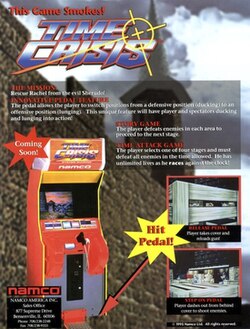
 Metal Gear Solid: Integral on PlayStation
 ISS Pro Evolution 2 on PlayStation
 Pro Evolution Soccer 2 on PlayStation
 Metal Gear Solid 3: Snake Eater on PS2
 Dance Dance Revolution Best Hits on PlayStation












 Another SquareThought Site