

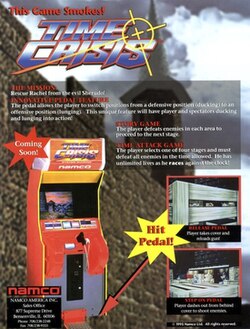

By the mid-1990s the arcade was a place of spectacle: huge cabinets, loud speakers, and novelties that made quarters feel like investments. Time Crisis arrived in 1995 as one of those novelties that actually earned its hang on the marquee. Namco's rail-bound, light-gun bruiser brought a simple but brilliant twist to the genre: a cover pedal. The PlayStation port, bundled with the GunCon peripheral and later sold as a standalone cartridge for controller-play, attempts to bottle that arcade adrenaline for your living room. In 1997, when most home light-gun conversions were content to be passable imitations, Time Crisis landed on the PlayStation with the swagger of something that knew it had invented a few rules and intended to keep them. This review looks at how well that swagger translated from the smoke-filled arcade to the carpeted den, and whether the console version still made you feel like a one-man army or just a guy pointing a plastic gun at a tiny TV.
Time Crisis is unapologetically simple in its aims, and that is both its strength and its only genuine flaw. The basic loop is straightforward: you are Richard Miller, you storm through predefined areas (three stages, each with three areas plus a boss), you shoot anyone who tries to shoot you, and you do it against the clock. Namco keeps the pressure up with short time limits per area, and the game rewards aggressive, accurate play by extending the clock when you clear a section quickly. That ticking clock is the metronome of the design - every encounter becomes a negotiation between speed and safety. What separates Time Crisis from its contemporaries is the cover system. In the arcade cabinet you stomp on a foot pedal to duck behind cover and reload; on the PlayStation you either use the GunCon's reload button, map a pad button to the action, or - if you're the kind of person who owns a steering peripheral with pedals - you can even use that to replicate the original. The pedal mechanic does more than simulate realism. It forces decision-making. Ducking is your only defense against enemy fire; rearing up to shoot exposes you. The rhythm of stepping into danger to shave seconds off the clock and then slamming back into cover to survive creates an oddly musical tension. You feel like a man performing a very violent waltz. The PlayStation port is faithful to the arcade structure while adding a meaningful single-player-only bonus: Special Mode. This mode is, in effect, an early attempt at branching paths based on performance. Clear areas quickly and you get rewarded with different routes and, in certain cases, entirely new encounters (famously the "Kantaris Deal" sequence). For a game that would otherwise be over in an hour, this adds genuine replay value - you can chase better times, different boss encounters, and alternative set pieces. Critics at the time praised Special Mode, and rightly so: it single-handedly extends Time Crisis' lifespan from a single arcade blast into a replayable console title. Combat is mercilessly predictable in structure but not in execution. Enemies appear in set waves and positions - if you want to memorize spawns, you can. That predictability is not a fault when the fun is in mastering the timing of the pedal and learning when to risk exposure for the clock bonus. Boss fights are a welcome high-stakes counterpoint: bigger health bars, scripted attack patterns, and the sort of dramatic camera cues that made the arcade booth smell of coin-op glory. There are compromises, of course. The PlayStation lacks the arcade gun's blowback recoil, a tactile flourish that made the cabinet feel more like a prop from an action movie. Accuracy can be a touch finicky with the bundled GunCon, and a few publications noted moments where a point-blank headshot felt like it missed. Playing with a standard controller is serviceable but turns the experience into more of a thumb-based aiming puzzle than a true light-gun outing. The lack of multiplayer is oddly conservative for a genre that thrived on shared spectacles in arcades: Time Crisis ships as a single-player affair at home, and the absence of a two-player split-screen or linked-ports co-op is noticeable. Design choices in the console conversion betray the hardware limits of the era. The Namco team knowingly halved the frame rate, simplified geometry, and staged enemy appearances so only a few could exist on-screen at once - pragmatic solutions to a platform that was not designed to run a System 22 arcade board. The end result is a PlayStation that looks like the arcade and plays like it, though with a touch less polish when the action gets busy. Still, the rhythm and risk-reward loop translate beautifully, and that is the core of the experience. The plot is typical mid-90s action fare - coup, kidnapped daughter, shadowy mercenary 'Wild Dog' and the moustache-twirling Sherudo Garo. It exists to connect the shooting galleries and give the bosses names, and it does that job capably. The Kantaris Deal in Special Mode is an example of the game's modest ambitions to tell more with small, branching cinematic sequences rather than lengthy expository cutscenes. If you want deep narrative complexity you will be disappointed; if you want pulp-action set pieces and an excuse to shoot spectacularly bad men, you are in the right place.
Graphically Time Crisis on the PlayStation sits in the comfortable middle of late-90s polygonal design. Namco's arcade pedigree is visible: character models are blocky by modern standards but animated with the snap and timing that matter most in a shooter. Backgrounds are convincingly layered, and in larger PlayStation-only areas - such as hotel sections in Special Mode - the designers photograph references from Tokyo to help give environments a lived-in look. The team wisely chose to mask some of the system's limitations by delaying enemy spawns and coloring polygons to fake real-time lighting rather than trying to compute expensive light models on the sluggish CPU. The half-frame-rate decision is obvious if you look for it: animations are a tad stiffer than the arcade and certain movements feel a fraction less fluid. In practice this rarely hurts the game's readability; enemies still telegraph their openings and shots land where they should. Special effects, explosions and boss-telegraphing flares are serviceable and punch above what the PlayStation usually managed in the action genre. Where the conversion stumbles is in moments of crowded chaos: pop-in of enemies, occasional texture flicker and a drop in animation fidelity that betrays the system's compromise. For fidelity to the arcade spirit, however, this port is admirable. Sound design takes a bow, too. Namco recorded a new synthesized-orchestra score for the Special Mission, layering around fifty individually synthesized instruments to give the proceedings a more cinematic sheen than the arcade's looped riff. Gunshots snap, enemies grunt, and bosses come with their own dramatic musical cues. This stage-managed audio makes you feel like you are the lead in a straight-to-video action flick, which suits Time Crisis' aesthetic perfectly.
Time Crisis on the PlayStation is the sort of conversion that, in the flurry of 90s arcade-ports, actually justifies its own existence. It doesn't merely transcribe the cabinet; it translates the beat. The signature pedal mechanic survives the journey and remains the game's beating heart. Special Mode gives players a reason to keep returning, and the brisk, tactical shoot-and-duck choreography is as addictive as ever. The port's concessions - reduced frame rate, lower polygon counts, the lack of the arcade gun's blowback - are all understandable in context and rarely blunt the thrill. Criticisms leveled at the game at the time are fair: the experience can feel simple, it lacks typical genre trappings like power-ups and innocent bystanders for moral gymnastics, and the absence of multiplayer is a missed opportunity. The GunCon is not flawless and PAL owners sometimes suffered from regional sluggishness, but these are mostly blemishes on a robust core. For the PlayStation owner in 1997 who wanted an arcade-quality light-gun outing at home, Time Crisis was the headline act. It won praise from most major outlets of the era and even earned Electronic Gaming Monthly's "Light Gun Game of the Year," which speaks to the impact it had. Score: 8.5/10. This is a disciplined, stylish shooter that understands its strengths and plays them loud. If you crave the precise tempo of a shoot-then-hide contest, if the idea of timing a pedal press to shave seconds off a stage makes your palms sweat in a good way, Time Crisis remains a masterclass in focused design. It won't pretend to be anything more than an elegant arcade translation, and for that it should be forgiven a few sins of omission. Load it up, pick your method of aim (GunCon or pad), and prepare to learn the choreography. You will step on the pedal. You will rise. You will feel very, very 1997.
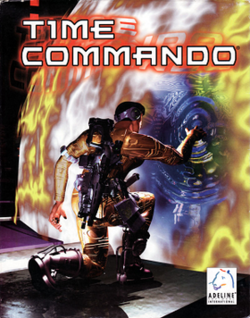 Prince of Persia: The Sands of Time Remake on PS4
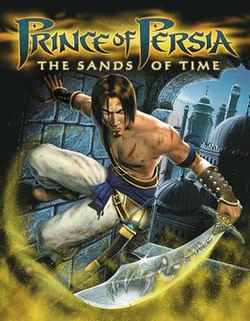 TimeShift on PS3
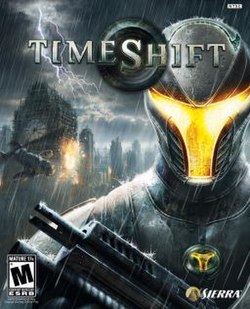 PixelJunk Shooter 2 on PS3
 Projection: First Light on PS4
 PixelJunk Shooter on PS3
 Super Smash Bros. Ultimate on Switch
 Pac-Man Championship Edition DX+ on PS3
 R4: Ridge Racer Type 4 on PlayStation
 Tales of Arise on Xbox Series X/S
 Tekken on PlayStation












 Another SquareThought Site